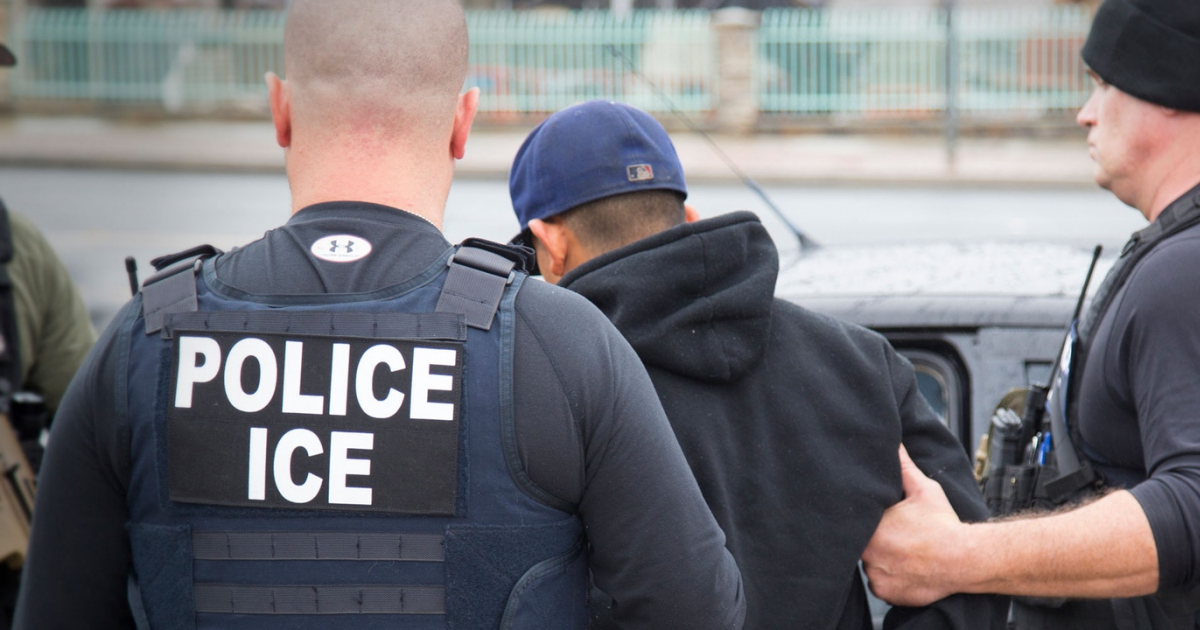
A recent report from the Deportation Data Project at the University of California, Berkeley, has unveiled striking insights into a contentious topic in U.S. immigration policy: Who is truly being targeted by Immigration and Customs Enforcement (ICE) under the guise of apprehending "dangerous criminals"?
The findings, based on collected data, starkly contradict the narrative that has been used to justify the recent crackdown on immigration enforcement operations.
ICE's Arrest Figures Reveal Discrepancies
Between January 20 and October 15 of this year, ICE has detained nearly 220,000 individuals. Significantly, over one-third of these—approximately 75,000 people—had no prior criminal record.
Both the report and experts assert that these figures do not align with the official rhetoric, which claimed that ICE's efforts would focus solely on apprehending "murderers, rapists, and gang members."
"This contradicts the administration's statements about targeting convicted criminals and going after the worst of the worst," stated Ariel Ruiz Soto, a senior policy analyst at the Migration Policy Institute, in comments shared with NBC Miami.
Data Transparency Issues and ICE's True Targets
The data, obtained through a lawsuit filed by the Deportation Data Project team against ICE, is managed by an internal office responsible for compiling arrest, detention, and deportation information. Since January, the administration has stopped regularly publishing these statistics.
The report highlights that a vast majority of those arrested by ICE up to mid-October have been men (90%), with a predominant age range of 25 to 45 years old. Most arrests have involved citizens of Mexico (85,000), Guatemala (31,000), and Honduras (24,000).
However, the report does not specify whether those with criminal records were guilty of minor offenses or severe crimes like murder or rape, making it challenging to assess the severity of prior offenses among those apprehended.
Voluntary Departure and Policy Pressures
Around 22,959 individuals fall under the "voluntary departure" category, indicating they left the country on their own without formal deportation proceedings.
The rise in arrests has coincided with intense pressure from the Trump administration. In May, then-Deputy Chief of Staff Stephen Miller threatened to fire senior ICE officials if a daily arrest quota of 3,000 was not met. Despite this, the average daily arrests from January to October were 824—far below the target, yet more than double the daily average during the Biden administration in 2024, which saw 312 arrests per day.
The Hidden Role of Border Patrol
A significant portion of current immigration control operates out of the public eye. While ICE has been spotlighted, the report did not include arrests by the Border Patrol, representing a crucial gap in information. This omission is particularly significant given the agency's aggressive operations in cities like Chicago, Los Angeles, Charlotte, and New Orleans.
"That's the black box we know nothing about," warned Ariel Ruiz Soto. "How many arrests is the Border Patrol making? How many result in deportations, and under what conditions?" questioned Ruiz Soto.
Although both ICE and the Border Patrol are under the Department of Homeland Security (DHS), they have distinct roles and areas of operation. Traditionally, border agents work along the frontiers, but many have been deployed within the country to locate undocumented immigrants.
Economic Ramifications and Workforce Concerns
The impact of these operations extends beyond legal or immigration realms. The report notes growing concerns from the business sector, where the absence of migrant labor is beginning to take a toll.
"We're really feeling that pain in the workforce now," cautioned George Carrillo, executive director of the Hispanic Construction Council. Carrillo acknowledged the government's right to control borders but pointed out that the current strategy is destabilizing industries reliant on migrant labor.
"Even the most conservative Republicans are noticing this and understand that something different needs to be done because it's affecting their businesses. They are worried about this strategy," he concluded.
In summary, the recent Deportation Data Project report highlights a significant disconnect between the official narrative and ICE's operational reality in the United States. Rather than focusing solely on dangerous criminals, the agency has detained tens of thousands of migrants without criminal backgrounds, while public information about these actions has become increasingly scarce.
Key Insights into ICE Operations
What percentage of migrants arrested by ICE had no criminal record?
Over one-third of those arrested by ICE, approximately 75,000 individuals, had no prior criminal record.
How has the Trump administration influenced ICE arrest policies?
The Trump administration exerted pressure on ICE to meet high arrest quotas, including threats of firing senior officials if quotas were not met.
What role does the Border Patrol play in immigration enforcement?
The Border Patrol operates mainly at frontiers but has increasingly been involved in domestic operations to track undocumented immigrants, though its activities are less publicly scrutinized than those of ICE.
How are ICE's operations affecting the U.S. economy?
The absence of migrant labor is impacting industries that rely heavily on such workers, causing concern among business leaders about workforce stability.