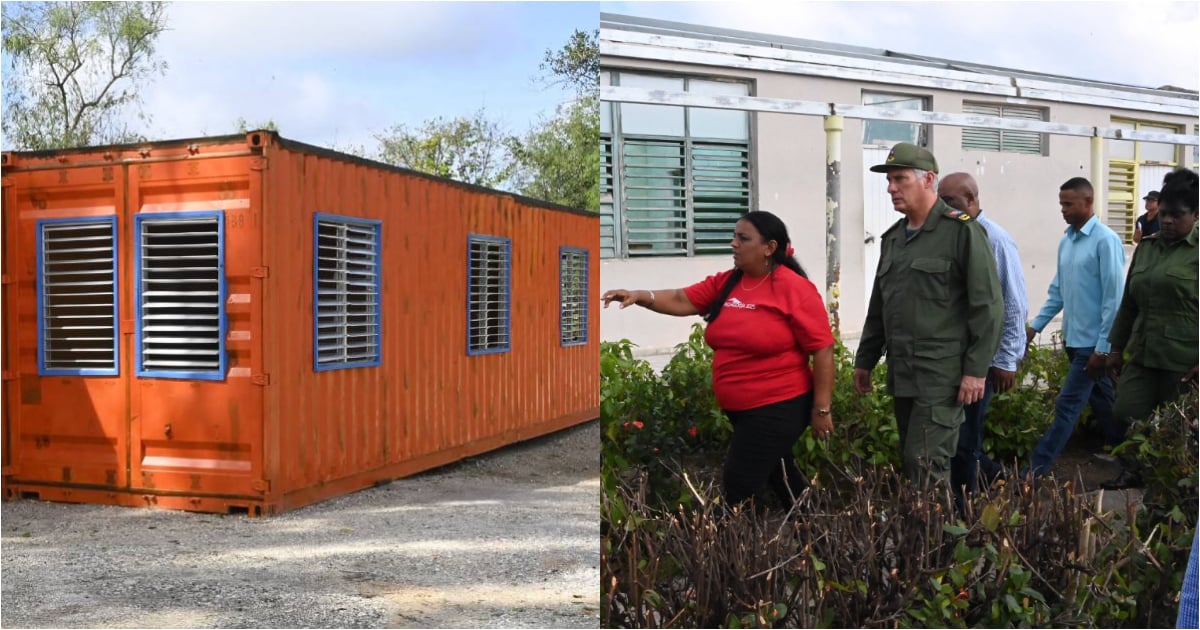
The authorities in Santiago de Cuba have announced an expedited plan to convert shipping containers into temporary housing solutions due to the worsening housing crisis that has left thousands of families vulnerable, particularly following the devastation caused by Hurricane Melissa.
This decision was highlighted during a recent governmental visit led by Miguel Díaz-Canel on December 5th. The tour underscored the severe structural decline throughout the province, leading to increased complaints about building collapses, leaks, and overcrowded living conditions.
The official newspaper, Granma, reported that with over 137,000 homes impacted, the transformation of containers into dwellings is a top priority, especially in the municipalities of Segundo Frente and Santiago de Cuba, where people are still sheltered. Local officials admitted that the demand far exceeds current capacities, with critical cases escalating, particularly in neighborhoods suffering from decades of neglect.
The provincial leadership has defended using containers as an "immediate solution," yet has not specified how many units will be available or the criteria for their allocation. Authorities claim these modules can expedite timelines, but they have avoided committing to specific goals regarding the delivery or rehabilitation of existing housing stock.
Amid calls for unity and perseverance, Díaz-Canel emphasized leveraging available resources without neglecting the environment. Provincial authorities also mentioned partial progress in electricity, telecommunications, and road access.
Water supply issues still affect around 20,000 residents, with multiple systems remaining damaged. While the official narrative emphasizes resilience and recovery, the reality paints a grimmer picture: many areas remain without stable services, and housing reconstruction relies heavily on emergency solutions like containers. This situation highlights the significant impact Melissa had on the eastern province.
On that same December 5th, Díaz-Canel marked Builder's Day in Cuba with a message on X, calling for the construction, reconstruction, and beautification of the nation, which he described as mercilessly battered for six decades.
Instead of acknowledging the government's role in the severe urban decay and rising extreme poverty across the country, the leader opted to blame external adversaries once again.
The government has maintained a triumphant narrative, promoting containers as a swift and innovative solution to the island's severe housing shortage, as well as a means to address the damage following Melissa's destruction.
However, this proposal has been met with skepticism and criticism from the public, who argue that in the Cuban climate, containers are unsuitable and uninhabitable without proper thermal insulation, turning them into solar ovens. Additionally, the lack of adequate infrastructure and security against extreme weather events further fuels criticism of these metal structures.
Weeks ago, the government acknowledged the slow progress in adapting these structures into homes, despite releasing over 1,700 containers for this purpose.
Key Questions About Container Housing in Santiago de Cuba
Why is the Cuban government using shipping containers for housing?
The Cuban government is turning to shipping containers as a quick solution to the severe housing crisis exacerbated by Hurricane Melissa, as traditional housing options are limited and demand exceeds capacity.
What are the criticisms regarding the use of containers as homes?
Critics argue that containers are unsuitable in Cuba's climate without proper insulation, turning them into excessively hot environments. Additionally, the lack of infrastructure and protection against extreme weather amplifies concerns.
How many homes have been affected in Santiago de Cuba?
Over 137,000 homes have been affected in Santiago de Cuba, creating an urgent need for alternative housing solutions like container conversions.