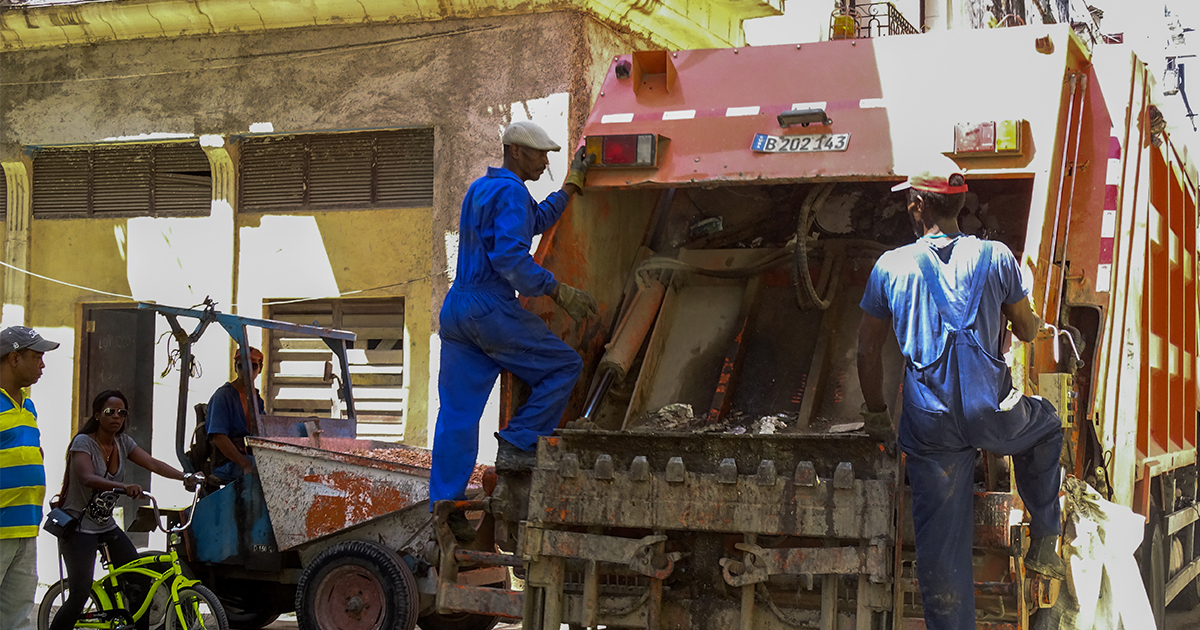
This week, the Cuban government admitted it is unable to ensure the cleanliness of Havana or provide fair wages to street sweepers amid a severe service crisis impacting the capital.
The acknowledgment came during a meeting led by Miguel Díaz-Canel and Prime Minister Manuel Marrero, where discussions focused on failures in garbage collection, water supply, and the epidemiological situation.
The state-run newspaper Granma reported that three central municipalities—Marianao, Centro Habana, and Plaza de la Revolución—do not meet the basic efficiency standards for waste collection.
Marrero noted that while some areas see garbage trucks making up to five trips to the landfill daily, others manage only two.
Excuses ranged from vehicle breakdowns and fuel shortages to a lack of personnel, all while the population is besieged by dengue and chikungunya outbreaks.
Marrero himself acknowledged that the nearly 900 street sweepers in the capital receive "low wages considering what they face," a rare admission in a context where the regime typically avoids discussing the economic collapse.
The prime minister ordered an examination of possible "exceptional" measures to improve compensation, though without pledging any specific resources.
Additionally, the government admitted to having insufficient work tools. Of the 126 planned trash bins, only 31 have been produced by the national industry, and out of 1,000 promised sweepers' carts, merely 40 have been completed.
Yanet Hernández, Havana's governor, mentioned working "with the available resources," without providing timelines or structural solutions.
Official discourse once again shifted responsibility to "work organization" and local leaders, sidestepping issues like budget shortages, corruption, or state inefficiency that have turned the capital into an open-air landfill.
Images of accumulated trash in streets and residential areas starkly contrast with the regime's rhetoric about "cleanliness as a strategic national issue."
The deterioration of sanitation services in Havana is not a new problem. Fuel shortages, the collapse of public transportation, and a massive loss of workers have made garbage collection a chronic issue.
This is compounded by the precarious condition of the workforce, lacking protective equipment, basic tools, and adequate working conditions.
While the government admits its inability to pay or organize the work of those who keep the city marginally clean, residents continue to face an unsanitary environment, plagued by mosquitoes, bad odors, and health risks.
The failure in something as basic as public cleanliness has become another reflection of the collapse of the Cuban state system, which is unable to manage even the most fundamental services.
The Cuban regime has confessed its failure to maintain urban cleanliness in Havana, a situation that not only affects the city's appearance but also heightens health risks amid an arboviral crisis.
Alongside the official admission of its inability to pay street sweepers fairly or produce basic equipment, inefficient management has turned streets into open-air dumps.
The government has also admitted it has no idea how much garbage accumulates in Havana, highlighting an institutional disconnect within a system unable to measure its own collapse.
The lack of updated statistics, planning, and resources has left many neighborhoods in a state of permanent unsanitariness, with direct consequences on residents' health.
In historic areas like Old Havana, the situation reaches absurd levels. Residents are forced to bring their trash directly to the landfill due to the complete inoperability of the collection service.
This makeshift measure endangers the elderly, children, and vulnerable individuals who must navigate debris and refuse to perform a task that should be the state's responsibility.
Understanding Havana's Waste Management Crisis
What are the main reasons for Havana's waste management failure?
The waste management failure in Havana is primarily due to vehicle breakdowns, fuel shortages, and a lack of personnel. Additionally, the government's inability to provide adequate wages and equipment for street sweepers exacerbates the issue.
How is the current situation affecting Havana's residents?
Residents face unsanitary conditions with accumulated garbage, which leads to the proliferation of mosquitoes and other health hazards. The lack of efficient waste management has made the city environment increasingly unhealthy.
What steps has the government proposed to improve the situation?
The government has suggested studying "exceptional" measures to improve compensation for street sweepers. However, no specific resources or timelines have been committed to address the issue effectively.