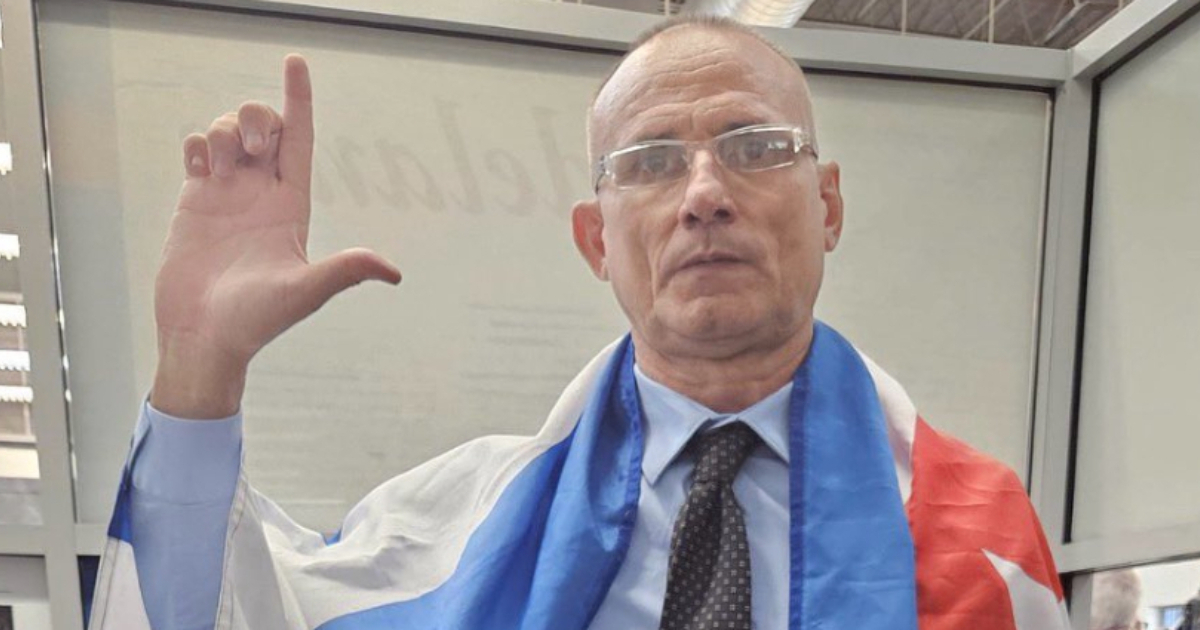
In a shift from his usual focus on prisons and torture, José Daniel Ferrer has turned his attention to the internal struggles within the Cuban exile opposition, which he sees as a pressing issue comparable to the repression in Cuba itself.
"Many are doing the same thing while neglecting other fronts," Ferrer stated in an interview with the Spanish newspaper El Debate. He openly criticized the ego conflicts and redundant efforts that, according to him, hinder any real possibility of democratic progress.
Having spent months closely monitoring Cuban exile groups in the United States, Ferrer identifies the primary obstacle not as a lack of will, but as an inability to coordinate effectively.
"No matter how well we act individually, it won't lead us far," he emphasized, pointing out that the Cuban cause requires strategy, humility, and discipline, not self-promotion.
Ferrer has previously warned about these issues. Upon arriving in Miami in October, he summarized the state of the opposition with a phrase that resonated throughout many sectors: "There is no cohesion, coordination, discipline. We have many star players but no team." Three months later, he maintains this assessment, asserting that fragmentation remains a significant challenge for activism outside the island.
Ferrer’s warnings do not come from the comfort of an outsider analyst but from someone who endured severe punishment during his last stint in prison. He described being restrained by guards and fellow inmates, having his nose covered, being force-fed rotting food, and being beaten until he was exhausted. "It was a daily routine of beatings and suffocation," he recalls. This history, according to many of his followers, gives him the legitimacy to call for less ego and more coordinated action.
Currently, Ferrer is focused on establishing resistance cells within Cuba, which are supervised from the exile to minimize risks and sustain internal pressure. He claims these clandestine networks are already operational and have even initiated visible campaigns within the island, such as graffiti featuring the initials "DD.HH." for human rights ahead of December 10.
Simultaneously, Ferrer is working to build bridges among various opposition organizations outside Cuba, a task he acknowledges as complex. "There's a bit of ego wars," he admitted, although he insists that he is in talks with several groups to form more stable alliances. As part of this effort, he collaborates with members of the Council for Democratic Transition in Cuba and former members of the Patriotic Union of Cuba (UNPACU).
Ferrer has also sought international political support. Recently, he held meetings in Washington with the State Department and Secretary Marco Rubio, whom he described as "well-informed" and committed to improving living conditions on the island. Later, Ferrer was awarded the Truman-Reagan Medal of Freedom, recognizing his resistance against the dictatorship.
Amidst these activities, Ferrer also participated in a recent debate within the exile community by defending Alexander Otaola following the controversy over donations to the victims of Hurricane Melissa. "I am more interested in actions than words," Ferrer stated, highlighting the support Otaola allegedly provided to political prisoners.
For some, this statement was another indication of his efforts to curb divisions; for others, it served as a reminder that the struggle for Cuba requires, above all else, coherence and solidarity.
Ferrer insists that the exile community can become a decisive force, but only if it overcomes the internal divisions he describes. His message is clear: unity is not just symbolic but a political necessity. "If we continue duplicating efforts while abandoning essential fronts, the cause will not progress," he reiterates.
Ferrer vows to keep pushing from afar, with his eyes set on the island and a conviction that freedom is not achieved through noise and rivalries, but through genuine organization. For him, this remains the weakest point of the Cuban exile community.
Understanding José Daniel Ferrer's Critique of Cuban Exile Politics
What is the primary issue José Daniel Ferrer highlights in the Cuban exile opposition?
Ferrer highlights the internal ego conflicts and duplication of efforts as the primary issues hindering progress in the Cuban exile opposition.
How does Ferrer propose to overcome these challenges?
Ferrer suggests that the Cuban cause requires strategy, humility, and discipline, emphasizing the need for coordinated action and unity rather than individual self-promotion.
What actions is Ferrer taking to support the Cuban cause?
Ferrer is organizing resistance cells within Cuba, fostering international political support, and seeking to build stable alliances among various opposition groups outside Cuba.