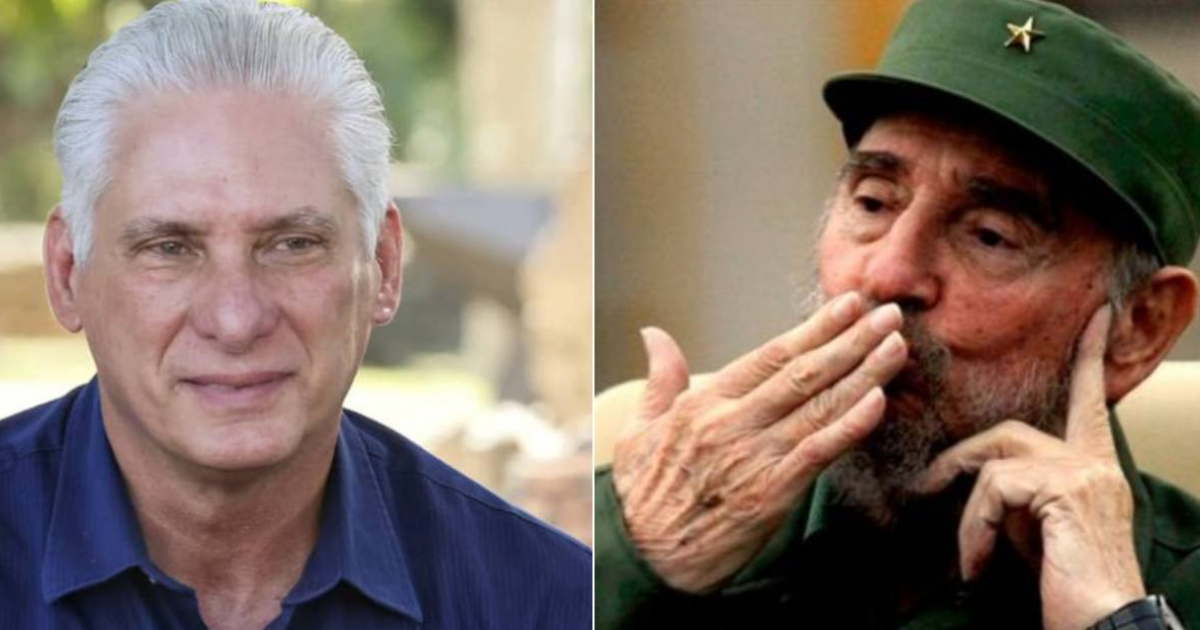
Miguel Díaz-Canel has once again brought Fidel Castro's legacy to the forefront, emphasizing it as a cornerstone for the political education of young Cubans.
During a meeting with student leaders, the Cuban leader declared that "now is the time to study Fidel" and encouraged the younger generations to "act as he instructed."
This message, widely shared through the official Cuban Presidency's channels, is part of a renewed propaganda push aimed at reviving the cult of the late dictator amid growing social discontent.
Díaz-Canel stressed the need to "interpret Fidel and bring him into today's context," revealing an agenda to indoctrinate the youth rather than encouraging critical engagement.
The regime is determined to transform classrooms and student organizations into spaces of indoctrination, where the historical leader is studied not through critique, but as an unquestionable model of moral and political conduct.
The speech also highlighted the importance of achieving a "comprehensive general culture," which Díaz-Canel proposed as a means of national salvation. However, in practice, this notion serves to culturally justify political doctrine, conflating genuine academic education with loyalty to the Communist Party.
During the event, Díaz-Canel awarded the "Panchito" distinction to three standout student leaders, employing symbolic recognitions and rituals to reward political obedience over personal merit.
These gestures, repeated over the decades, aim to sustain the heroic narrative of the revolutionary process in the face of a youth increasingly disconnected from the official discourse.
Constant references to the historical leader also attempt to position Díaz-Canel as Fidel Castro's successor, in a context where his leadership is significantly weakened. Lacking charisma and visible results, the leader leans on the myth of the commander to legitimize his authority.
The insistence that young people should "act like Fidel" fits into a narrative of symbolic resistance, used by the government to frame ideological loyalty as a form of patriotism. This serves to justify the current crisis as part of a supposed heroic struggle against external adversaries.
Meanwhile, the regime continues to divert attention from the real crisis, avoiding discussions about power outages, hunger, or the mass exodus affecting millions of Cubans. Instead of offering solutions, Díaz-Canel suggests revisiting Fidel's teachings, as if the past could remedy the present.
The Impact of Díaz-Canel's Call to Study Fidel Castro
Why is Díaz-Canel emphasizing Fidel Castro's ideology now?
Díaz-Canel is emphasizing Fidel Castro's ideology to revive the cult of the late dictator as a response to growing social discontent in Cuba. By doing so, he aims to strengthen political indoctrination among the youth and legitimize his leadership.
How does the regime plan to implement this ideological indoctrination?
The regime plans to implement this ideological indoctrination by transforming classrooms and student organizations into spaces where Fidel Castro's legacy is studied as an unquestionable model of political conduct, rather than encouraging critical analysis.
What are the criticisms of Díaz-Canel's approach?
Critics argue that Díaz-Canel's approach conflates true academic education with political loyalty to the Communist Party. It is seen as a way to distract from the real issues facing Cuba, such as power outages, hunger, and mass migration.