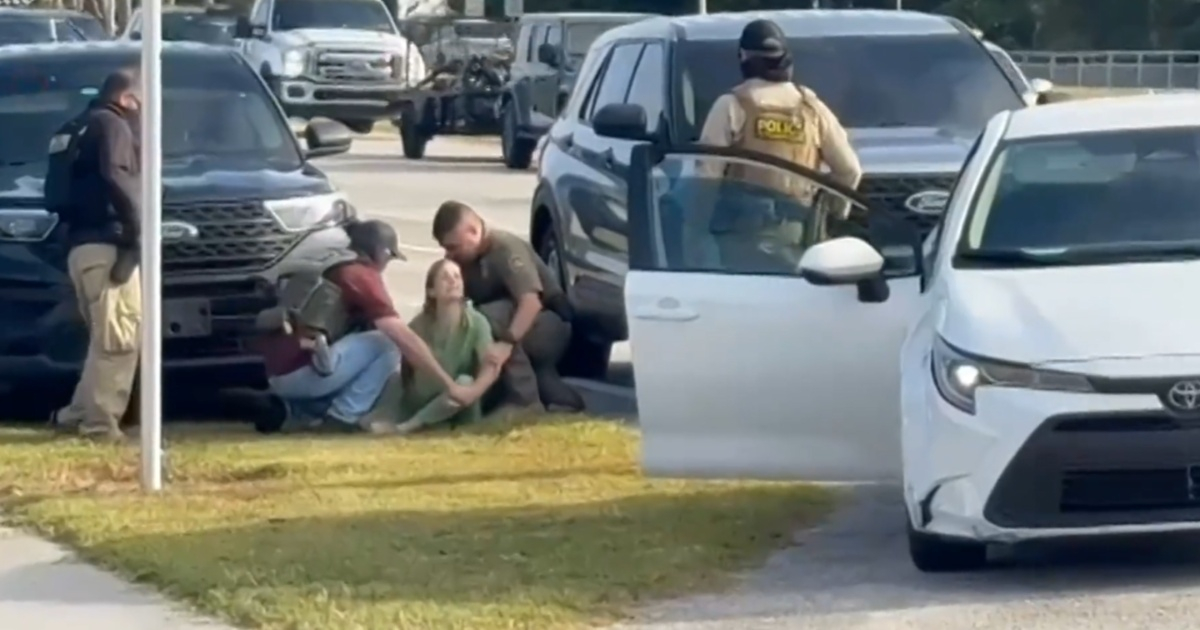
A medical professional was forcibly detained by federal agents in Key Largo during an immigration checkpoint in the Florida Keys. She maintains that she fully complied with the officers' instructions and refutes the initial federal reports that claimed she refused to lower her window and hand over her license, stating these allegations are "completely false."
In a statement to the Miami Herald, the woman, who is a United States citizen, asserted that she lowered her window "as soon as" she was stopped, and the video of the incident corroborates her account of compliance from the start.
The incident took place at approximately 9:15 a.m. on Wednesday, December 3, in the southbound lanes of US-1, near the Pink Plaza shopping center (mile marker 103.4) in Key Largo.
A Miami Herald journalist captured the moment when an agent forcibly removed the woman from her white Toyota Corolla, amidst the presence of agents from ICE, CBP, and Border Patrol.
Identified as a behavioral therapist of short stature, the woman recounted heading to work when masked individuals surrounded her car, threatened to break her window, and then opened her door "without her consent," before dragging her out of the vehicle.
According to her testimony, the situation escalated quickly: she claimed her phone was snatched from her hand, she was pulled towards a grassy area, and thrown to the ground before being handcuffed, all while she screamed for help and repeatedly stated that she was an American citizen.
The woman emphasized that the agents never identified themselves, which heightened her fear and confusion. She described panicking when faced with masked men, especially given the context of incidents involving individuals impersonating law enforcement.
While the Miami Herald respects her privacy by not disclosing her name, it confirmed her identity independently, verifying her as the individual in the video detained by Customs and Border Protection (CBP) agents and the CBP air and marine operations in Key Largo.
In her account, the woman revealed that this was the third time she had been stopped in the same area for an "immigration inspection," but highlighted that the use of force on Wednesday marked a significant and unwarranted escalation.
The initial official version, provided the same Wednesday by a CBP spokesperson, claimed that the woman initially refused to lower the window and then refused to hand over her driver's license.
When asked on Friday about the woman's version, a CBP spokesperson declined to comment.
The woman stated that while she was retrieving her identification, she was threatened and removed from her car before she could present it. She was then placed in an unmarked Ford van while agents searched her belongings —including her purse— without her consent, until they found her license; after verifying her citizenship, she was released.
This case has reignited the legal debate over the limits of immigration checkpoints in areas near the border.
Immigration attorney Magdalena Cuprys told the Miami Herald that although agents have the authority to request citizenship or legal status documents within 100 miles of the border, this does not grant them the right to search a vehicle or purse without a warrant or probable cause, describing the incident as a potential "unreasonable search and seizure" under the Fourth Amendment of the Constitution.
In a further statement, the woman's sister described the incident as "kidnapping" and a "complete violation of human rights and dignity," noting that her sister has suffered panic attacks, persistent fear, and physical repercussions following the detention.
The woman agreed with this sentiment, stating she has been unable to sleep, suffers from arm and body pain due to the treatment she received, and continues to relive the episode. She insisted that she refuses to let her rights be violated or her dignity taken away.
CBP reported in a statement that their agents arrested 14 undocumented immigrants during the operation on Wednesday in the Keys, reminding that an earlier operation at the beginning of the month resulted in 12 arrests.
Meanwhile, the woman's testimony —and the widely circulated video— has sparked public outrage and raised questions about identification protocols, the use of force, and the treatment of individuals claiming U.S. citizenship during these stops.
Legal and Human Rights Concerns in Immigration Checkpoints
What are the legal rights of individuals during immigration checkpoints?
Individuals have the right to refuse searches of their vehicle or personal belongings unless there is a warrant or probable cause. Within 100 miles of the border, agents can request proof of citizenship or legal status, but this does not extend to unwarranted searches.
How does the Fourth Amendment protect against unreasonable searches?
The Fourth Amendment of the U.S. Constitution safeguards citizens from unreasonable searches and seizures. It requires law enforcement to have a warrant or probable cause to conduct a search, protecting individuals' privacy and property rights.