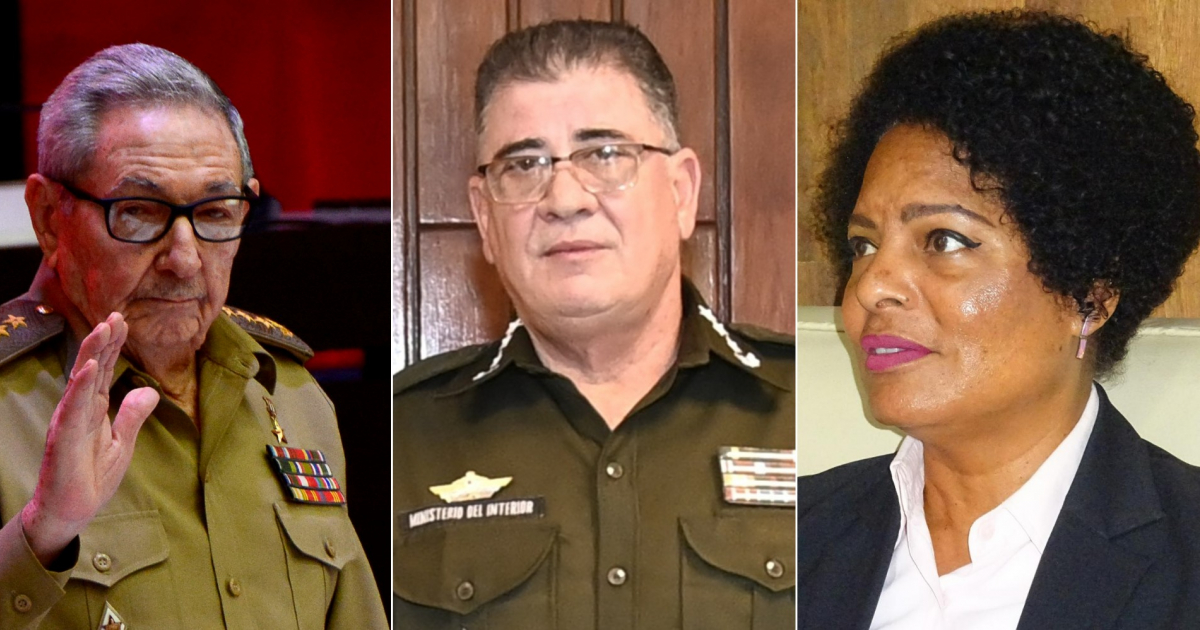
In today's Cuba, governance is not executed by a unified and coherent entity, but rather by a triangular power structure that monitors, competes, and hinders one another, all while sharing a common obsession: maintaining control over the state, currency, and society. Their primary goal is to preserve the dominance of the socialist state enterprise and the monopoly over incoming dollars at any cost.
Efforts to open up the private sector, along with promises to "regulate" the exchange market or "modernize" the economy, serve more as tactical maneuvers than a shift in paradigm. These are merely illusions meant to buy time amidst collapse, while clinging to the dream of reverting to a system where foreign currency stores and remittances are exclusively managed by state and military conglomerates.
A Complex Power Structure
The first vertex of this power triangle is the political-military elite organized around the GAESA business complex, which oversees the FAR, tourism, foreign trade, foreign currency banking, and a significant portion of official remittances. This faction does not govern with economic efficiency or citizen welfare in mind, but rather ensures that no dollar circulates without passing through their channels. This explains their aggressive stance against "financier" networks in exile and parallel remittance schemes, which, according to official data, now account for the majority of money not entering through FINCIMEX or other state entities. Consequently, the leadership has lost much of its effective control over remittances, yet instead of adapting, they seek to reclaim it through decrees, media campaigns, and police operations.
The Technocratic-Economic Apparatus
The second component is the technocratic-economic apparatus: the Central Bank, ministries, and pro-government economists who acknowledge the calamity, discuss a currency market that "doesn't function," and promise to "regain control of the dollar" with new "flexible" or "more realistic" exchange mechanisms. They explain in official programs why inflation spirals, why the peso plummets, and why the economy is effectively dollarized, yet they never challenge the dogma that the state enterprise must remain central or GAESA's dominance over the foreign currency economy. Their room for maneuver is minimal: they propose engaging with the informal currency market to attract remittances and provide oxygen to micro, small, and medium enterprises (MSMEs), while another power vertex criminalizes many of the actors sustaining that real market.
The Repressive Machinery
The third vertex is the repressive apparatus: the Ministry of the Interior, State Security, prosecution, and courts, which have become the economic arm of repression through investigations into "illegal currency trafficking," overseas "financiers," and alternative remittance networks operating between Miami and various Cuban provinces. Files clearly show how those capturing dollars outside the island and converting them to pesos within Cuba—supplying MSMEs with goods imported through non-state channels or paying suppliers using parallel payment and import channels—are criminalized, precisely because the official banking system is incapable of doing so effectively and with liquidity. This apparatus is not designed to resolve the crisis but to punish any economic circuit escaping direct State-GAESA control, even though the survival of millions of Cubans depends on that circuit.
The three poles converge on two key points: all desire to retain political power without oversight, and all regard private enterprise as a "necessary evil" that, at best, should remain subordinate to the state, and at worst, could become an enemy if it gains too much autonomy.
Hence the dual narrative: while conveniences for MSMEs, investments, and wholesale markets are announced, the informal currency market is fiercely pursued, judicial proceedings are initiated against entrepreneurs working with financiers, and foreign currency stores under GAESA's control are reinforced, aiming to recentralize remittances and consumption as in previous "top-down dollarization" phases. Private enterprise is tolerated because there is no other source of domestic supply, but it is constantly reminded that it operates on borrowed, revocable ground.
Unresolved Chaos
The lack of a unified policy among the three blocs exacerbates the disaster. The political-military elite requires foreign currency and some private activity but blocks any mechanism reducing their intermediation; technocrats speak of "more realistic" exchange markets while the repressive apparatus dismantles those enabling them; and the population finds itself trapped between devalued pesos, unattainable dollars, and increasingly aggressive financial repression.
The repercussions of this new witch hunt will not explode in December: December is already "secured" as MSMEs stocked up for the year-end campaign. The real damage will come later. The Ministry of the Interior's crackdown on the informal exchange market has forced many MSMEs to reduce or be compelled to reduce food imports for the coming year. This will become noticeable in early 2026, when the small markets and bodegas that currently sustain the vast majority of supply begin to run dry.
That's when the blow will strike: less food, less variety, higher prices, and more desperation. As long as those in power in Cuba continue fighting for control and dollars, acting without a common direction and without genuine economic and political openness, the country will remain stuck in a permanent, ever-deepening crisis.
Understanding Cuba's Power Struggle
What are the three main power groups governing Cuba today?
The three main power groups in Cuba today are the political-military elite around GAESA, the technocratic-economic apparatus, and the repressive machinery involving the Interior Ministry and State Security.
How does the GAESA complex influence Cuba's economy?
GAESA controls significant sectors such as the FAR, tourism, foreign trade, and remittances, ensuring no dollar circulates without passing through its channels, thus maintaining a tight grip on the economy.
Why does the technocratic apparatus struggle to reform the economy?
The technocratic apparatus struggles due to minimal maneuverability and the adherence to the dogma of state enterprise centrality, despite recognizing the economy's issues and proposing market adaptations.
What role does the repressive apparatus play in Cuba's economic situation?
The repressive apparatus enforces the economic control by criminalizing alternative financial activities, ensuring any economic circuit outside the State-GAESA control is punished, affecting millions of Cubans' livelihoods.