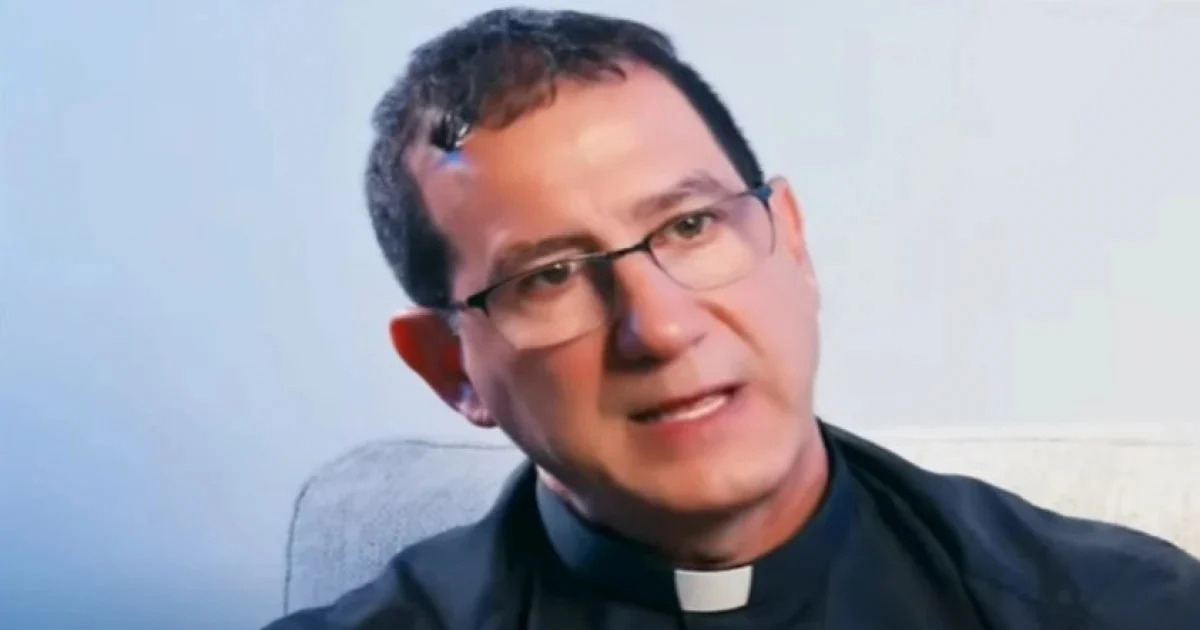
Cuban priest Alberto Reyes Pías has once again issued a scathing critique of the island's political system, this time contemplating the relentless passage of time and its devastating impact on entire generations due to the so-called "Revolution."
In a piece shared on Facebook, Reyes candidly addresses the nation's prolonged crisis, the moral and material decay, and the historical evidence that, in his opinion, thoroughly dismantles the myth at the heart of Castro's ideology.
Reyes paints life in Cuba as an "endless cycle of darkness, misery, absent freedom, and shattered dreams," where decades of suffering lead everyone to the inevitable question: "How much longer?"
The Camagüeyan priest acknowledges the accumulated exhaustion but suggests that the length of this ordeal might leave behind a lasting lesson: the conviction that "never again on this earth" will an ideology like Marxism be allowed to dominate the country.
The Role of Time as a Historical Judge
One of the focal points of Reyes' reflection is how time serves as a historical judge. He argues that if Fidel Castro had died young, before seizing power, many Cubans might have canonized him, attributing all potential solutions to the country's woes to a hypothetical Revolution.
However, that scenario did not unfold. Castro had "all the time in the world" to reveal his true intentions and the actual impact of his project, which Reyes summarizes as the complete destruction of the nation "from its economy to its soul."
In contrast, he discusses Che Guevara, whom he describes as a "textbook psychopath," noting that Guevara's myth persisted because he died young, preventing reality from contradicting his heroic image in the world.
The Illusion of the 1980s
Reyes also recalls the Cuba of the 1980s, a time when fear of dissent was greater than it is now, but there was food, electricity, and economic stability. This mirage led thousands to fervently defend the system.
Yet, he knows that "time is the best filter," and it has already shown that the Revolution "was a great lie." The priest condemns the leaders for never caring about the people's lives, being unhesitant to repress and imprison, while Cubans "die of hunger and disease before their indifferent eyes."
A Moral and Political Warning for the Future
In his conclusion, Father Reyes suggests that the prolonged disaster could have historical significance: ensuring that when Cuba finally becomes free, no oppressive ideology—especially Marxism—will ever take root on the island again.
He goes further, expressing a hope that Cuba, once an exporter of Marxism, will transform into a beacon that helps other nations achieve their freedom.
Reyes, a steadfast and courageous voice within the Cuban Church, insists that time, which the regime has used to perpetuate its control, has become its greatest accuser.
Key Insights into Cuba's Political Struggles
What is Alberto Reyes' main criticism of the Cuban Revolution?
Reyes criticizes the Cuban Revolution for being a facade that led to the moral and material decay of the nation, ultimately revealing itself as a grand deception over time.
How does Alberto Reyes view the role of time in evaluating the Cuban Revolution?
Reyes sees time as a historical judge that has exposed the true nature of the Revolution and those who led it, highlighting the reality behind the myths surrounding figures like Fidel Castro and Che Guevara.
What is the significance of the 1980s in Reyes' argument?
The 1980s are significant in Reyes' argument as they represent a period where the illusion of stability masked the underlying issues of the Revolution, which time has since unveiled as false.