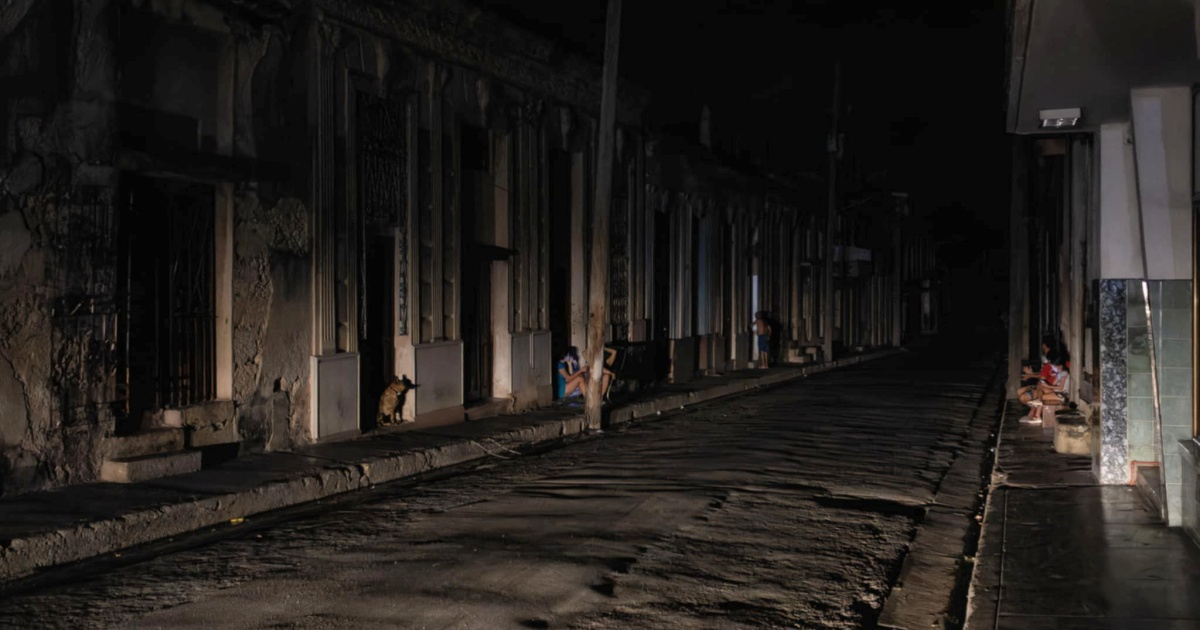
This Friday, Cuba will experience one of its darkest days—both literally and metaphorically—of the year.
The Cuban Electric Union (UNE) has forecast widespread blackouts that will impact up to 61% of the national territory simultaneously during peak demand hours. This unprecedented figure sets a new record in the ongoing energy crisis plaguing the island.
Attached to the Ministry of Energy and Mines (MINEM), the UNE predicts a peak demand of 3,400 megawatts (MW), while the available generation capacity will barely reach 1,392 MW. This represents a shortfall of 2,008 MW, with an estimated impact of 2,078 MW, meaning more than half the country will be without electricity at the same time.
Based on these figures, the agency Efe has calculated that the energy disruption will affect 61% of the Cuban population, marking the highest rate recorded to date.
On December 1st, a previous record of 59% impact was already reached. Just two days later, a partial blackout plunged nearly the entire western part of the country into darkness, with a real deficit of 67% during the night.
Struggling Infrastructure: Power Plants, Engines, and Fuel in Crisis
The collapse of the National Electrical System (SEN) is due to multiple factors, all converging in a landscape of outdated infrastructure, lack of maintenance, and fuel shortages.
According to the UNE, seven out of the 16 operational thermal power units are currently out of service due to breakdowns or maintenance, including key plants like CTE Diez de Octubre, Felton, Renté, and Santa Cruz, which contribute nearly 40% to the Cuban energy mix.
Adding to this, Friday's report reveals the paralysis of 97 distributed generation plants that should run on diesel and fuel oil but are halted due to fuel shortages. Another ten are inactive due to the absence of lubricants. In total, over 1,000 MW are unavailable for this reason.
In Moa, for instance, five engines of the Fuel system are not operational, resulting in an additional loss of 68 MW, while another 72 MW are unavailable due to lack of lubricants, according to the official report.
An Ongoing Energy Crisis
The situation is not new. Since mid-2024, Cuba has been spiraling into an increasingly critical energy crisis. Daily information notes from the UNE confirm that the country has faced complete days of electrical disruption.
This past Thursday, the disruption was constant throughout the 24 hours, peaking at 1,982 MW at 7:00 PM.
The Havana Electricity Company also acknowledged that it "could not fulfill the scheduled" cuts due to low availability. The capital's electric service was interrupted from 2:10 PM, with a 271 MW impact at 7:10 PM, and was not restored until the early hours of Friday.
Beyond the Darkness: A Structural Crisis
The Cuban regime has repeatedly justified the crisis due to a "lack of foreign currency and an aging system," pointing to U.S. economic sanctions as the main obstacle to renewing the energy sector. On various occasions, it has accused Washington of carrying out a policy of "energy suffocation."
However, independent experts offer a different perspective. They point to decades of underfunding, corruption, and centralized management as the root causes of the problem. The Cuban electrical system, entirely state-controlled since 1959, has deteriorated without significant investments. According to several studies, between $8 billion and $10 billion are necessary to minimally revitalize the national electrical system, an unthinkable amount under the current economic conditions of the country.
Solar Parks: Insufficient Relief
Amid the overall collapse, the 33 new photovoltaic solar parks in the country offer minimal relief. According to the official report, they produced 2,722 MWh on Thursday, with a maximum power output of 516 MW at midday. However, this energy source, while necessary, is far from sufficient to remotely cover the country's demand during critical hours.
While technical reports list numbers and percentages, the reality in Cuban homes translates into endless nights without ventilation or refrigeration, the inability to cook or preserve food, and insomnia due to heat and mosquitoes. Each new blackout adds to the collective exhaustion, while the government continues to promise "medium-term" solutions.
The population, however, is living a present marked by uncertainty and hopelessness, with the feeling that the energy crisis—like so many others on the island—has come to stay.
Understanding Cuba's Energy Crisis
What is causing the widespread blackouts in Cuba?
The blackouts are caused by a combination of outdated infrastructure, insufficient maintenance, and a critical shortage of fuel, which have led to a significant deficit in electricity generation capacity.
How much of Cuba is affected by the current energy crisis?
The current energy crisis has affected up to 61% of the Cuban population, marking a record in the ongoing challenges faced by the nation's electrical system.
What steps are needed to improve Cuba's electrical system?
Experts suggest that revitalizing Cuba's electrical system would require investments between $8 billion and $10 billion, addressing decades of underfunding and systemic inefficiencies.