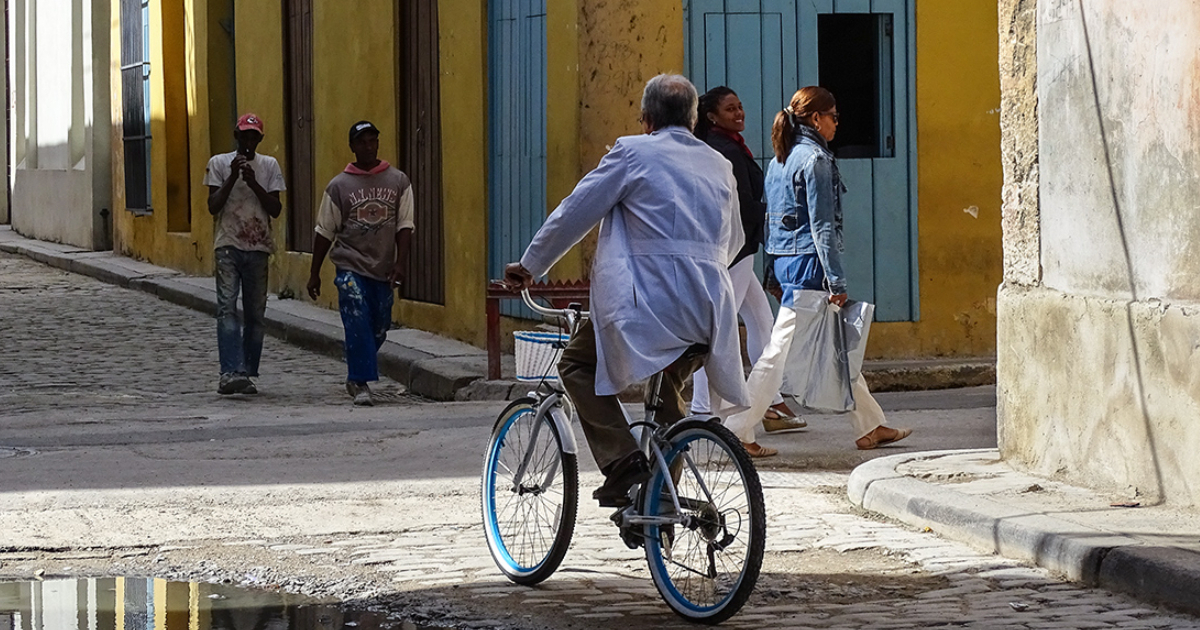
Dr. Reynaldo Verona Bonce, a Cuban physician, has painted a stark picture of what it truly means to be a healthcare professional on the island, where the healthcare system is plagued by severe decline.
In an emotional and lengthy message posted on Facebook to mark Latin American Medicine Day, Verona took the opportunity to highlight the precarious conditions under which healthcare specialists work.
He reminisced about a time when Cuban society revered doctors as respected figures and symbols of family pride.
Today, however, that respect has diminished in a setting where hospitals are dominated by shortages, a chronic lack of supplies, and economic hardships that affect every aspect of professional and family life.
Despite the challenging work environment, "many remain there." In the streets, others question whether those who still cling to their white coats are in their right mind.
"Reality bites today," he wrote, highlighting a climate where citizens demand results even though healthcare centers have been languishing in shortages and decay for years.
The doctor points out that many have forgotten the sacrifices made by medical staff during the COVID-19 pandemic, when they were exposed and infected, yet they continue to face extreme conditions.
"They are undoubtedly the most sacrificed, those who have studied the longest, and the worst paid," he emphasized.
According to Verona, the lack of resources, insufficient salaries, and overwhelming workloads have led some in the profession to question whether it is worth continuing their roles despite their dedication.
The System's Scapegoats
Verona Bonce's text criticizes a pattern: when a treatment fails, a surgery is postponed, or a procedure is delayed due to inadequate conditions, the blame is automatically placed on the doctor.
In his view, society overlooks the systemic deficiencies and prefers to hold the professional accountable.
"Even if there are no resources in hospitals, procedures are delayed, standards aren't met, or surgical schedules are not adhered to, it will always be the doctor's fault," he questioned.
"They are invariably accused of diagnostic errors, inept treatments, laziness in decision-making, negligence, or protocol violations," he detailed.
Verona asserted that doctors become targets of attacks, distortions, and criticisms, even facing job sanctions or legal proceedings when tragic events occur that are often beyond their control.
In his reflection, he laments that in Cuba, few people share the real experiences of "white coats" or acknowledge the harshness of a job that involves endless hours, sleepless nights, family sacrifices, and deep physical and mental exhaustion.
"No one wants to be in their shoes," he states.
Dedication Amidst Neglect
Despite his harsh words, Verona Bonce admires the resilience of his peers.
He describes doctors as "unquenchable," who, even in adverse conditions, continue to care for patients, driven by the satisfaction of saving lives.
For him, this dedication is so strong it borders on "masochism," as professionals persist even when their work and social environment seem to turn against them.
He also notes that after years of study and personal sacrifices, a doctor never returns to a normal life: they carry the burden of others' pain, give up family life, and accept that the hospital becomes their home, with their schedules dictated by urgency.
In a critical tone, he asserts that this endless dedication becomes a kind of "curse," because even off-duty, they cannot escape their role: neighbors, friends, and acquaintances constantly seek them out for any health issue.
An Unrecognized Profession in a Country in Crisis
The doctor questions why, despite the historical sacrifices of the profession, in Cuba, no monuments are built nor is there public recognition for brilliant professionals.
Their contributions are forgotten, as if medical work were just another silent obligation rather than a fundamental service to society.
His message, symbolically titled "The Curse," concludes with a thought that summarizes his stance: despite the neglect, scarcity, and exhaustion, if he had the chance to be born again, he would choose medicine once more.
This declaration contrasts with the reality of a devastated healthcare system, where the state demands sacrifice without offering the minimum conditions necessary to practice the profession.
With his post, Verona Bonce not only congratulated his colleagues on their day but also exposed a deep-seated complaint: in Cuba, doctors—trained for years and responsible for holding up a system in crisis—continue to be heroes, although the country they should serve ignores, exhausts, and blames them for failures the government refuses to acknowledge.
Thousands of Doctors Lost
Cuba has lost 30,767 doctors in just three years, dropping from 106,131 registered physicians in 2021 to 75,364 in 2024, according to figures released by the National Office of Statistics and Information (ONEI) this week.
This decline, acknowledged by the state institution in its statistical reports, confirms a rapid contraction of medical personnel amid a deteriorating healthcare system, marked by resource shortages, lack of medication, and the exodus of professionals.
The figure appears in the section released by ONEI in honor of Latin American Medicine Day, which also notes that in 2024, the island had 5,399 fewer doctors than in 2023 (when 80,763 were reported) and 10,199 fewer than in 2014 (with 85,563).
This reflects a sustained downward trend following the peak of 2021, identified by ONEI as the year with the highest number of doctors in the country.
The decline is not limited to doctors. Official statistics indicate that total health sector personnel—including dentists, nurses, technicians, and other licensed professionals—also experienced a significant decrease in 2023, with 248,512 workers, 32,586 fewer than in 2022.
This deterioration of the healthcare workforce coincides with the post-pandemic hospital crisis and the departure of professionals from the sector, whether through emigration or leaving medicine for other jobs as a means of survival, in a context where, according to the report, many workers are "exhausted, underpaid, and hopeless."
The reduction in personnel is compounded by a decrease in material capacities.
Challenges Faced by Cuban Doctors
Why are Cuban doctors facing difficult working conditions?
Cuban doctors are facing tough conditions due to a deteriorating healthcare system marked by resource shortages, insufficient salaries, and overwhelming workloads.
What is causing the decline in the number of doctors in Cuba?
The decline in the number of doctors in Cuba is primarily due to the exodus of professionals, lack of resources, and poor working conditions, leading many to leave the profession or emigrate.
How has the public perception of doctors changed in Cuba?
Public perception of doctors in Cuba has shifted from reverence and respect to skepticism and blame, as societal expectations clash with the realities of a failing healthcare system.