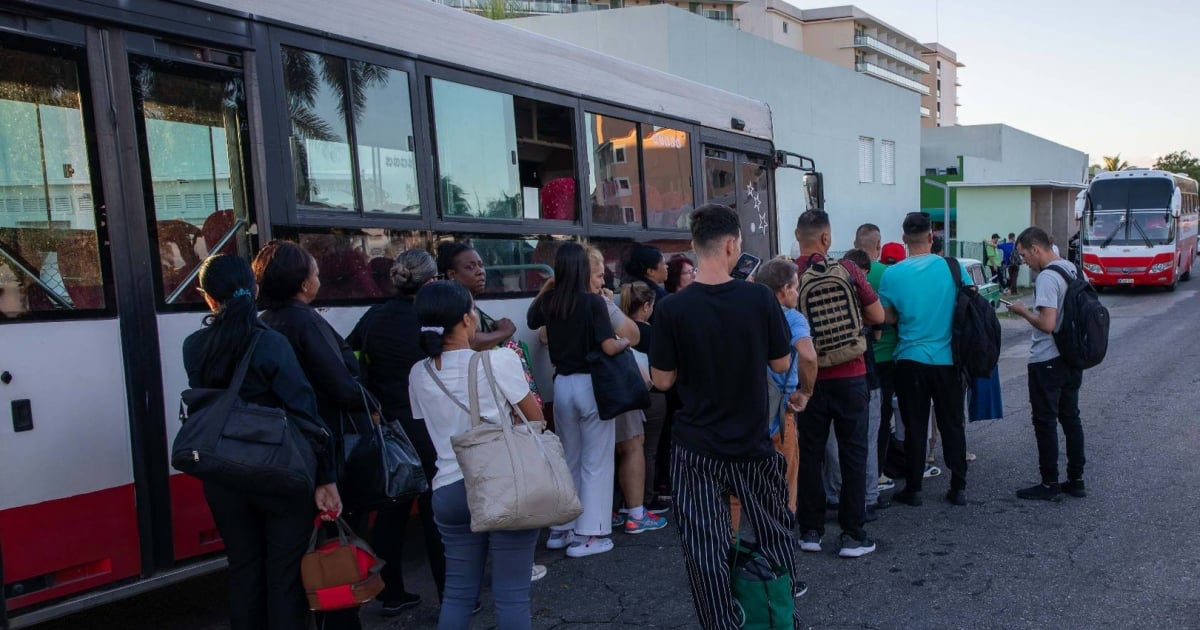
The transportation crisis in Matanzas has reached a critical point, severely affecting those who support one of Cuba's most crucial sectors: tourism workers.
Thousands of hotel and service employees, essential to the national economy, face a daily ordeal to commute to work and return home. The failures of the system are no longer isolated incidents but part of the everyday routine.
A report by the Girón newspaper highlights a worsening situation that leaves no room for nuance.
Transmetro, the company responsible for transporting tourism personnel, has ceased to provide the service levels that once ensured mobility in Varadero, Matanzas, and Cárdenas.
The Daily Struggle: A Commuter's Nightmare
Buses, which previously operated with relative stability, now frequently fail and entire shifts have vanished, leading to endless waits, extended workdays, and a weariness felt throughout the workforce.
The story of Wicho, a veteran with 36 years in the industry, illustrates the scale of the problem. Living 50 kilometers away from his hotel, his once-tiring routine has become unpredictable.
He used to rely on the bus from Cárdenas to Varadero. Now, he is unsure if the bus will arrive in the morning or if he can return by 3:30 p.m. as he used to, since that schedule has been canceled. He must wait until 5:30 p.m., with uncertainty about whether the journey will even occur.
Meanwhile, a crowd of desperate workers attempts to get to work by any means: makeshift motorcycles, private cars, hitchhiking, anything to avoid losing part of their wages for being late.
A System on the Brink of Collapse
Behind this chaos lies a structural issue: Matanzas' public transport operates with only 32% of an already insufficient fuel plan. This reduction means that sometimes passenger transport availability is "zero," as admitted by the Provincial Transport Company director.
Transmetro, which used to receive guaranteed fuel for tourism workers—8,500 liters daily for Matanzas and 6,500 for Cárdenas—now contends with significantly lower deliveries.
At times, the Matanzas–Varadero route has had only 3,000 liters, a drastic drop for a circuit reliant on numerous buses operating simultaneously.
Adding to the woes is a fleet in disrepair: out of 145 ideal buses, only 66 are operational in Matanzas. The rest are grounded due to a lack of tires, batteries, spare parts, and lubricants.
Stopgap Measures and Unresolved Issues
As a temporary fix, Transmetro introduced the "second position" system. When a bus completes its route, it returns to pick up stranded workers. However, this measure negatively impacts workers: late arrivals mean losing two or three hours of pay; waiting for a replacement incurs unpaid overtime.
The general secretary of the Provincial Hotel and Tourism Union bluntly described it: after a 24-hour shift, if a replacement doesn't arrive, they must stay five extra hours, becoming exhausted and providing a diminished service that customers notice.
Despite this, some officials downplay the crisis.
Transmetro representatives claim there's "no instability," only "some delays," and assert that no one is left without transport because the second position always appears. However, workers avoid this system due to its economic and physical toll.
Poor communication compounds the issue: although tourism directors are informed of affected routes the night before, this information doesn't always reach the employees who depend on it to plan their day.
Rejected Solutions and Persistent Challenges
Instead of resolving, the crisis deepens.
To cope with the lack of fuel and buses, Transmetro has consolidated shifts, resulting in more crowded buses and forcing many workers to seek private alternatives they can't always afford.
There are reports of drivers refusing to pick up or drop off staff at consolidated stops, claiming "it's not their responsibility," and even instances of verbal abuse. All this occurs when cooperation should be the minimum requirement.
Union proposals, such as hiring Transtur buses, which have vehicles and fuel, have been dismissed because that company is said to only transport tourists. The option to hire private transporters was also rejected. Meanwhile, workers continue to pay upfront for an unreliable service.
Just hours before Girón's publication, there was news of fuel supplies beginning to normalize and new measures being announced to relieve the burden on tourism staff. However, after months of hardship, expectations remain cautious.
Until real solutions are implemented, thousands of workers like Wicho will continue waking up at dawn, improvising routes, accumulating delays, losing wages, and arriving exhausted in a sector that demands excellence.
The transportation crisis not only affects their time and wallets but also undermines the quality of tourism services in a province where the economy literally depends on the buses running.
FAQs on the Transportation Crisis in Matanzas
What are the main causes of the transportation crisis in Matanzas?
The crisis is primarily due to structural issues, including a severe shortage of fuel and a deteriorating fleet of buses, which operate at only 32% of the required capacity.
How does the transportation crisis affect tourism workers in Matanzas?
Tourism workers face daily challenges in commuting, resulting in late arrivals, lost wages, and extended work hours. This not only impacts their personal lives but also the quality of service they can provide.
What measures have been proposed to solve the crisis?
Proposals include hiring buses from Transtur and private transporters, but these have been rejected. Efforts are underway to normalize fuel supplies and announce new measures to support tourism workers.