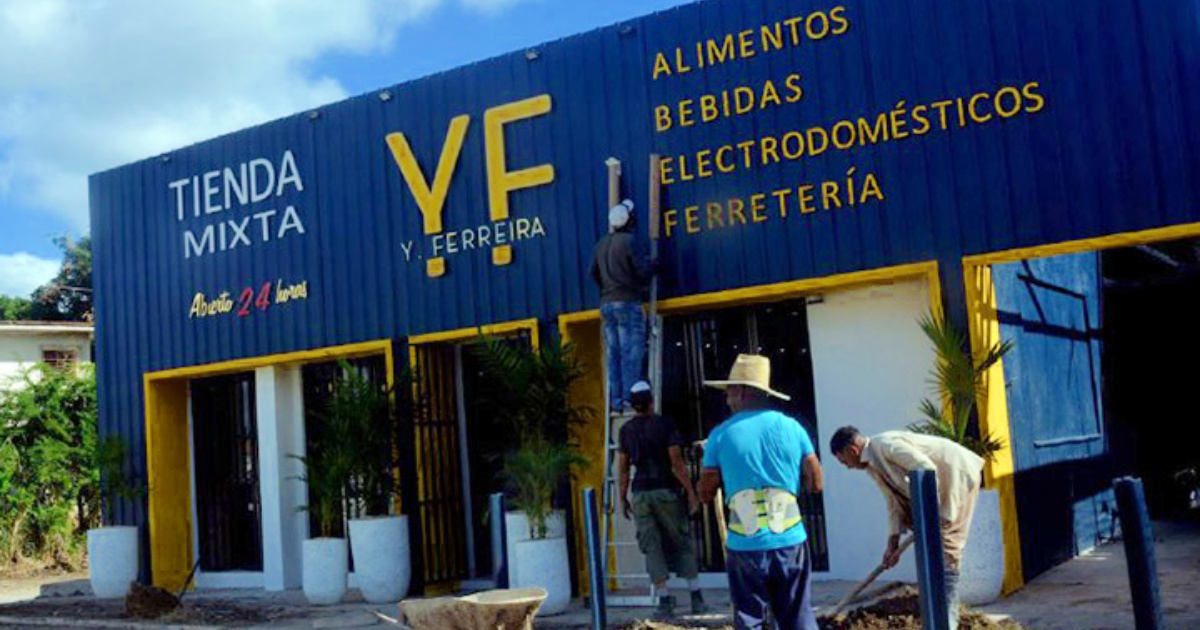
In a country where buying a lock or a bag of cement can feel like an obstacle course, the idea of a 24-hour hardware store in Cuba might sound like a relic from a bygone era. Yet, this is no fantasy.
By the end of 2025, the private company Y. Ferreira, based in Villa Clara, plans to open its fourth retail location in Santa Clara. This new venture will focus on hardware products and will be located in a refurbished space facing the Antonio Maceo Park, as reported by the Cuban News Agency (ACN).
The standout feature of this store is its commitment to providing uninterrupted service, operating 24 hours a day.
This is a stark contrast to the state-run commercial network, which is riddled with restricted hours, product shortages, outdated payment systems, and a bureaucracy that stifles efficiency.
The hardware store will occupy part of a building that previously housed a state-owned laundry, now divided among residential units and a local development project.
Without initial access to water and with the space nearly in ruins, the refurbishment has been entirely funded by the private sector.
According to Norge Lugones Martín, the manager of Y. Ferreira, “the goal was to revive the former social purpose, but the building no longer exists in its entirety.”
The transformation addresses, as Lugones states, “a real need of the population, since there aren’t many places to purchase these types of products in the city. Those that do exist, like the Candonga, are controlled by resellers who triple the prices.”
His statement, while accurate, is somewhat ironic. The official narrative has demonized the informal market for years, yet it has simultaneously fostered the conditions for its existence.
Now, it is the private capital—allowed but monitored—that meets part of that demand, always under its own conditions: “competitive” prices that are nonetheless not affordable for everyone.
Market Realities: Importing, Selling, and SurvivingY. Ferreira aims to make a strong entry: ample stock, "differential" pricing, and acceptance of all payment gateways.
“The idea is to make the supply stable and not leave it solely in the hands of resellers,” Lugones assures.
However, who can guarantee that prices will truly be accessible? Who is this 24/7 hardware store really for?
The experience with other private sector stores suggests otherwise: products are available, but prices remain out of reach for the majority of Cubans, whose average state salary is insufficient to buy even a decent paintbrush.
The company, which also specializes in importing confectionery, even plans to include a small food section.
Private Sector Steps In Amid State ShortagesThe lack of supplies in the state sector has opened the door for private business, but under conditions that perpetuate inequality.
The transformation of the building, which is 80% complete, has cost approximately 12 million pesos, according to the company.
Renovations have included floor, roof, security, and ambiance restoration, all managed by four local private companies.
Simultaneously, efforts have begun to clean and beautify surrounding areas, including sidewalk repairs and public lighting improvements.
The contrast is evident: while state sectors remain paralyzed due to budget constraints, the private sector sets the pace, reshaping entire areas of the city.
Some see this as urban revitalization, while others perceive it as a form of gentrification, where access to services and products depends on one's ability to pay.
“It's good that the space has been remodeled, enhancing the environment and preventing the building from further decay,” commented Damarys Ballate Machado, a local resident.
However, skepticism remains: “Prices need to be more aligned with the population's needs,” urged Lizie Esther García Díaz, concerned about the economic impact on working families in the area.
Questions Arise as New Business Model EmergesThe store, set to operate with a staff of about ten employees, presents itself as an alternative to the informal market's abuses. Yet, it embodies the same enduring dilemmas, with the most pressing being the perpetual issue of unaffordable prices for the most vulnerable sectors.
While the state continues to fail in providing functional hardware stores without endless lines and empty shelves, the population is caught between Candonga resellers and private enterprises that "enhance the environment" but don't necessarily improve access to consumption.
The opening is planned before the year's end, although a specific date remains uncertain. What is certain is that the store will open in a country where, even if you have money, finding essential goods is often a challenge. And when available, not everyone can afford them.
FAQs on the 24/7 Cuban Hardware Store
Why is the 24/7 service significant for a hardware store in Cuba?
The 24/7 service is notable because it contrasts sharply with the state-run stores' restricted hours and frequent shortages, offering constant availability that is rare in the Cuban market.
What challenges does the private sector face in Cuba's retail market?
The private sector in Cuba faces challenges such as bureaucratic restrictions, the need to import goods under difficult conditions, and the pressure to offer competitive prices in an economy marked by inequality.
How does the new hardware store plan to address the issue of high prices?
Y. Ferreira aims to offer "differential" pricing and a stable supply of goods, seeking to reduce reliance on resellers and make products more accessible, though challenges remain in achieving affordability for all.