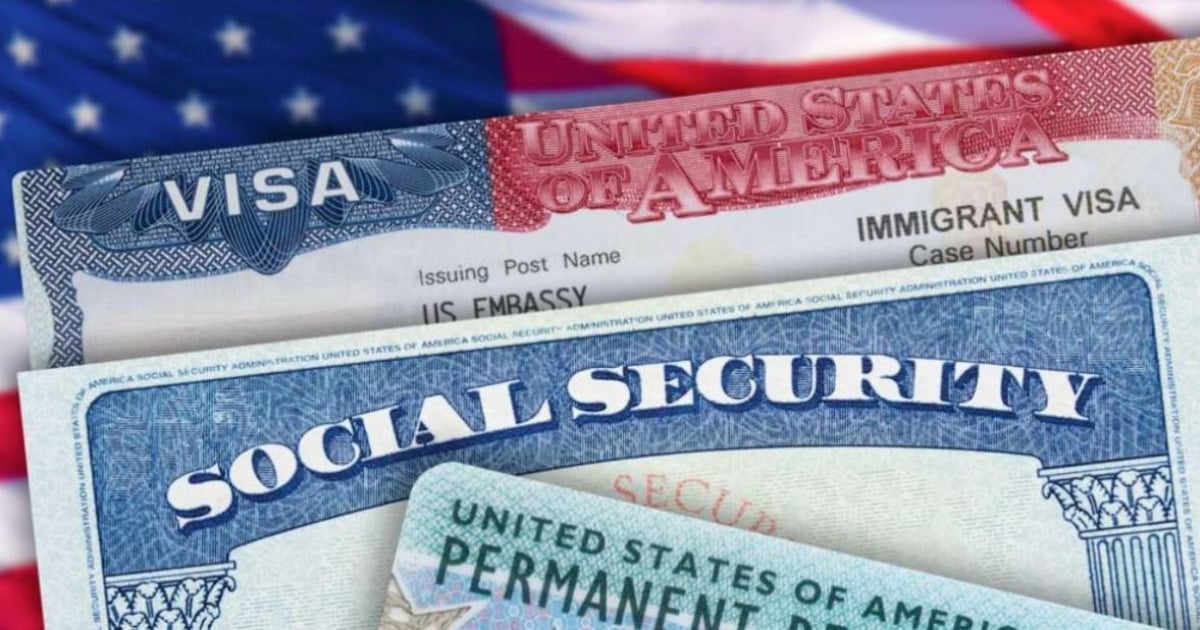
The Trump Administration has suspended all immigration applications from citizens of 19 nations restricted from traveling to the United States, including Cubans.
According to a report by The New York Times on Tuesday, this action halts the processing of both green cards and citizenship applications for large groups from countries included in a travel restriction list announced by the U.S. government in June.
This decision impacts nationals from Cuba, Iran, Sudan, Eritrea, Haiti, Somalia, Venezuela, among others, deemed some of the world's poorest and most unstable by immigration officials.
"The Trump Government is making every effort to ensure that those becoming citizens are the best of the best. Citizenship is a privilege, not a right," stated Matthew Tragesser, spokesperson for the U.S. Citizenship and Immigration Services (USCIS), confirming the suspension.
The American media highlighted that the decision follows last week's shooting in Washington, where two National Guard members were injured.
The suspect, Rahmanullah Lakanwal, a 29-year-old Afghan citizen who had received asylum in April, was identified by authorities.
Immigration attorneys consulted by The New York Times reported that the measure has led to the cancellation of interviews and naturalization ceremonies in various U.S. cities.
Attorney Ana María Schwartz, based in Texas, explained that two of her Venezuelan clients appeared for their appointments at the USCIS office in Houston and were informed that their interviews had been canceled without explanation.
"Everything has stopped. It's like a traffic jam and it's only going to get worse," Schwartz noted.
Another attorney, Elissa J. Taub from Tennessee, shared that a doctor represented by her firm — born in Iran and a permanent U.S. resident — had his naturalization ceremony scheduled for this week, only to be notified of its cancellation.
"We have heard through our network of immigration lawyers that this is not an isolated case," she added. "People from Venezuela and Iran are having their oath ceremonies canceled."
The report by The New York Times stated that authorities have framed the measure as a part of a process to review and strengthen security and background checks for applicants already in the country.
"Nothing is off the table until every foreign national is evaluated and assessed to the fullest extent possible," USCIS mentioned in social media this week.
This suspension also aligns with other recent changes announced by the Department of Homeland Security, including the review of green cards granted to citizens from banned countries, the temporary suspension of asylum decisions, and the reevaluation of cases approved during the previous administration.
The report estimates that the new rules could impact over 1.5 million individuals with pending asylum applications and more than 50,000 asylum recipients granted under the Biden administration.
USCIS Issues Temporary Suspension of Asylums, Residencies, and Naturalizations
As of December 2, 2025, USCIS released memorandum PM-602-0192, titled "Hold and Review of All Pending Asylum Applications and All USCIS Benefit Applications Filed by Aliens from High-Risk Countries."
The document, signed by the USCIS Director's Office, mandates the immediate suspension of all asylum processes, permanent residency applications, and naturalization requests from citizens of the 19 countries deemed high-risk, as per Presidential Proclamation 10949, issued on June 4, 2025, by President Donald Trump.
The order instructs officials to pause all asylum requests (Form I-589), permanent residency petitions (I-485), green card renewals (I-90), preservation of residency for naturalization (N-470), removal of residence conditions (I-751), and travel authorizations (I-131), pending a comprehensive national and public safety review.
The memorandum also calls for a reexamination of already approved benefits for applicants from these countries who entered the United States since January 20, 2021, the start date of the previous administration.
These cases will require new interviews, without exception, to assess potential security risks or criminal backgrounds.
Among the review criteria, USCIS instructs checking if applicants appear in the Terrorist Screening Dataset (TSDS) as suspects or linked to terrorist activities, or if they have connections to organizations, individuals, or activities deemed a national security threat.
The document cites sections 212(a)(3)(A), (B), and (F) and 237(a)(4)(A) and (B) of the Immigration and Nationality Act (INA), which empower the Government to deny or revoke immigration benefits for security reasons or terrorist links.
The memorandum justifies the measure by referencing two thwarted or completed attacks in 2024 and 2025, involving Afghan citizens admitted under humanitarian asylum programs.
One individual, Nasir Ahmad Tawhedi, was convicted of planning a terrorist attack on Election Day 2024, while Rahmanullah Lakanwal is the main suspect in the Washington attack where National Guard members were killed.
In response to these incidents, USCIS determined that a "comprehensive review, interviews, and potential re-interviews" of all applicants from designated countries is necessary to close vulnerabilities in the immigration benefit adjudication system.
The text also clarifies that the suspension will remain in effect until further notice from the USCIS director or deputy director, and any exceptions must be approved by the agency's Office of Policy and Strategy.
The guidance, directed to all immigration personnel, emphasizes that this review may delay pending adjudications but considers the administrative cost "necessary and appropriate to preserve national and public safety."
Finally, the memorandum warns that this procedure does not create enforceable rights or benefits for applicants and that its application is limited to the internal functions of USCIS during policy and procedure reviews.
In November, it was reported that Cuba and Venezuela were among the 19 countries whose citizens with permanent residency in the United States would undergo a thorough review of their Green Cards, by order of President Donald Trump.
The presidential proclamation, signed in June, has become known as the "travel ban." Specifically, the order implied a temporary suspension of various visa types for Cubans, affecting both immigrants and non-immigrants.
The measure prohibited the issuance of tourist, business, and student visas, restricting the entry of Cuban nationals to the United States with B-1 (business), B-2 (tourism), B-1/B-2 (tourism and business), F (academic studies), M (vocational training), and J (student or professional exchange) visas.
Impact of Immigration Suspension on High-Risk Countries
Which countries are affected by Trump's immigration suspension?
The suspension affects citizens from 19 countries, including Cuba, Iran, Sudan, Eritrea, Haiti, Somalia, and Venezuela.
What processes are halted under the suspension?
The suspension halts the processing of asylum applications, permanent residency, and naturalization requests.
Why has the USCIS implemented this suspension?
The USCIS implemented the suspension to conduct a comprehensive review of security and background checks for applicants from high-risk countries, addressing potential threats.
How does this affect Cuban nationals?
For Cuban nationals, the suspension temporarily halts various visa types, impacting their ability to travel to the U.S. for tourism, business, and study.