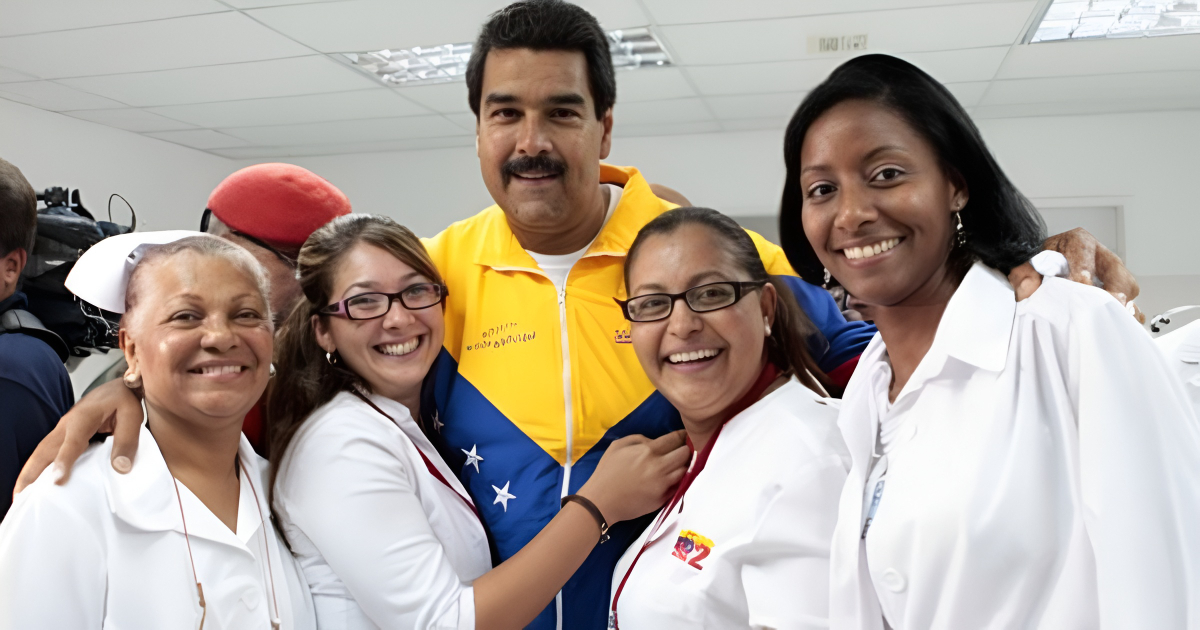
Amid rising tensions in the Caribbean, marked by the deployment of U.S. warships off the Venezuelan coast, airspace closures ordered by Donald Trump, and threats of ground operations against Nicolás Maduro's regime, the Cuban government remains completely silent regarding the situation of thousands of its workers currently stationed in Venezuela.
Activist Norges Rodríguez captured the situation in a tweet: “Significant military deployment in the Caribbean, 'closure' of airspace, suspension of flights, threats of ground military incursion, Maduro and his clan declared terrorists... and the Cuban regime remains silent about the Cuban doctors who are presently in Venezuela.”
The True Scale of Cuban Presence
There is valid concern. According to official estimates from Havana, there are between 10,000 and 20,000 Cuban collaborators actively working in Venezuela, primarily in medical, educational, and technical missions. However, various independent and diplomatic sources suggest this number could be as high as 25,000, including military advisors, intelligence personnel, and logistical staff.
Venezuelan Secrecy and Cuban Dependency
Despite being Venezuela’s primary political and economic ally, no official data regarding the Cuban presence is published. Bilateral agreements signed since 2000—during the peak of Chavismo—are kept strictly confidential, lacking parliamentary oversight or audits.
Havana portrays these figures as an “example of international solidarity” yet avoids addressing the increasing risks faced by its workers given the deteriorating security situation and potential conflict scenario.
An Unspoken Fear
The silence from Cuban authorities starkly contrasts with the gravity of current events. While Maduro's regime denounces an “imperialist aggression,” Cuba limits its response to generic statements of solidarity, omitting any mention of its personnel's fate in the country.
This silence is reminiscent of the situation in Grenada (1983), when Fidel Castro ordered Cuban workers to resist the U.S. invasion with arms. Since then, the regime has insisted its “collaborators” are also “internationalist soldiers.”
However, in today's context, a call to defend Venezuela militarily would be unsustainable: Cuba is enduring its worst internal crisis in decades and cannot bear the political or human costs of engaging in an open conflict.
Despite this, diplomatic sources and analysts suggest that Havana might be preparing evacuation plans in anticipation of a potential collapse of the Chavista regime, particularly for those engaged in intelligence and political control tasks.
The silence may be a blend of fear and political calculation: acknowledging the extent of its presence would mean admitting dependency on the Chavista regime and the direct exposure of thousands of Cubans should armed conflict arise.
Once again, Havana retreats into its historical narrative of revolutionary heroism, while its “collaborators” find themselves trapped between propaganda and the real threat of a war that is not theirs.
Key Questions on Cuba-Venezuela Relations
How many Cuban workers are in Venezuela?
Estimates vary, but official numbers from Havana suggest between 10,000 and 20,000, while other sources indicate up to 25,000, including those involved in military and intelligence roles.
Why is the Cuban government silent about their workers in Venezuela?
The silence may stem from a desire to avoid acknowledging their dependency on the Chavista regime and the potential threat to their workers if conflict arises.
What risks do Cuban workers face in Venezuela?
Cuban workers face increasing risks due to the deteriorating security situation in Venezuela and the potential for conflict, which could directly affect their safety.