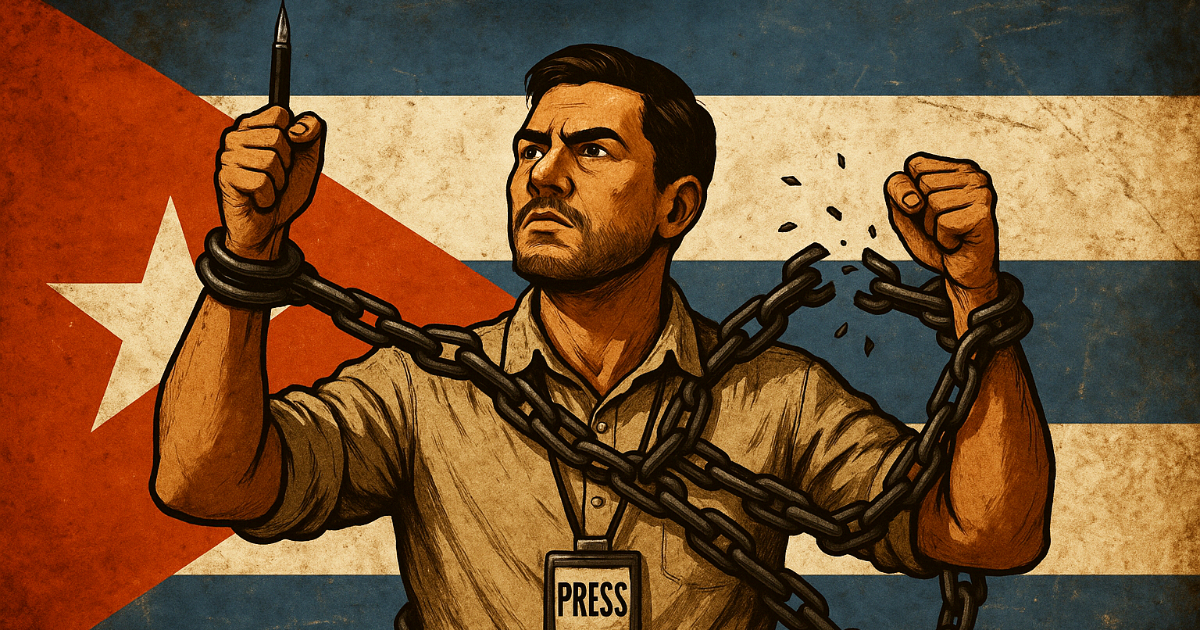
In Cuba, reporting has long been an act of defiance. For over sixty years, the regime has turned the practice of independent journalism into a suspicious, if not outright criminal, activity.
Today, in the 21st century, the methods may have evolved, but the goal remains unchanged: to stifle the truth, intimidate those who speak it, and create enemies to justify censorship.
The ongoing campaigns against elTOQUE, CiberCuba, CubaNet, Diario de Cuba, and other independent media aren't isolated incidents. They are part of a coordinated effort by the state’s ideological and repressive machinery, which has found a new battleground in the digital sphere to suppress critical thought.
A New Face for an Old Strategy
On November 26, 2025, Cubadebate published an article titled “A Snapshot of Far-Right Accounts Operating Against Cuba on X,” produced by its so-called ‘Media Observatory.’
Disguised as a technical analysis, the piece listed about thirty social media accounts—including those of journalists, economists, and activists—accusing them of leading a “cognitive war” organized from abroad to “incite hatred against Cuba.”
Two days later, Foreign Minister Bruno Rodríguez Parrilla echoed these accusations on his official X account, turning a piece of propaganda into state policy.
Immediately, Razones de Cuba, Granma, Prensa Latina, and TV spokesperson Humberto López adopted the narrative, particularly targeting elTOQUE, accusing it of “economic terrorism” and “mercenarism.”
The pattern is familiar: first, media demonization, followed by judicial threats. The publication by Cubadebate of photographs and personal details of 18 alleged “elTOQUE directors” confirms this approach.
Institutional Censorship Over Six Decades
The suppression of press freedom is not a temporary misstep but a foundational policy of the regime established in 1959.
Immediately after the so-called “revolution” succeeded, the new regime shut down newspapers like Prensa Libre and Diario de la Marina, seized printing presses, and created a state-run media apparatus led by Granma and ICRT.
Since then, the Communist Party has monopolized information under the premise that “the press is a weapon of the Revolution.”
Throughout the 1970s and 1980s, journalists and writers like Carlos Franqui, Marta Frayde, Guillermo Cabrera Infante, or Reinaldo Arenas were silenced or expelled for not adhering to the official narrative.
In 2003, during the ‘Black Spring,’ 27 independent journalists—including Raúl Rivero and Ricardo González Alfonso—were sentenced to lengthy prison terms for “mercenarism,” a crime custom-made to punish intellectual dissent.
The Modern Day Repression
The 21st century brought the internet and social networks, but also a digital version of the same control. Today, repression doesn’t need visible prisons; it operates through smear campaigns, threats on social media, interrogations, hacks, website censorship, and economic persecution. Controlling the narrative remains central to the regime’s survival.
The Cuban Penal Code, revised in 2022, entrenched the criminalization of journalism through vague legal definitions that allow for the punishment of any form of critical expression, including:
- Article 143 (Mercenarism): Punishes with up to ten years in prison anyone who “receives or intends to receive material benefits from a foreign government to undertake acts against the Cuban state.” Its ambiguity turns any journalist working with international funds into a potential criminal.
- Article 119 (Treason): Includes penalties for “cooperating or providing information to the enemy,” a flexible category the regime uses against those collaborating with foreign-based media.
- Articles 124 to 126 (Crimes Against State Security): Allow for the prosecution of citizens for “enemy propaganda acts.”
- Article 370: Penalizes “spreading false news,” leaving the state as the sole arbiter of truth.
In Cuba, the law protects not the citizen from power, but power from the citizen. These laws don’t defend national security; they shield the Party from criticism.
Unmasking the Regime's Myths
“Mercenarism”: The government insists that independent media are “mercenaries” because some receive international funding. However, all funds for independent media are public, transparent, and audited.
Despite the regime's persistent defamation of CiberCuba as a recipient of such funds, this outlet has repeatedly clarified that it receives no external financing and operates with self-generated revenue from advertising and traffic.
The real issue for the regime is not the source of the money, but the destination of the information: it cannot be controlled.
Moreover, state media also receive external funding, though disguised as cooperation or state investment from allied countries. The difference is they serve political interests, while independent journalism serves the truth.
“Enemy Propaganda”: If there is propaganda in Cuba, it is within state media. Granma, Juventud Rebelde, or Cubadebate don’t inform; they repeat slogans. Free journalism, in contrast, verifies, fact-checks, and gives voice to those silenced by power.
The regime fears independent press because it breaks the narrative monopoly: it exposes poverty, blackouts, corruption, and human rights violations that official media deny.
“Treason” and “State Security”: A journalist's loyalty is not to the government but to society. The regime deliberately confuses criticism of the Party with treason to the nation. But criticizing an authoritarian power is not betraying Cuba; it is defending it.
Equating “Revolution = State = Nation” is the greatest political subterfuge of Castroism. Under this formula, the regime claims ownership of the country and criminalizes any dissent.
“Counterrevolution”: For decades, the term has been used to exclude and demonize those who don’t subscribe to the official narrative. But in today’s Cuba, where the so-called “revolution” means stagnation and repression, the true revolutionary is the one who demands change.
Being “counterrevolutionary” has become an honor for those fighting for rights, transparency, and freedom. Just as being labeled a “hater” has become a badge of distinction for those who oppose the violence, repression, stupidity, manipulation, indoctrination, and corruption of a totalitarian power.
The Language War
The regime has refined its semantic arsenal. Now it doesn’t just speak of “enemy propaganda” or “mercenaries,” but of “cognitive warfare,” a concept borrowed from Russian military jargon.
The idea is simple yet dangerous: present public debate as war, criticism as an attack, and free thought as a weapon. By militarizing language, the state justifies its surveillance, censorship, and repression as national defense.
When power calls the truth a “war,” it’s because it has run out of arguments.
The Role of Independent Journalism
Despite persecution, free Cuban journalism remains alive, both within and outside the country. Outlets like CiberCuba, elTOQUE, CubaNet, Diario de Cuba, 14ymedio, or ADN Cuba document what the state hides: poverty, mass migration, political prisons, healthcare collapse, and the inequality generated by the system’s “partial dollarization.”
Their existence is not a crime but a public service. They keep Cuba connected to the truth, despite censorship, exile, and hate campaigns.
The Real Crime
The regime accuses those who report of treason, but the real traitors are those who lie in Cuba’s name. Those who use the flag to cover up repression, the word “homeland” to justify poverty, and the “revolution” to perpetuate the power of an elite.
In Cuba, to inform is to resist. There is no greater crime for a dictatorship than speaking the truth. Independent Cuban journalists are not enemies of the nation but dissenters of a dictatorship that uses state-run media as a tool of domination. They are those who, as Martí said, “with a bit of light on their foreheads, cannot live where tyrants rule.”
And as long as power continues to confuse its permanence with the nation, it will need to be reminded that Cuba is not the Party, the Revolution, or the Government: Cuba is the current victims of a dictatorship but also the future citizens of a state governed by law, in a free and democratic homeland.
Key Questions About Press Freedom in Cuba
Why does the Cuban regime target independent media?
The Cuban regime targets independent media to maintain its control over information and suppress dissent. By criminalizing free journalism, the regime seeks to stifle the truth and prevent the exposure of its shortcomings and human rights violations.
What legal measures does the Cuban government use against journalists?
The Cuban government uses a variety of legal measures to criminalize journalism, including vague charges like "mercenarism," "treason," and "enemy propaganda," allowing the regime to penalize any form of critical expression.
How does the Cuban regime justify its actions against the press?
The Cuban regime justifies its actions by framing criticism as a threat to national security, using terms like "cognitive warfare" to present public debate as hostile and dissenting opinions as attacks on the state.