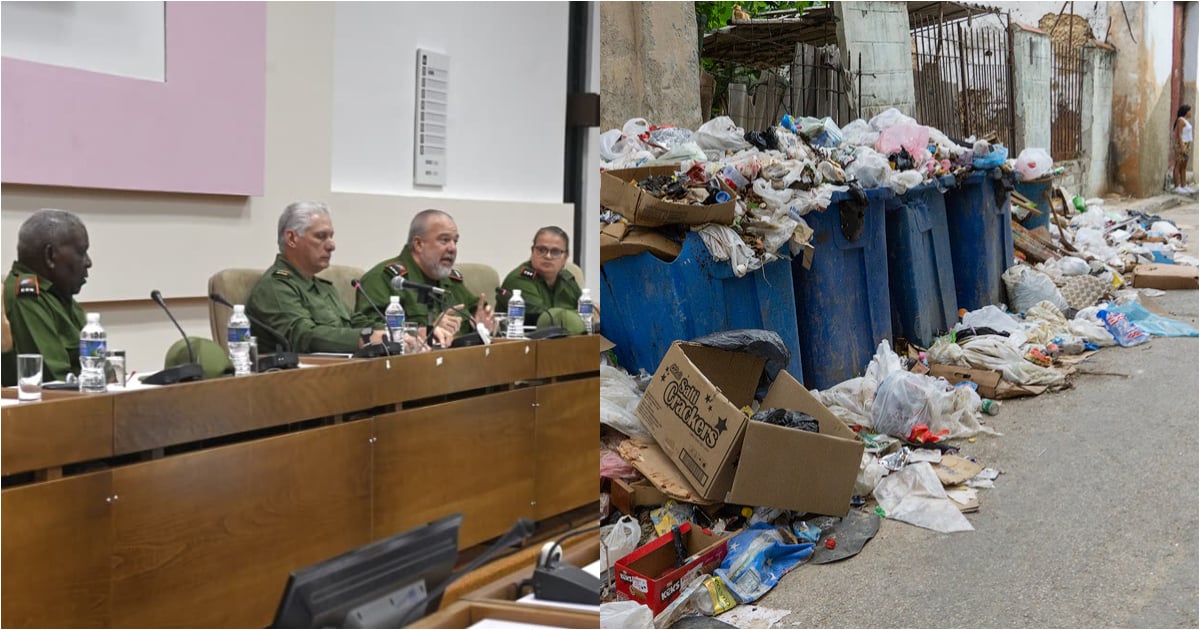
In a startling acknowledgment, the Cuban government on Saturday admitted that it lacks precise data on the volume of trash produced in Havana. This critical deficiency hampers any efforts to develop effective urban cleaning and infrastructure strategies.
The revelation came during a routine meeting between national and Havana authorities, where initial findings from a pilot study on waste generation by households and both state-owned and private entities in a specific neighborhood were shared.
Spearheaded by the Ministry of Science, Technology, and the Environment along with several universities, this research aims to establish a foundational figure necessary for planning a waste collection system. "Understanding the actual amount of solid waste generated in the capital is crucial," stated Prime Minister Manuel Marrero Cruz, as reported by the Presidency's digital portal.
Chaired by President Miguel Díaz-Canel, the meeting was attended by key figures including Esteban Lazo Hernández, President of the National Assembly; Vice Prime Minister Inés María Chapman; Havana's Provincial Party First Secretary Liván Izquierdo Alonso; and the city's Governor Yanet Hernández Pérez.
In the absence of comprehensive data, the city relies on partial figures. From November 21 to 27, about 91,695 cubic meters of garbage were collected, averaging 13,101 cubic meters daily, less than the previous week due to reduced equipment availability.
During this period, approximately 221 pieces of equipment were used, 73 fewer than the prior week. Interruptions in fuel supply hindered the system, which requires vehicles to be ready the day before. Additional setbacks included breakdowns from a lack of oil and lubricants, along with issues related to tires and batteries.
This situation highlights ongoing material constraints that hamper the city's response capabilities weekly. Despite these challenges, authorities reported some operational progress. Sweeping crews have increased to 85, covering 650 sections and 47 avenues.
The Cuban Steel Company is producing 40 new picker carts, and a recovery program for ampiroll containers has refurbished 21 of the planned 40, with 10 new units ready for distribution on Monday.
Efforts also included the distribution of containers: 30 for Playa municipality, another 50 expected to be retrieved by Monday, and 80 more destined for Old Havana upon completion of their production.
Additionally, the government noted an uptick in recyclable recovery, totaling 197 tons in the past week. Private ventures contributed 109.2 tons, the "I Recycle My Neighborhood" movement added 77.31 tons, and an extra 11.29 tons were collected from avenues.
These figures not only aid in cleaning efforts but also generate revenue, including foreign currency, that could support ongoing sanitation activities, the report highlighted.
Parallel to these initiatives, 4,111 private businesses were inspected, and an equal number of waste management contracts were signed, bringing the total to 19,005 agreements.
Despite these efforts, the fundamental issue remains: the city does not know its total waste output. This lack of data severely limits the ability to effectively plan routes, size fleets, allocate resources, assess effectiveness, or measure the real impact of any program.
While the government now acknowledges this as a "vital" issue, the long-standing absence of such foundational data partly explains why Cuba's main city faces a severe waste management crisis, with trash piling up in the streets, causing unsanitary conditions and public health risks.
Authorities have attempted to conduct cleaning operations, but resource shortages and ineffective measures have thwarted sustainable solutions. For weeks, soldiers, officers, and civilian workers from the Revolutionary Armed Forces have led "Operation Clean-Up," an initiative aimed at improving the capital's sanitary conditions.
Since November 17, Old Havana's government has implemented a system requiring residents and private businesses to bring their waste directly to collection trucks, rather than leaving it on the streets.
Journalist Ana Teresa Badía captured the situation in a Facebook post, stating, "Havana smells like garbage," highlighting "rampant institutional indifference." She argued that living with such waste conditions should not be normalized, calling Havana "an eternal dump awaiting someone to care. Too much indifference."
Addressing Waste Management in Havana
Why is the lack of data on trash production in Havana a problem?
Without accurate data on trash production, it's challenging to plan effective waste management strategies, allocate resources efficiently, and measure the impact of cleaning programs in Havana.
What measures has the Cuban government taken to improve waste management?
The government has initiated pilot studies to estimate waste generation, increased sweeping crews, distributed containers, and signed waste management contracts with private businesses to enhance the city’s waste management system.