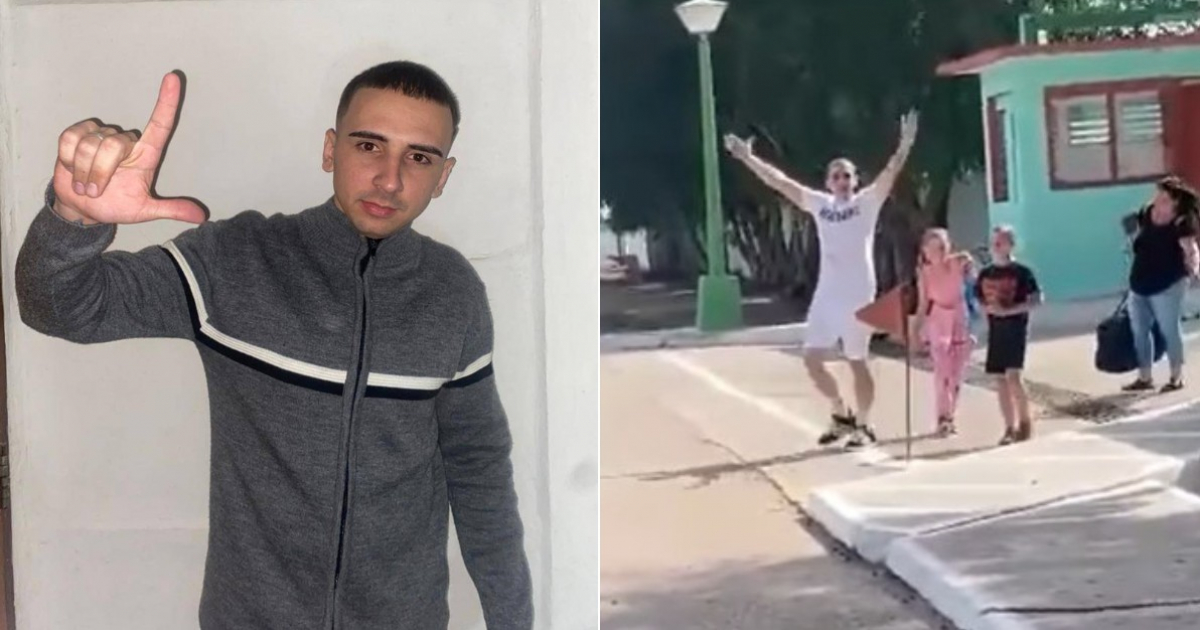
After enduring four years of unjust imprisonment, José Alejandro Rodríguez Gelín, a detainee from the July 11 protests, opened up to Martí Noticias about his harrowing time behind bars and his hopes for the future.
At just 26, Rodríguez Gelín reflected on his incarceration at the Agüica Penitentiary in Matanzas, where he was confined since he was 22. He described a particularly troubling incident involving the theft of a box of cigarettes, which served as a pretext for prolonging his release, saying, "something very dark happened."
Originally from Jovellanos, Matanzas, Rodríguez Gelín shared with journalist Yaima Pardo his repeated anticipation of freedom, only to have it dashed. "They kept taking away reductions in my sentence, delaying my release," he recounted.
He described the manipulative tactics of his captors, who sought to convince prisoners of their 'untouchable' status and protection. "It was the opposite. Behind their facade was a repressive instinct. They even sent common criminals to harm us," he revealed.
A particularly painful memory was being denied permission to attend his grandfather's funeral. "They led me to believe I would be allowed to go... but it never happened. That was the greatest torture they inflicted on me," he recalled.
Upon his release, Rodríguez Gelín expressed dismay at the state of his country, remarking, "I see a nation in spiritual, human, and economic misery." A poignant moment came when a child attempted to sell him bitter oranges, underscoring the nation's decline.
Regarding the flawed procedures leading to his conviction, Rodríguez Gelín explained, "There was no real process: when I faced the authorities, they already had all the videos. I was labeled as the 'ringleader.' Everything was predetermined." He likened the proceedings to "a play with a pre-written script."
Now free, the 26-year-old has no intention of returning to academia, fearing that "opening the door to university means opening a door for State Security to frame me again." He remains critical of the regime, stating, "The reasons for protesting are still present, worsening."
Rodríguez Gelín also expressed solidarity with political prisoners on hunger strikes and highlighted the support he received in jail from fellow dissident Félix Navarro, whom he referred to as "a father."
He concluded with a hopeful vision for his country: "My greatest contribution is my voice, my soul, my pen. I want a Cuba where Cubans love each other."
His Release Rodríguez Gelín returned home on November 18, after spending four and a half years incarcerated for his involvement in the peaceful July 11, 2021 protests. His mother, Meibel Gelin García, shared the joyous moment on Facebook, capturing a reunion marked by years of suffering, uncertainty, and the frustration of a judicial system used to punish dissent.
Despite his return, the memories remain. "We've suffered and cried a lot, but today God brings him back to us as a mature man, firm in his convictions, with scars that only time and our love can heal," Meibel expressed.
She thanked those who supported them over the years and stressed that her happiness remains incomplete while many Cuban mothers await their children's freedom.
"We will not stop thinking of the mothers yearning to embrace their children and we will continue demanding freedom for all political prisoners, supporting those unjustly behind bars," she emphasized.
A Conviction Without Evidence José Alejandro's story exemplifies the judicial repression following Cuba's largest protests. Hundreds of young people were accused of crimes like assault, incitement, or public disorder, with no evidence of harm presented during trials.
In Rodríguez Gelín's case, State Security admitted he did not commit assault, yet he was sentenced to nine years in prison—a punishment his family decried as politically motivated. In January 2022, the families of five Jovellanos detainees, including Rodríguez Gelín, publicly denounced the lack of legal guarantees in Cuba, highlighting the absence of evidence and the biased actions of judges and prosecutors serving as state enforcers.
Meibel Gelin García, his mother, explained that the trial sought to portray him as the protest's "leader," despite no one being able to confirm he organized or led the demonstration.
A Student Turned into a Criminal In October 2021, Meibel Gelin García addressed a letter to Miguel Díaz-Canel, revealing her son as he truly was: not a political agitator, but a Spanish-Literature student with severe health issues and aspirations for a better future, like many disillusioned Cuban youths.
The letter criticized the prosecution's portrayal of him as "unemployed," despite his university studies prior to arrest. She recounted how her son did not harm anyone, merely chanting and advising others not to protest irresponsibly outside a hospital. Yet, he was punished as a dangerous criminal.
She also described his 40-day confinement in a windowless room, isolated, and denied medical relief even during health crises.
Gelin's words in that letter remain a potent accusation: "I know exactly what to call what they're doing to my son: injustice, repression."
Insights on José Alejandro Rodríguez Gelín's Imprisonment
What were the circumstances of Rodríguez Gelín's arrest?
José Alejandro Rodríguez Gelín was arrested for participating in the July 11, 2021 protests in Cuba. He was accused of being a leader of the demonstration, despite no evidence supporting such claims.
How did Rodríguez Gelín describe his time in prison?
He described his imprisonment as filled with manipulation and repression, including being denied attendance at his grandfather's funeral and facing hostility from common criminals.
What are Rodríguez Gelín's views on Cuba after his release?
Rodríguez Gelín sees Cuba in a state of spiritual, human, and economic decline, and he expresses no desire to return to academic life due to fears of further persecution.