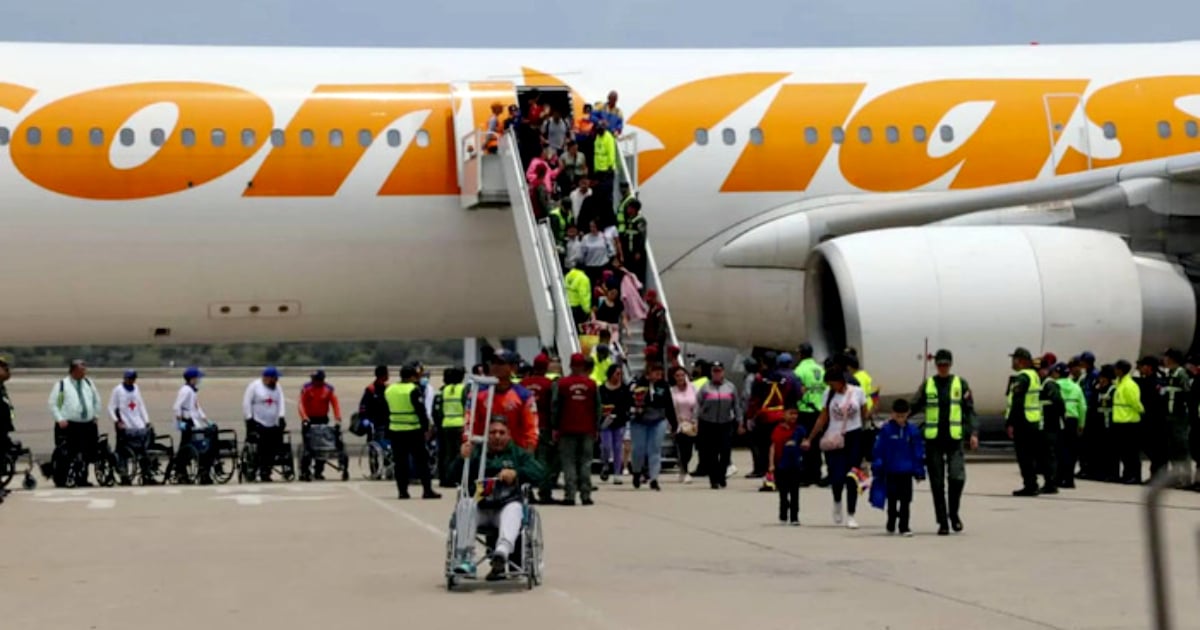
The administration led by Nicolás Maduro declared on Saturday an immediate halt to flights carrying deported migrants from the United States. This move comes as a direct reaction to President Donald Trump's directive to completely close Venezuelan airspace, a move that Caracas criticized as "arbitrary, hostile, and a violation of national sovereignty."
In a statement released by the Venezuelan foreign ministry, the Chávez regime denounced what it termed an "unprecedented measure in decades in Latin America and the Caribbean," accusing Washington of attempting to exert illegitimate jurisdiction over Venezuelan airspace beyond its borders.
"The government of the Bolivarian Republic of Venezuela strongly condemns this threat to national sovereignty and unilaterally halts the repatriation flights of migrants from the United States," the statement mentioned, as reported by the ANSA agency.
As of now, 75 deportation flights have returned nearly 14,000 Venezuelans from U.S. soil in 2025, according to official statistics. The most recent flight, carrying 175 migrants, landed in Maiquetía from Arizona last Wednesday.
Caracas Denounces Trump's "Imperialist" Actions
The message from the U.S. president, shared on his social platform Truth, warned "airlines, pilots, drug traffickers, and human traffickers" that the airspace over and surrounding Venezuela should be considered "completely closed."
The lack of operational details has led to confusion among international airlines and regional governments.
Vice President Delcy Rodríguez accused Trump of acting in concert with opposition leader María Corina Machado, whom she blamed for requesting the air blockade against Venezuela.
"The U.S. government is accommodating María Machado's request to attempt to block Venezuela's airspace," Rodríguez stated, labeling the decision as an "unprecedented imperialist aggression."
Special Repatriation Plan and New Air Restrictions
Simultaneously, Rodríguez announced the establishment of a special repatriation plan for Venezuelans stranded in other countries, particularly in Latin America, due to the cancellation of international routes. This program will include humanitarian flights and coordination with allied airlines.
The aviation crisis worsened after U.S. aviation authorities advised airlines to avoid Venezuelan airspace due to increased military flights in the Caribbean. Subsequently, Caracas revoked the licenses of six international companies, including Iberia, TAP, Turkish Airlines, Avianca, Gol, and Latam, which had halted their operations.
Panama-based Copa Airlines continues to operate flights between Panama and Caracas, but only during daytime hours and under "maximum alert levels." The surge in prices for alternate routes has driven ticket costs up to $1,000, highlighting an unprecedented aviation crisis in the region.
Impact of U.S.-Venezuela Diplomatic Tensions
What prompted Venezuela to halt deportation flights from the U.S.?
Venezuela stopped deportation flights in response to President Trump's order to close Venezuelan airspace, which Caracas viewed as a violation of its sovereignty.
How has the airspace closure affected international airlines?
The closure has led to confusion among international airlines and resulted in the revocation of licenses for several companies, causing a spike in ticket prices for alternative routes.