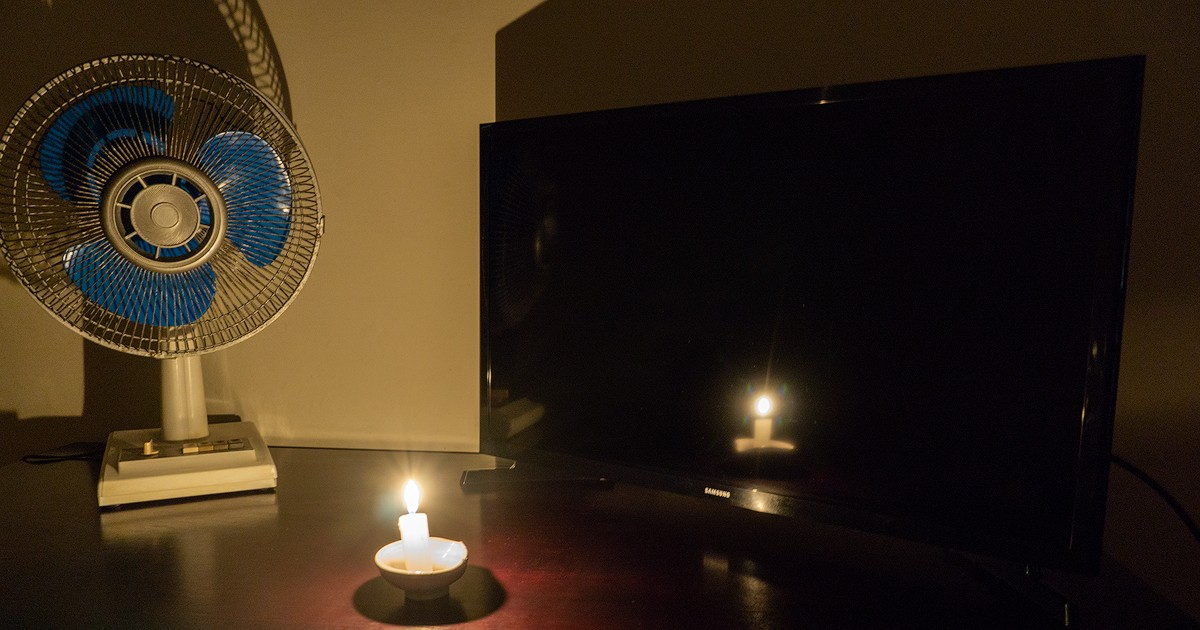
The Electric Union (UNE) disclosed that Cuba experienced a full day of widespread power outages on Tuesday. It warned that the country is facing a deficit exceeding 1,800 MW during peak hours, a figure that highlights the system's collapse without the need for further explanation.
The energy crisis, which the government has failed to resolve despite years of vague promises, opaque investments, and constant "scheduled maintenance," has reached a stage where many areas are left without electricity for 24 hours straight.
According to the official report, the electrical system was impacted throughout the day, with the maximum deficit reaching 1,704 MW at 6:20 p.m.
This Wednesday, the national demand continues to far exceed the available capacity. At 6:00 a.m., it hovered around 1,500 MW, compared to a demand of 2,382 MW. This shortfall led to more than 900 MW of outages.
By midday, the deficit is expected to increase to 950 MW.
During peak hours, the maximum demand is estimated at 3,300 MW, while actual availability remains at just 1,500 MW. The result: a deficit of 1,800 MW and a projected disruption of 1,870 MW, underscoring the ongoing widespread blackout across the nation.
These figures illustrate a system on the brink of collapse.
Daily breakdowns are affecting Unit 6 of the Antonio Maceo thermoelectric plant and Unit 2 of the Felton plant. Meanwhile, three other thermoelectric plants at the CTE Mariel, Santa Cruz, and Cienfuegos are offline for maintenance.
Additionally, severe limitations in thermal generation keep 546 MW out of service with no clear recovery timeline.
The situation is further exacerbated by a chronic fuel supply problem: 95 distributed generation plants are idle due to lack of fuel, nearly 100 MW at the Moa site are inactive, and another 68 MW remain offline due to a shortage of lubricant. In total, the country is losing 998 MW solely due to this issue.
These are not isolated failures but rather the result of a system that has been operating at its limits for years, lacking effective investment and relying on temporary fixes that are increasingly failing.
While the government attempts to showcase progress, such as the energy production from 33 new photovoltaic solar parks that generated 2,827 MWh and contributed a maximum power of 584 MW, this is insufficient for a country where demand far exceeds what is available and whose core infrastructure still relies on aging, poorly maintained, and fuel-deprived plants.
In Havana, disruptions were also reported: the provincial Electric Company confirmed on Facebook that the capital was without power for more than seven hours.
Service was restored shortly before 11:00 p.m. The report notes that overnight "there was no outage due to deficit," a feeble attempt at reassurance that only highlights how blackouts have become a normalized part of daily life.
While the government continues to blame breakdowns, maintenance, and fuel shortages, the reality is clear: state inefficiency has led Cuba to rely on a dilapidated electrical system incapable of sustaining the daily lives of its inhabitants.
Today, the population faces a nation that is increasingly shutting down, not only due to lack of power but also due to the absence of solutions.
Understanding Cuba's Energy Crisis
What is causing the massive power outages in Cuba?
The massive power outages in Cuba are primarily caused by a severe deficit in power generation, with a system that has been operating at its limits for years. Contributing factors include outdated and poorly maintained infrastructure, a chronic fuel supply shortage, and ineffective government investments.
How is the government addressing the energy crisis in Cuba?
The Cuban government has attempted to address the energy crisis through investments in renewable energy, such as photovoltaic solar parks, and scheduled maintenance of existing plants. However, these measures have been insufficient given the country's outdated infrastructure and high energy demand.