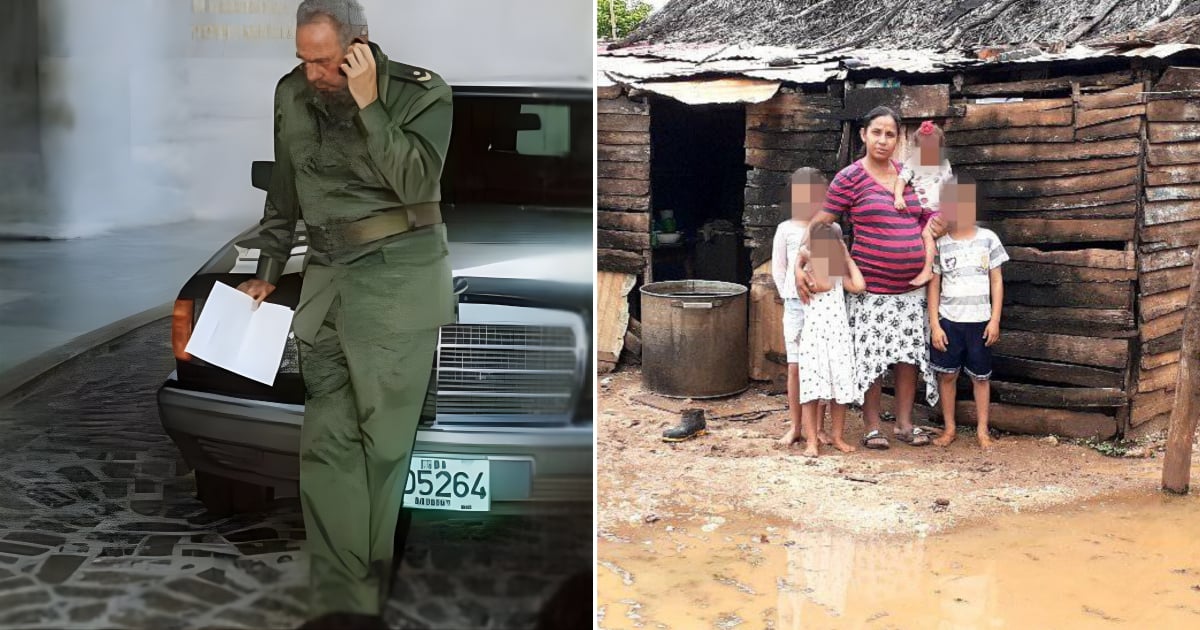
Every year, as the anniversary of Fidel Castro's death approaches, the Cuban regime attempts to project the image of a "people's leader" and an "architect of equality." However, the reality of Cuba's ongoing power outages, meager salaries that can't even cover a basic bottle of oil, and citizens fleeing by any means possible, reveals a different truth: Fidel's genuine legacy was the systematic dismantling of the Cuban middle class, leaving it in ruins.
The Promise of Equality that Led to Widespread Poverty
Back in the 1950s, Cuba boasted a thriving middle class composed of small and medium business owners, professionals, prosperous farmers, entrepreneurs, journalists, artists, and merchants driving the economy. While Fidel Castro promised social justice, he effectively applied the most destructive strategy for wiping out an open society: eradicating individuals' economic autonomy.
Through nationalizations, confiscations, prohibitions, complete employment control, and targeting those who "lived too well," each measure aimed to render citizens reliant on the state. A person dependent on the state loses the ability to make decisions, voice dissent, compete, or thrive independently.
The Rise of the New Elite: Military and Party Leaders
While the general populace plunged into poverty, another dynamic took root: an economic elite directly connected to the military hierarchy, embodied today by GAESA, an empire managed by the Castro family via the military. This tiny fraction—less than 1%—holds sway over hotels, foreign currency, imports, exports, commercial zones, and strategic resources.
The socialist rhetoric served as the perfect excuse to establish an oligarchy of the powerful, free from competition, transparency, or public accountability.
The Outcome: A Nation Divided into Two Classes
Decades of policies suffocating private initiative have yielded a stark reality:
A vast majority of 99% living in poverty or near-poverty, caught between symbolic wages and mere survival. Meanwhile, a 1% elite—comprised of generals, the Castro family members, and privileged officials—enjoys access to food, energy, travel, foreign currency, and luxuries unimaginable to the average Cuban. This was always the blueprint: absolute power over an impoverished populace.
Cuban People: The Perpetual Victims
Contrary to the official narrative, the Cuban people have suffered under a system that stifled economic independence and weaponized poverty for political control. Today, as the regime's elite continues amassing privileges, millions of Cubans endure hunger, blackouts, and scarcity. This tragedy is not a result of the embargo, but rather the incompetence and corruption of those ruling Cuba for over six decades.
Dismantling Fidel's Legacy
Fidel Castro's true legacy is not equality but the intentional obliteration of the Cuban middle class. This legacy persists under Raúl Castro, GAESA, and their puppet leaders like Miguel Díaz-Canel, who maintain the facade of leadership. Until this system is dismantled, Cuba will remain a nation engineered for widespread poverty, with a select few living like royalty.
Understanding the Impact of Cuba's Economic Policies
What was the state of Cuba's middle class before Castro's revolution?
Before Castro's revolution, Cuba had a vibrant middle class consisting of small and medium-sized business owners, professionals, successful farmers, entrepreneurs, journalists, artists, and merchants who kept the economy thriving.
How did Castro's policies impact Cuban society?
Castro's policies, including nationalizations, confiscations, and employment control, systematically dismantled the Cuban middle class, making citizens dependent on the state and creating widespread poverty.
Who are the new elite in Cuba under the current regime?
The new elite in Cuba are primarily linked to the military and party leadership, notably represented by GAESA, which is controlled by the Castro family through the military and holds significant economic power.