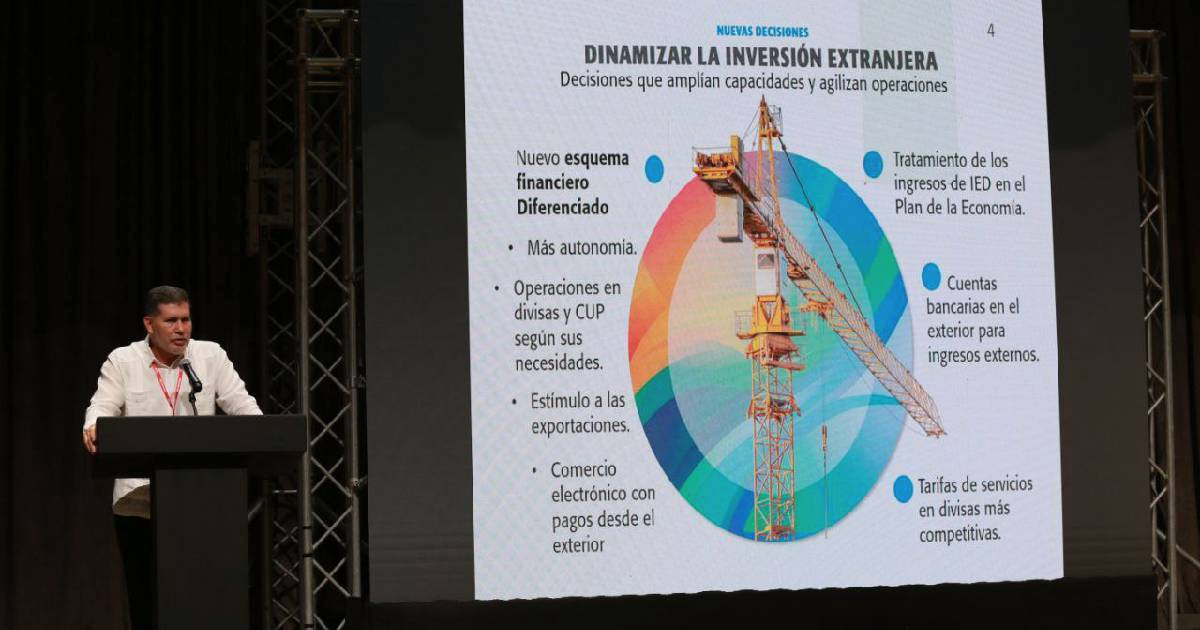
The Cuban regime announced on Monday that foreign companies will now be able to operate directly in hard currency within the island. This decision is part of a new strategy for partial dollarization of the national economy.
This move comes amid a severe economic crisis, characterized by the devaluation of the Cuban peso. It was introduced by Oscar Pérez-Oliva Fraga, the Vice Prime Minister and Minister of Foreign Trade and Foreign Investment (MINCEX), during the opening of the VIII Investment Forum at the 2025 Havana International Fair (FIHAV).
Pérez-Oliva Fraga explained that this change is part of a broader "package of transformations" aimed at attracting foreign capital and easing foreign investment operations in Cuba. Currently, the sector includes over 370 businesses from 40 different countries, as reported by the state-run portal Cubadebate.
"A new differentiated operational scheme for foreign investment will be established, allowing operations in both national currency and foreign currency based on their needs," said Pérez-Oliva Fraga.
The new model aims to allow foreign enterprises to acquire and manage revenues in foreign currencies autonomously, whether through exports or segments of the domestic market that generate hard currency.
This measure further deepens the dollarization process of the economy, addressing the structural crisis of the Cuban peso (CUP) and the regime's increasing need for fresh foreign currency amid liquidity shortages.
The MINCEX head also mentioned that companies will be able to open bank accounts abroad, an option already included in Cuban legislation but now politically backed as a tool to facilitate international transactions and counteract the effects of the U.S. embargo.
"These transformations are linked to the partial dollarization process of the economy and aim to orient foreign investment towards obtaining external revenues," Pérez-Oliva emphasized.
The Vice Prime Minister also revealed plans to set prices in foreign currency for certain goods and services to make them "more competitive and closer to the realities of the exchange market."
MINCEX is set to issue a new decree replacing the current Decree 325 (regulation of Law 118 on foreign investment) and update Resolution 21 to simplify procedures and reduce approval times for projects.
Pérez-Oliva stated that the goal is "to create a more transparent and agile environment for investors," though he did not provide details on capital repatriation guarantees, a major concern for foreign businesses.
Economists consulted by independent media suggest that such measures confirm the Cuban government's move towards selective dollarization, where only certain players can operate in hard currency, while most citizens receive wages in a currency with no real value.
The decision also highlights the failure of the Cuban peso and the monetary unification implemented in 2021, which caused inflation, shortages, and loss of purchasing power.
While the government tries to justify the opening as an "update of the socialist model," it is essentially a desperate strategy to attract dollars amid a stifled economy and a lack of investor confidence.
Understanding Cuba's Economic Changes
Why is Cuba allowing foreign companies to operate in hard currency?
Cuba is permitting foreign enterprises to operate in hard currency as part of a strategy to partially dollarize its economy. This move aims to attract foreign capital and alleviate the country's severe economic crisis marked by the devaluation of the Cuban peso.
How will this new model benefit foreign companies?
The new model allows foreign companies to autonomously acquire and manage revenues in foreign currencies, either through exports or by engaging in domestic market segments that generate hard currency. This provides them with greater financial flexibility.
What are the implications of Cuba's partial dollarization process?
Cuba's partial dollarization process is intended to attract foreign investment by allowing operations in hard currency. However, it also highlights the failure of the Cuban peso and could lead to a dual economy where only certain sectors benefit from foreign currency transactions.