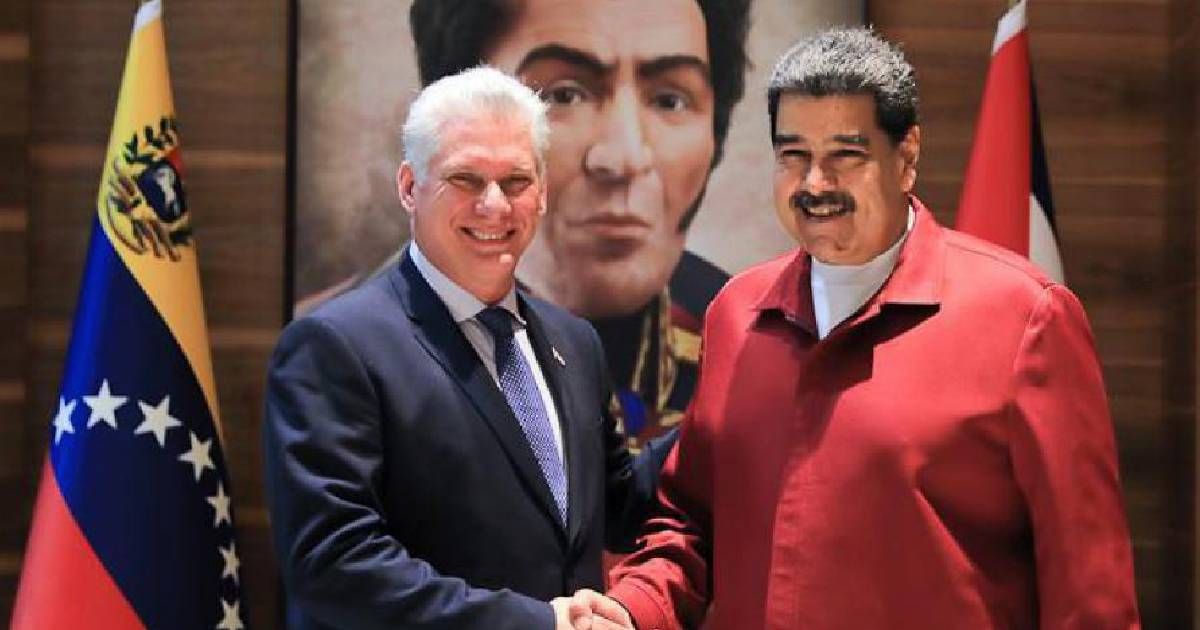
Senior U.S. government officials have reportedly indicated that Nicolás Maduro is apprehensive about the possibility of being assassinated by his Cuban allies if he were to relinquish his hold on power in Venezuela. This revelation comes from an Axios report detailing supposed internal discussions within President Donald Trump's administration.
The report cites U.S. intelligence services suggesting that Maduro fears being eliminated by his Cuban advisors should he step down, due to Havana's control over Venezuelan security and counterintelligence apparatuses.
Maduro is perceived as a liability because he possesses extensive knowledge of secretive dealings between the Venezuelan and Cuban governments, encompassing financial transactions, drug trafficking networks, and joint intelligence activities. This makes him a potential threat to Cuban interests if he is ousted from power, according to the document.
The challenge in persuading Maduro to resign is compounded by the belief that his Cuban handlers might execute him if he capitulates to U.S. pressure, the report notes.
The Cuban regime's influence in Venezuela has remained pivotal since 2013, with Cuban agents overseeing intelligence, presidential security, and a significant portion of the Venezuelan military framework. This control allows Havana to sustain its political and economic presence in exchange for oil and financial benefits.
For the United States, this alliance poses a direct threat, sustaining both repression in Cuba and regional drug trafficking.
Despite Washington officially labeling Maduro as the leader of a terrorist organization linked to international drug trafficking, Trump is reportedly planning to engage in direct dialogue with him.
Regarding U.S. strategies, a senior official cited by Axios emphasized that "no one is currently planning to shoot him or kidnap him—at least not for now. Never say never, but that's not the plan at the moment."
The article further reveals that at least 83 individuals have perished in 21 missile attacks targeting vessels allegedly involved in drug trafficking in the Caribbean, part of the U.S. military's "Southern Spear" operation.
While officially an anti-drug mission, military sources admit the operation seeks to instigate regime change in Caracas by weakening Maduro's grip and his alliances with Cuba, Russia, China, and Iran.
"We have covert operations, but they are not designed to kill Maduro. They aim to halt drug trafficking," a White House official assured.
"If Maduro steps down, we won't shed a tear," the official added.
Axios reports that Trump views a negotiated exit as a means to cement his legacy as the leader who "did everything possible to stop the flow of drugs into the United States."
"A diplomatic solution is very likely," one of Trump's advisors stated. "The president wants tangible results, not just bombs."
The relationship between the Venezuelan and Cuban regimes has been scrutinized for decades.
Three years ago, the book "Cara e' crimen" by former Venezuelan deputy Pablo Medina exposed "the true causes of Chávez's mysterious death, as well as his unhealthy relationship with Fidel Castro, to the extent of subordinating his nation's interests to those of Cuba."
The author contends that Chávez did not die in Venezuela, contrary to the official account, and that his remains were sent from Cuba. Furthermore, the body received in Caracas did not match that of the Venezuelan leader, who suffered from an illness known only to his inner circle. Upon seeing the body, his mother reportedly said, "This is not my son," according to the book.
U.S. Perspectives on Venezuela-Cuba Relations
Why does Maduro fear his Cuban allies?
Maduro fears his Cuban allies because they control the security and intelligence apparatus in Venezuela. If he leaves power, they might see him as a liability due to his knowledge of secret dealings, making him a potential target.
What is the U.S. strategy towards Maduro and Venezuela?
The U.S. strategy involves a combination of diplomatic efforts and operations like "Southern Spear" to weaken Maduro's control and his alliances. Although direct military intervention is not currently planned, there is a focus on disrupting drug trafficking and seeking a negotiated exit for Maduro.