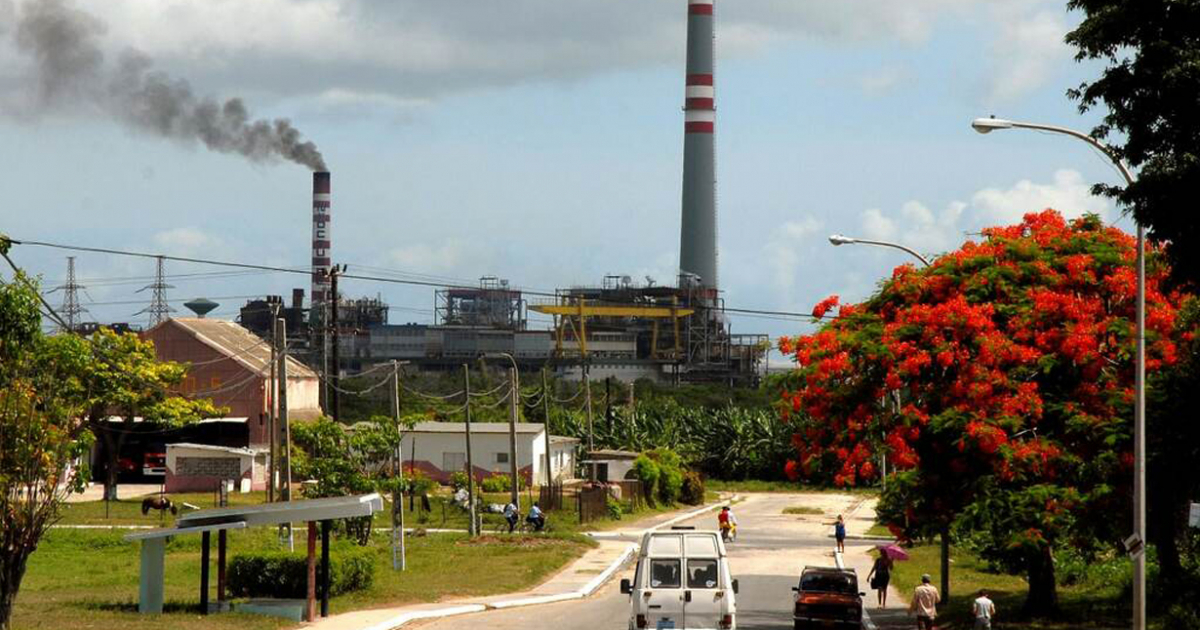
On Saturday afternoon, Unit 1 of the Lidio Ramón Pérez thermoelectric plant (Felton) reconnected with Cuba's National Electric System (SEN). However, just minutes earlier at 3:17 PM, Units 3 and 5 of the CTE Antonio Maceo plant (Renté) in Santiago de Cuba had gone offline.
According to the Electric Union (UNE), the Renté plant suffered a boiler leak, exacerbating the already fragile power generation situation in Cuba.
Earlier that day, Felton had also been taken offline, further highlighting the government's failure to maintain even a minimally stable energy infrastructure.
The Felton Plant's Ongoing Struggles
The UNE reported on its Facebook page that at 9:00 AM, Unit 1 was shut down due to "high temperature in the bearing," a malfunction affecting a critical component of the generation system. Although the official report was brief, users themselves described the severity of the issue.
One user explained that the bearings support the turbine shaft, allowing it to spin at high speed. A failure requires disassembly, adjustment, cleaning, and maintenance of these components. Another user bluntly stated that such repairs "take at least 20 days," indicating a lengthy period of instability.
National Grid Under Pressure
While Felton faced operational challenges, the SEN remained under significant operational stress. The UNE predicted a 1,685 megawatt (MW) deficit during peak hours on Saturday, following days of ongoing issues and a generation capacity unable to meet national demand.
This marked the fifth consecutive day where the projected shortfall exceeded 1,600 MW, highlighting the structural crisis of the electrical system and the persistence of prolonged blackouts across the country.
On Friday, the SEN also operated at its limit, with disruptions lasting 24 hours. The UNE reported that the deficit reached 1,707 MW at 6:10 PM, confirming a scenario where demand far outstrips available capacity, with no immediate recovery in sight.
Public Frustration and Criticism
The figures released on November 22 reveal a system struggling to meet even the country's minimum demand. At 6:00 AM, availability was only 1,605 MW against a demand of 2,320 MW, leaving 732 MW offline due to capacity deficits, not accounting for potential new failures.
In response, many social media users directly attribute the situation to decades of improvisation and propaganda, instead of serious state planning. One user succinctly captured the general sentiment, stating that Cuba is "far, far from having a stable national electro-energy system, not now, not in 10 years, not in 50."
Others criticized the government's persistent portrayal of photovoltaic energy as a miracle solution, cautioning that if the government continues to rely on it as the sole answer, the situation might worsen, according to consulted specialists.
In this context, the fact that Felton 1 managed to synchronize again while Antonio Maceo lost two units due to a boiler leak underscores the SEN's extremely fragile balance. Each time a major thermoelectric plant goes online or offline, new cycles of blackouts ensue, leaving the Cuban population resigned to delayed repairs and UNE's announcements as part of a repeated script of unsolved electrical crises.
Understanding Cuba's Power Crisis
What caused the shutdown of the Renté plant?
The Renté plant was shut down due to a boiler leak, contributing to the precarious power generation situation in Cuba.
How long might repairs at the Felton plant take?
Repairs at the Felton plant could take at least 20 days, as indicated by users familiar with the technical requirements of the necessary fixes.
Why is Cuba's National Electric System under significant stress?
Cuba's National Electric System is under stress due to a combination of structural deficiencies, high demand, and insufficient capacity, leading to frequent power outages.
What is the public's perception of the government's energy policies?
The public largely criticizes the government's energy policies, attributing the crisis to decades of poor planning and reliance on ineffective solutions like photovoltaic energy.