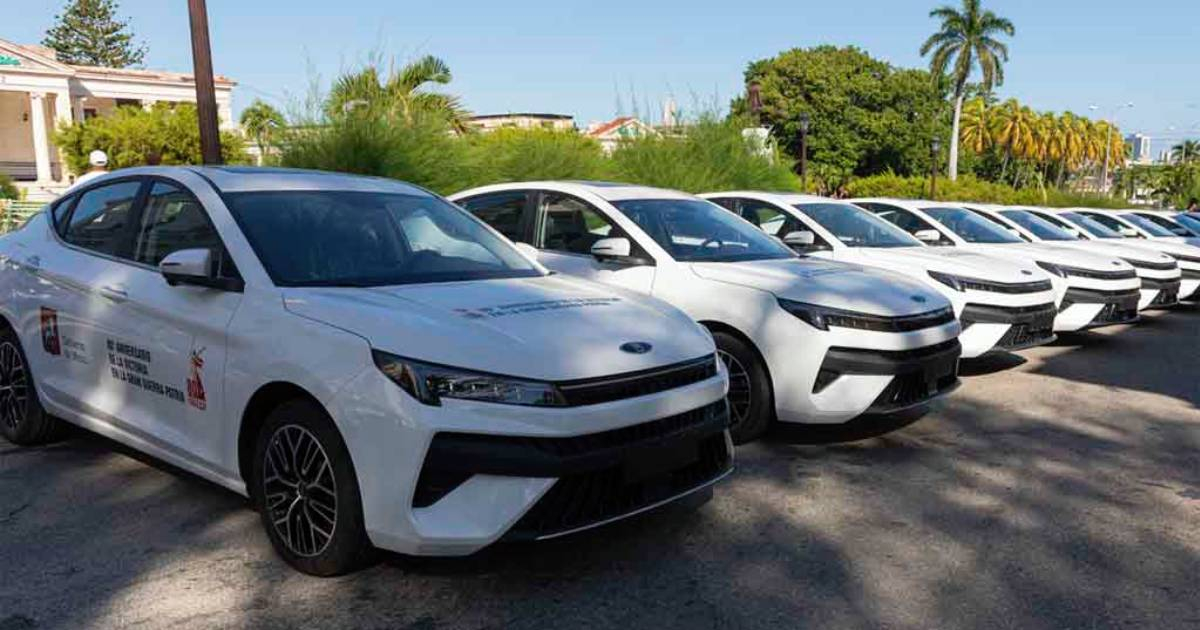
This week, a batch of 10 Moskvich cars, gifted by Moscow to the Cuban government, has started making its way through the streets of Havana, local authorities have confirmed.
Labeled by the state media as a gesture of "solidarity and brotherhood," this donation comes at a time when Havana is experiencing one of the most severe collapses of public transportation and state infrastructure in decades.
The vehicles were initially offered in May by Moscow's Mayor, Serguéi Sobianin, during a visit by Cuba's appointed president, Miguel Díaz-Canel, to the Moskvich automobile plant. This factory, originally Soviet and recently reactivated with state control and Chinese technological assistance, was highlighted by Prensa Latina.
During the handover ceremony at the Salvador Allende Hospital, Havana's governor, Yanet Hernández, expressed gratitude for the Kremlin's "solidarity gesture," stating that the vehicles will support Maternal and Child Care programs and logistical needs in health and education systems in the capital.
The donation—just ten cars—will be allocated to the ministry amidst reports of a complete breakdown of the Cuban healthcare system.
According to state media, the delivery of the Moskvich cars is part of the "strategic cooperation" between the two governments, marking the 65th anniversary of diplomatic relations between Cuba and Russia.
The first counselor of the Russian embassy in Havana, Serguei Pakhomenko, stated that this gift reaffirms the "brotherhood between the peoples," though he refrained from discussing the economic and military interests that Moscow has ramped up on the island in recent years.
Another Russian diplomat, Vitaly Sprinchan, mentioned that the new Moskvich cars symbolize "the revival of the Russian automotive industry," a sector hit hard by international sanctions following the Ukraine invasion. He also noted the continued high demand for Russian vehicles in Cuba, where Soviet-era models from the 70s and 80s are still in use.
In recent years, Russia has supplied Cuba with hundreds of utility vehicles, including more than 400 GAZelle minibuses, 300 Lada cars, 2,000 Kamaz trucks, and several UAZ models, primarily for tourism or state entities rather than public transport.
Meanwhile, Cubans continue to grapple with a structural mobility crisis, exacerbated by fuel shortages, a deteriorating vehicle fleet, and corruption within transportation companies.
Key Aspects of Russian-Cuban Vehicle Collaboration
What is the significance of the Moskvich car donation to Cuba?
The donation of Moskvich cars is seen as a gesture of solidarity from Russia to Cuba, aimed at supporting essential services amidst a severe transportation crisis in Havana.
How does the donation fit into the larger context of Russian-Cuban relations?
The car donation is part of broader strategic cooperation between Russia and Cuba, celebrating 65 years of diplomatic relations and highlighting ongoing economic and military interests.
Why are Russian vehicles in high demand in Cuba?
Russian vehicles are in demand due to their durability and the longstanding presence of Soviet-era cars in Cuba, which creates a familiarity and reliance on these models.