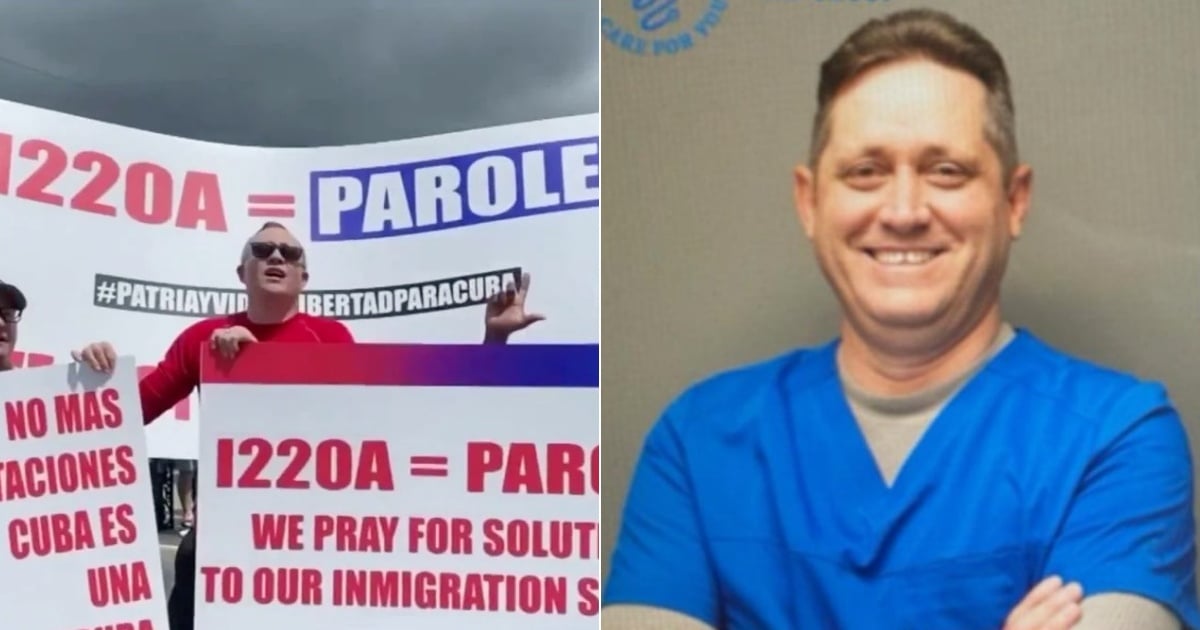
The escalating migration crisis faced by thousands of Cubans in the United States has once again come to the forefront with a recent detention that has caused alarm.
Dr. Miguel A. Alba, a healthcare professional, was apprehended by the U.S. Immigration and Customs Enforcement (ICE) on November 4th in Houston, Texas, during what was supposed to be a routine check-in with immigration authorities.
Alba is one of many Cuban migrants who entered the U.S. under the I-220A status—a type of supervised release without parole—who, despite living stable lives with no criminal records and employment, now face potential deportation.
Arriving in the U.S. in 2022, Miguel A. Alba had begun rebuilding his life. He worked as a medical assistant in a clinic and lived with his wife, also a doctor, and their three young children, all of whom are legal residents in the country.
In a heartfelt message to Univision journalist Javier Díaz, his wife expressed her distress: “We always say everyone is good, but he is special and an exemplary father. My children are suffering greatly.”
The Journey Before the Detention
Prior to his immigration, Miguel was part of a medical mission in Brazil, which he chose to leave voluntarily. This decision resulted in sanctions within Cuba's public health system, where he never practiced again.
Univision’s Díaz, known for covering many similar cases, asked a critical question: “Why did the United States allow these families to enter only to deport them after years of living here?”
He further noted the contradiction, stating, “While the U.S. condemns the exploitation of Cuban doctors, and although the Cuban Parole program is suspended, in Florida, under the organization 'Solidaridad sin Fronteras,' Governor Ron DeSantis approved SB7016, allowing doctors to complete residency periods to practice in the state.”
Federal Policy Contradictions
Despite local advancements, detentions like Alba’s highlight severe contradictions within federal immigration policy.
Previously, in June, Cuban doctor José Enrique Batista Méndez was detained by ICE in San Antonio, Texas, and remains in custody. His asylum request was denied, leaving deportation to Cuba looming over him.
His mother from Cuba sent a poignant message to Díaz: “I am a suffering Cuban mother, Javier.” José Enrique had also started integrating into the U.S. medical system with assistance from 'Solidaridad sin Fronteras.'
The I-220A Dilemma
Both Alba and Batista were admitted under the I-220A form, an administrative tool used by ICE to release certain migrants under supervision while their cases proceed. However, this status is not equivalent to parole, leaving many Cubans in a legal limbo.
Immigration attorneys have pointed out that many judges lack an understanding of Cuba’s complex context. One lawyer remarked, “Judges in other states don’t even know where Cuba is on the map or are unaware of its political situation.”
The absence of a solid legal status, coupled with increasingly restrictive policies, has made those with an I-220A easy targets for detention and deportation, despite having committed no crimes or posing any threats.
ACLU's Intervention: A Ray of Hope
In response to this predicament, the American Civil Liberties Union (ACLU) has stepped in to support Cubans with I-220A, filing an Amicus Brief with the Eleventh Circuit Court of Appeals in Atlanta. This legal document supports an appeal against the decision in the Matter of Cabrera, where the Board of Immigration Appeals (BIA) ruled that I-220A holders do not qualify as parole, blocking their path to legal residency under the Cuban Adjustment Act.
The ACLU's intervention follows a public campaign that gathered over 50,000 signatures, largely driven by Cuban migrants through social media platforms like TikTok.
While the hearing is set for December and an immediate decision is not anticipated, the backing of an organization with the ACLU’s legal and symbolic weight has breathed new hope into thousands of families.
Meanwhile, detentions persist. Cases like Miguel A. Alba’s continue to occur, highlighting the inconsistencies of a system that initially permits migrants to enter, only to later threaten them with expulsion without clear or fair processes.
The ACLU’s involvement not only signifies a legal milestone but also mirrors the growing consensus on the need to reform the mechanisms governing the immigration status of thousands of Cubans. For many, it is more than a legal issue; it is a fight for the right to live freely without fear of being returned to the oppressive regime they fled.
Key Questions About Cuban Migrants and I-220A Status
What is the I-220A status for Cuban migrants?
The I-220A status is a form of supervised release used by ICE for certain migrants, allowing them to stay in the U.S. under supervision while their immigration cases proceed. However, it does not grant parole and leaves many in a precarious legal situation.
Why are Cuban doctors like Miguel A. Alba targeted by ICE?
Despite having no criminal records and contributing to the U.S. healthcare system, Cuban doctors with I-220A status are targeted due to their lack of a solid legal status, making them vulnerable to detention and deportation under current immigration policies.
How is the ACLU helping Cuban migrants with I-220A?
The ACLU has filed an Amicus Brief with the Eleventh Circuit Court of Appeals to support the appeal against the decision that blocks I-220A holders from obtaining legal residency under the Cuban Adjustment Act, offering legal backing and hope for affected families.