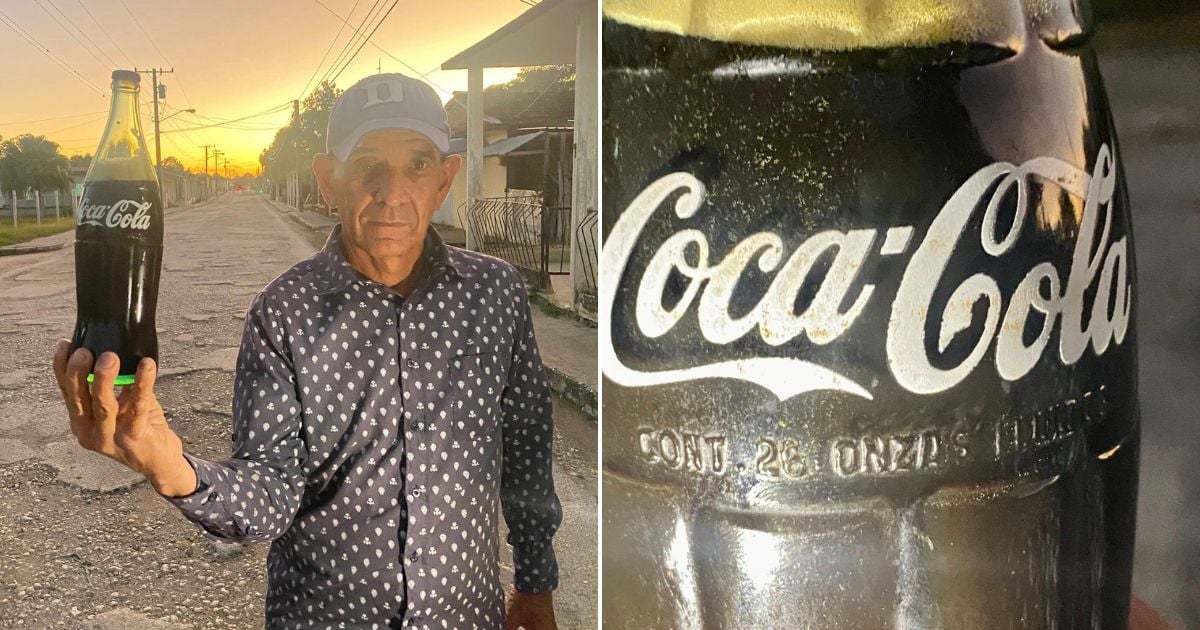
This past Wednesday, social media was abuzz with a fascinating discovery: an unopened Coca-Cola bottle from the 1950s has been preserved in Fomento, Sancti Spíritus.
Shared by Yois Cárdenas on Facebook, the find has amazed many due to the pristine condition of the glass container. It still bears its original logo and the drink’s distinctive color.
The bottle is owned by Carlos Manuel Triana Gómez, who has treasured it as a relic for decades. He recounted that back in the day, the drink was priced at 25 cents, making it a luxury item accessible to few.
“It’s never been opened; there might not be another like it in the country with its original packaging,” Cárdenas noted while showcasing the images on social media.
Still containing the liquid and featuring an embossed label, the bottle is a testament to mid-20th-century industrial design and popular culture.
A Glimpse into the Past
In an era where almost everything is recycled, this untouched specimen harks back to times when Coca-Cola was among the simple pleasures of pre-revolutionary Cuba.
More than just a curiosity, this bottle serves as a time capsule, surviving over seventy years, untouched, on a shelf in Sancti Spíritus.
In 2024, it was revealed that a Coca-Cola advertisement, despite efforts to erase it, still adorned a building wall in Santa Clara, Villa Clara province.
Coca-Cola: A Symbol of Change
Among Cuban emigrants, Coca-Cola has evolved into a poignant symbol of transformation and separation. It's no longer just a beverage; it represents the adaptation to new realities and the inevitable pain of leaving home behind.
A young Cuban woman in the United States recently discussed this topic, sharing her journey amidst accusations of forgetting her roots.
In her account, she clarified that drinking the "Coca-Cola of forgetfulness" is not a betrayal—it's a way to emotionally survive amid new responsibilities, demanding jobs, and the inevitable distance.
Similarly, a Cuban expatriate in Brazil defended the right to change, admitting that after nearly a decade away, she no longer misses her homeland because she has reunited her family abroad.
For her, the "Coca-Cola of forgetfulness" is a powerful metaphor that encapsulates what many remain silent about: loving Cuba doesn’t mean being shackled to the pain. Her reflections resonated with thousands of emigrants who have felt guilt for moving forward and prioritizing their well-being in less hostile environments.
Another revealing incident occurred in Uruguay when a newly arrived Cuban was filmed drinking a Coca-Cola with deep emotion. In the video shared by family, he expressed that the drink was more than just a soda; it was a confirmation that his life had changed.
Sitting in a foreign kitchen but free, with tears in his eyes, the young man admitted he never thought a bottle of Coca-Cola could move him so much.
Exploring the Emotional Impact of Coca-Cola on Cuban Emigrants
Why is the Coca-Cola bottle from the 1950s significant in Cuba?
The unopened Coca-Cola bottle from the 1950s is significant because it is a well-preserved relic that offers a glimpse into the industrial design and popular culture of pre-revolutionary Cuba. It symbolizes a time when Coca-Cola was a luxury item.
How has Coca-Cola become a symbol for Cuban emigrants?
For Cuban emigrants, Coca-Cola has become a symbol of transformation and the emotional challenges of adapting to life abroad. It represents the process of leaving behind old realities and embracing new ones, often carrying deep emotional significance.
What does the term "Coca-Cola of forgetfulness" imply among Cuban emigrants?
The term "Coca-Cola of forgetfulness" implies a metaphorical way of coping with the emotional challenges faced by Cuban emigrants. It signifies the ability to move forward and adapt emotionally without feeling tied to the past or guilty for embracing new opportunities.