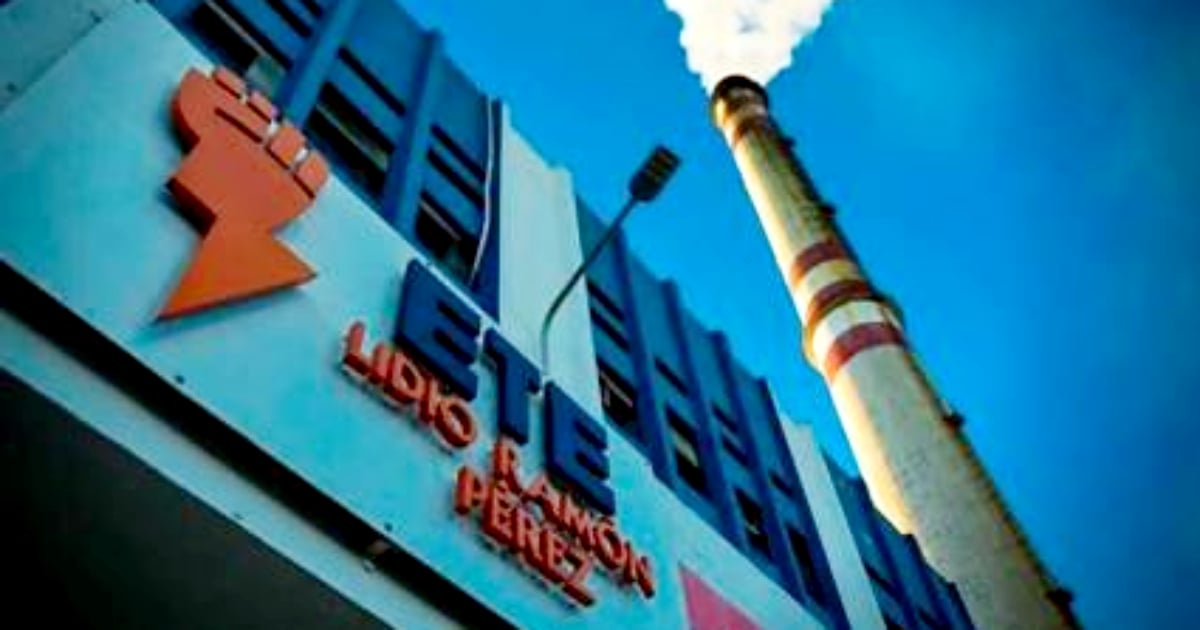
The National Electrical System (SEN) in Cuba faced another dire situation on Wednesday when Unit 6 of the Renté Thermoelectric Power Plant in Santiago de Cuba went offline. The shutdown was attributed to a "leak in the economizer on the left side," according to an official statement from the Electric Union (UNE).
By 7:00 PM, the state-run company's evening report indicated that the system's available capacity was 1,270 megawatts (MW), while demand reached 3,202 MW, creating a shortfall of 1,930 MW. This deficit led to widespread power outages across nearly the entire country during peak hours.
Additionally, UNE announced a "technical shutdown" at the Energas Puerto Escondido plant in the western region, emphasizing that this measure was necessary "to ensure operational safety."
Bernardo Espinosa, a journalist aligned with the government, explained that this intervention was part of the annual maintenance required for gas processing systems, which are crucial for both electricity generation and the supply of household gas to Havana.
The company did not specify how long the maintenance at Energas would last or when the Renté unit might return to service. However, it is anticipated that the disruptions could remain significant in the coming days.
The Blame Game: Independent Media Takes the Hit
As the SEN grapples with escalating tensions and deficits exceeding 1,800 MW, the situation marks one of the most challenging periods of the year. The Cuban government attributes these failures to technical issues and fuel shortages, yet citizens continue to endure extended blackouts, with some areas experiencing power cuts exceeding 18 hours per day.
While UNE claims it conducts "scheduled maintenance" to uphold system stability, constant breakdowns at Renté, Felton, Guiteras, and Mariel highlight the structural decay of Cuba's thermoelectric infrastructure, which has suffered from decades of neglect and inadequate maintenance.
In any other country, a deficit nearing 2,000 MW would be a national scandal. However, in Cuba, it's just another daily report. What's even more striking than the blackout itself is the regime's ability to deflect responsibility onto others.
As Renté shuts down due to a leak and Energas takes a break to maintain "operational safety," state propaganda ironically points the finger at El Toque, an independent outlet that publishes informal market exchange rates.
The Cuban regime seems to have found its scapegoat in El Toque, almost implying that the collapse of the electrical grid can be blamed on a website that reports the dollar's value, rather than on a government that has let the national power system deteriorate through technological obsolescence and lack of investment.
According to the government's logic, if the dollar rises, gas leaks; if the euro falls, a transformer fails; if El Toque publishes exchange rates, the current vanishes. So, if tomorrow starts with no electricity, we know who to blame: that journalist wielding an Excel sheet and a mischievous algorithm casting darkness over the island.
The Semantics of a Failing System
Meanwhile, UNE releases statements filled with emojis and technical jargon like "three-stage intervention" or "gas processing," as if the problem were semantic rather than a collapse in power generation, with clear accountability resting with the government.
Every "technical shutdown" is effectively a blackout masquerading as maintenance, and each "service disruption" is a euphemism the government uses to avoid stating the truth: the system is broken. There is no investment, no modernization, and fuel shortages stem not from any blockade, but from mismanagement and rampant corruption.
Ironically, in official Cuba, electricity doesn’t depend on petroleum but on rhetoric. If there’s a blackout, an ideological culprit is sought; if there’s protest, slogans are the response. Yet, slogans offer no illumination, and speeches fail to light bulbs.
UNE promises to "restore system stability," while the population becomes adept at predicting blackout schedules more accurately than the utility dispatchers themselves. In this daily darkness, the regime finds its perfect metaphor: a nation left in the dark, governed by those who cannot tolerate the light that arises from truth.
Understanding Cuba's Power Crisis
What caused the recent power outages in Cuba?
The recent power outages were caused by a combination of a leak at the Renté Thermoelectric Power Plant and a technical shutdown at the Energas Puerto Escondido plant, resulting in a significant shortfall in power supply.
How is the government responding to the power crisis?
The government attributes the power issues to technical failures and fuel shortages, while the Electric Union (UNE) claims to conduct scheduled maintenance to stabilize the system. However, there is widespread criticism of the government's failure to invest in and modernize the energy infrastructure.
What role does independent media play in this situation?
Independent media, like El Toque, have been scapegoated by the government, accused of being responsible for the power issues by merely reporting market exchange rates. This deflection serves to shift blame away from the government's mismanagement.