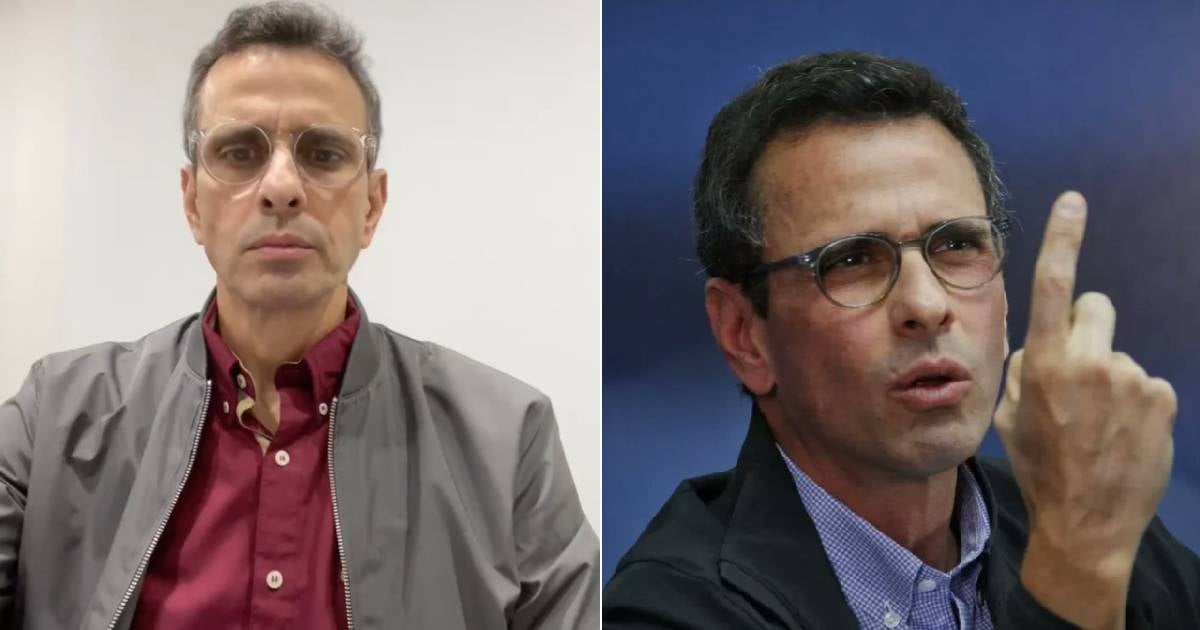
Venezuelan opposition leader Henrique Capriles, who lost two presidential elections to the ruling party—first in 2012 against the late Hugo Chávez and then in 2013 against Nicolás Maduro—and was subsequently barred from political participation by the regime, proposed on Wednesday that there should be direct negotiations between the dictator and U.S. President Donald Trump.
During a live broadcast on his account on X, Capriles asserted that resolving his country's crisis necessitates a dialogue between those who truly hold power: "There must be a negotiation process... This has to be between the Trump Administration and Mr. Maduro, who holds territorial control, institutional power, and military support."
His statements come amid escalating diplomatic tensions following the U.S. military's deployment in the Caribbean, which Washington describes as an anti-drug strategy, while Caracas perceives it as a "threat."
Potential Talks as Tensions Rise
Last Sunday, Trump mentioned the possibility of discussions with Maduro, saying, "Venezuela wants to talk," and on Friday, he announced having made a decision—yet undisclosed—regarding potential actions against the oil-rich nation, according to EFE.
Maduro, in turn, stated on Monday that he is open to a "face-to-face" meeting with his American counterpart.
In light of this scenario, Capriles argues that direct negotiation should address crucial issues, including Venezuela's severe economic and humanitarian crisis, as well as the release of all political prisoners, despite Maduro's denial of their existence, claiming "they are all criminals."
"Changing the head of the Executive tomorrow would result in absolute chaos," Capriles emphasized, insisting that the crisis extends beyond merely replacing the president.
Military Tensions in the Caribbean
Since August, the White House has maintained a significant air and naval presence in the Caribbean, involving the largest U.S. aircraft carrier. Washington asserts this is an operation against drug trafficking, while Maduro's regime interprets it as an attempt at "regime change."
On Monday, Maduro warned that a military strike against Venezuela would signify Trump's "political end." Trump countered by stating "all options are on the table."
Adding to the tensions, the U.S. State Department has designated the Cartel of the Suns, a group linked to Maduro and high-ranking Venezuelan military officials, as a foreign terrorist organization. Caracas dismisses this as "fabrication."
Capriles' Historical Call for Dialogue
Capriles’ call for negotiations does not go unnoticed. The politician has faced:
- Defeat in the 2012 presidential election against Chávez, amid contested results.
- A second loss in 2013 to Maduro, surrounded by widespread allegations of electoral fraud.
- Political disqualification by the regime in 2017, barring him from competing.
His current plea—for direct negotiations between the United States and Maduro—is viewed by some as a pragmatic move in an extreme context, while others see it as a concession to a regime that persecuted, marginalized, and denied him a fair political playing field.
Key Questions about Venezuela's Political Climate
Why is Henrique Capriles advocating for talks between Trump and Maduro?
Capriles believes that direct negotiations between those in power, specifically Trump and Maduro, are necessary to resolve Venezuela's ongoing crisis and address critical issues like the economic and humanitarian conditions.
What is the U.S. military presence in the Caribbean about?
The U.S. military's deployment in the Caribbean is described by Washington as part of an anti-drug strategy, although the Maduro regime sees it as a potential threat to its sovereignty.
How has the Maduro regime responded to U.S. actions?
Maduro has expressed a willingness to engage in direct talks with Trump, despite perceiving the U.S. military actions as a threat, and warned that a military strike could end Trump's political career.