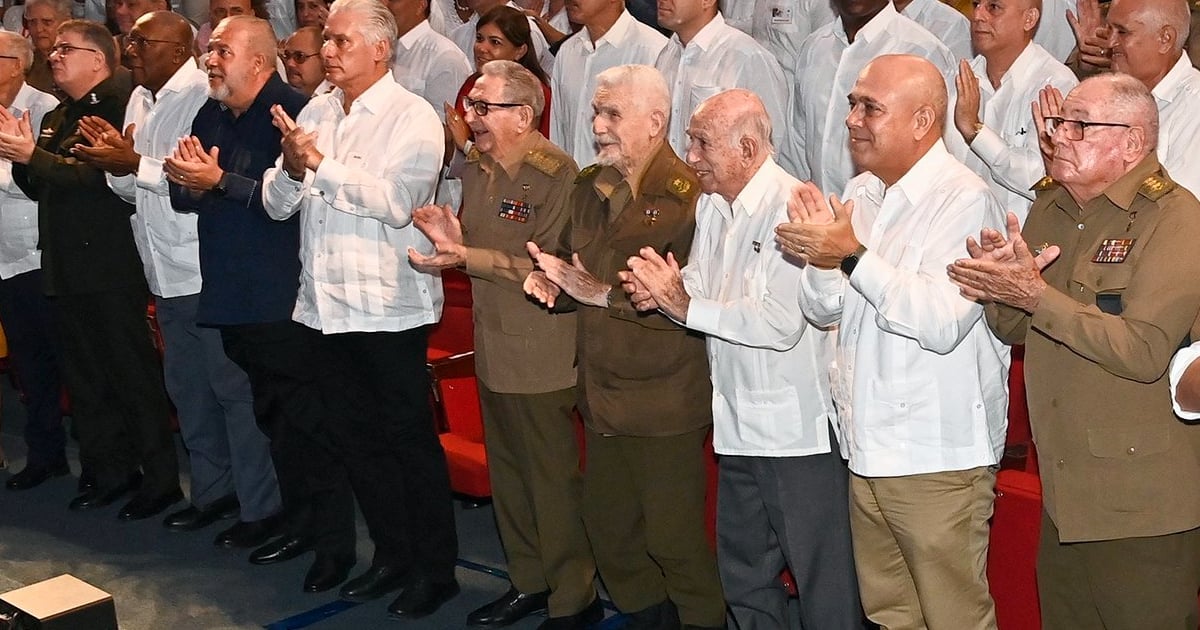
The Cuban regime, renowned for its meetings that yield little progress, announced on Monday the upcoming XI Plenary Session of the Central Committee of the Communist Party (PCC), set for December 12 and 13.
As shared by the PCC on the social media platform X, the session is intended to discuss “significant matters concerning the nation's socioeconomic and political life.” This promise starkly contrasts with the reality of an island grappling with mosquito-borne diseases, frequent power outages, and the aftermath of Hurricane Melissa.
Amid a national health alert—with thousands suffering from dengue and chikungunya, hospitals overwhelmed, and widespread fumigation failures—and as Santiago de Cuba and several eastern provinces are just beginning to recover from the cyclone's impact, the regime has chosen to launch yet another series of internal meetings, ideological debates, and controlled self-criticism exercises that, based on past experiences, do not offer genuine solutions.
Predictable Meetings with No New Outcomes
Starting November 15, the PCC and its affiliated organizations (UJC, CTC, ANAP, FMC, CDR, FEU) began a national "debate" process focused on the so-called Government Program aimed at correcting distortions and reinvigorating the economy.
This process encompasses meetings within Party cells, municipal assemblies of Popular Power, gatherings at workplaces, videoconferences with regions unaffected by the hurricane, and seminars for officials and cadres.
All of this unfolds while countless Cubans continue to live amid debris, mosquitoes, 12-hour power outages, and a total lack of medicines.
Empty Promises of "Correcting Distortions"
The government’s plan, now subject to "public discussion"—presented by Granma as a roadmap to overcome the crisis—is essentially another recycled version of programs announced since the Monetary Order collapse.
Rather than stabilizing the economy, this restructuring destroyed purchasing power, exacerbated inflation, and accelerated mass migration.
Despite Prime Minister Manuel Marrero's claims of "updating 39 specific objectives," the government fails to provide a single piece of data demonstrating real improvements: inflation soars, the peso continues to depreciate, agricultural production is at a historic low, the power generation remains in crisis, and essential imports are stalled due to a lack of liquidity.
An Exhausted Nation and a Disconnected Government
For the Cuban populace, weary of unfulfilled promises, the PCC’s XI Plenary Session is viewed as yet another propaganda exercise.
While leaders engage in discussions in air-conditioned rooms, Santiago de Cuba has restored only 34% of its electrical service post-Hurricane Melissa, and waste piles and micro-dumps proliferate in Havana and other provinces.
Moreover, the health crisis is worsening, with tens of thousands of chikungunya cases reported by MINSAP. Pharmacies remain empty, and power outages peak at over 1,500 MW of deficit.
All of this occurs as the Party insists on "correcting distortions" without addressing the core cause of the national collapse: a centralized economic model and the absence of productive freedoms.
The XI Plenary of the PCC, like those before, promises analyses, diagnoses, quiet self-criticisms, and new slogans. However, there is no indication of structural changes, profound reforms, or accountability being on the horizon.
As the nation faces a triple storm—a spiraling health crisis, a natural disaster leaving thousands displaced, and a chronic economic collapse with no signs of improvement—the question looms: Is anyone in the Palace of the Revolution prepared to discuss real solutions, or will it all just boil down to more meetings, more speeches, and more slogans?
Frequently Asked Questions About the Cuban Crisis
What is the purpose of the XI Plenary Session of the Cuban Communist Party?
The XI Plenary Session is intended to discuss significant socioeconomic and political issues facing Cuba, though past sessions have been criticized for failing to produce real solutions.
How is the health crisis in Cuba affecting the population?
Cuba is currently experiencing a major health crisis with thousands of cases of dengue and chikungunya, overwhelmed hospitals, and inadequate fumigation efforts.
What are the main criticisms of the Cuban government's current economic plan?
Critics argue that the economic plan, which is a rehashed version of past initiatives, fails to address the core issues of inflation, currency devaluation, and lack of productive freedoms.