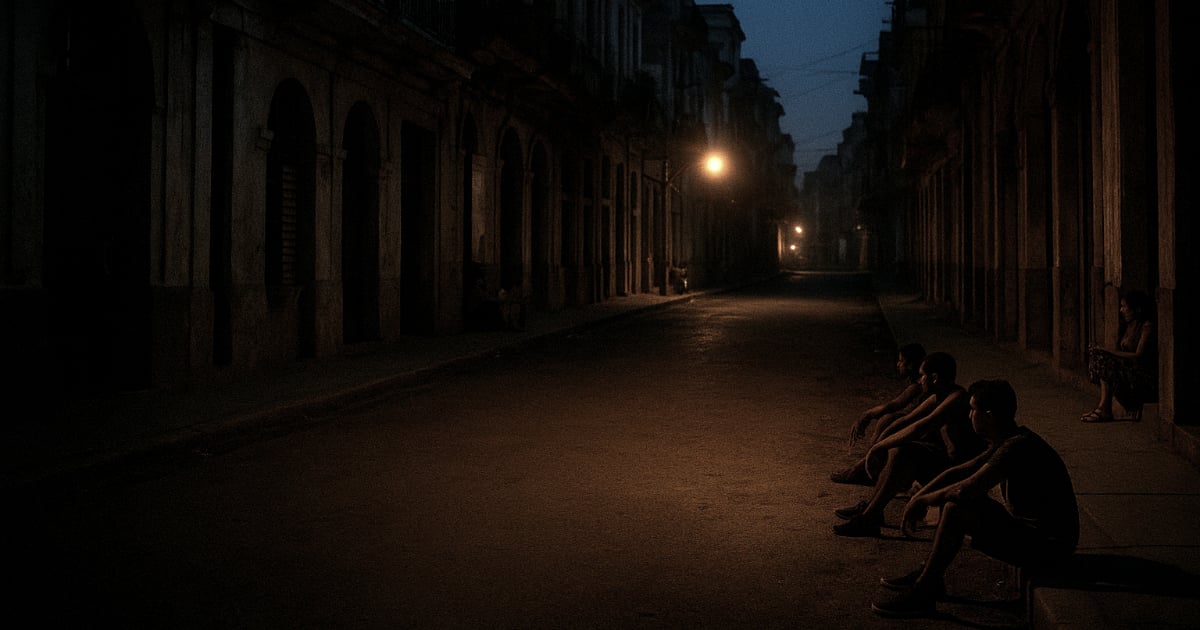
This Sunday, Cuba awoke to yet another round of relentless blackouts, underscoring the severe deterioration of the nation's National Electric System (SEN) and the government's inability to halt a crisis that has worsened over the years.
The report from the Cuban Electric Union (UNE) paints a familiar picture: power outages exceeding 20 hours, a structural deficit, and power plants failing faster than the state can repair them.
On the previous day, the nation was nearly without service from 5:10 a.m. to 2:07 a.m. the following day. Just three hours later, at 5:44 a.m., the supply was interrupted once again.
The maximum impact due to insufficient generation capacity reached 1,326 MW at 6:40 p.m.
A Nation in the Dark
The passage of Hurricane Melissa resulted in an additional 144 MW being affected in the provinces of Holguín, Granma, and Santiago de Cuba. Meanwhile, Granma faced another 50 MW loss, and Guantánamo 20 MW, due to high transfers and low voltage in the area.
For millions of Cubans, this means another day without refrigeration, pumped water, electric transportation, and other essential services that rely on a crumbling system.
System Unable to Meet Even Basic Demand
This morning, the real availability of SEN was 1,550 MW against a demand of 1,840 MW. This gap—highlighting the shortfall between the electricity Cuba can produce and what it needs for basic functionality—already resulted in a 400 MW early impact.
By midday, interruptions are expected to reach 750 MW.
This deterioration isn't just a temporary issue or the result of Hurricane Melissa. The majority of the collapse stems from accumulated failures, outdated technology, and a lack of sustained investments.
Thermal power plants, the backbone of national generation, remain out of action. Four units are still broken: two at Renté (Antonio Maceo), one at Felton, and another at Nuevitas.
Additional maintenance on blocks at CTE Santa Cruz and CTE Carlos Manuel de Céspedes in Cienfuegos, poorly planned, has left the nation without backup.
Even the plants expected to withstand demand have chronic limitations, reducing their power output daily.
A Country Stalled by Fuel Shortages
The UNE report includes a stark figure: 802 MW are offline due to a lack of fuel and lubricants. This means nearly one-third of what the country needs during peak hours isn't generated because the state lacks basic operational supplies.
More than 80 distributed generation plants, crucial for stabilizing the SEN, are either halted or producing minimally. An additional 109 MW are down due to lubricant shortages.
This energy shortfall isn't unexpected; it directly results from years of improvisation, excessive reliance on low-quality domestic crude, and international agreements failing to secure steady supplies.
An Unmanageable Nighttime Peak
The UNE announced the "planned" entry of Renté unit 6, contributing 45 MW—a negligible amount compared to the scale of the issue.
With this minimal recovery, peak hour availability would be 1,595 MW against a demand of 3,000 MW, resulting in a 1,405 MW gap and a real impact of 1,475 MW.
In practical terms, this means over half the nation will be without power during peak consumption hours when families attempt to cook, pump water, or simply rest.
Despite the government's attempts to present solar parks as a success—31 installations contributed 2,452 MWh the previous day—this production only minimally offsets the structural deficit and doesn't compensate for the decline of the thermal system or fuel shortages.
Havana: A False Sense of Normalcy
The Havana Electric Company reported that the capital endured 9 hours and 45 minutes of blackouts on Saturday, with a maximum of 140 MW affected.
Although service was restored before 9:00 p.m. and there were no cuts overnight, this relative "normalcy" is not representative of the country. Havana is often the last to lose power and the first to recover, but stability is nearly nonexistent elsewhere.
A Crisis Fueled by Inefficiency
Beyond the technical figures, this report exposes an electric system that has become a ticking time bomb.
There are more plants out of order than operational, more fuel absent than available, and more official promises than concrete solutions.
The government continues to speak of "temporary disruptions," yet Cubans have endured a crisis that is no longer temporary: it is structural and a direct result of poor management.
The UNE issues daily reports, but fails to offer a realistic strategy or credible timeline for restoring the SEN.
Meanwhile, the population faces reality without alternatives: food spoiling, children unable to sleep from heat, patients without functional medical equipment, and an economy at a standstill.
Cuba isn't merely suffering from blackouts; it's experiencing the progressive collapse of its energy system, a crisis that cannot be resolved with official statements or minor solar contributions, but with profound decisions the government has been unable to make.
Understanding Cuba's Energy Crisis
What is causing the frequent power outages in Cuba?
The frequent power outages in Cuba are primarily due to the deteriorating condition of the National Electric System, outdated technology, lack of sustainable investments, and fuel shortages.
How does the government plan to address the energy crisis?
The government has yet to provide a realistic strategy or timeline to address the energy crisis effectively, focusing instead on temporary measures and official statements that do not tackle the root causes.