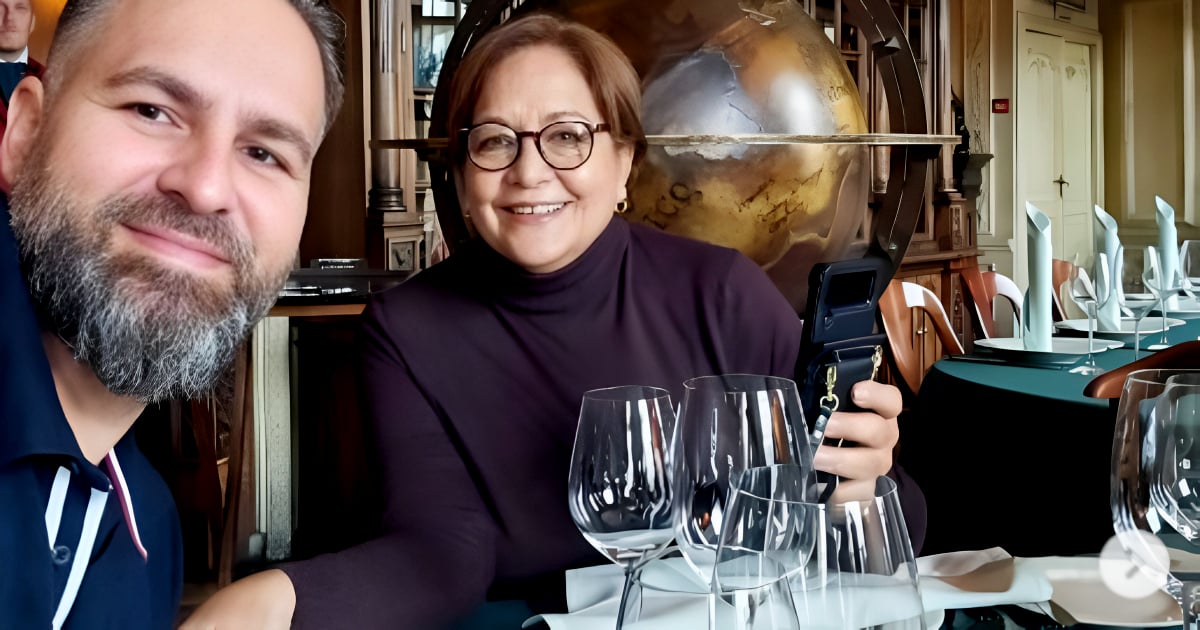
In Cuba's media landscape, tightly controlled by the socialist regime, few figures epitomize the essence of modern propaganda like Arleen Rodríguez Derivet.
With a long-standing career in state media—serving as a voice on Radio Rebelde, hosting the 'Mesa Redonda', writing columns for Cubadebate, and leading the podcast 'Chapeando Bajito'—Rodríguez Derivet has emerged as the primary narrative architect for the government.
Her role transcends mere reporting; it involves reshaping the story: clarifying, softening, and justifying the missteps of the appointed leader, Miguel Díaz-Canel.
The Confidante and Communication Shield
Díaz-Canel has publicly referred to her as “my companion through the ages” and “soul sister.” She has interviewed him several times on the program ‘Desde la Presidencia’, where the line between institutional communication and outright propaganda blurs completely.
In that setting, Rodríguez Derivet acts more as an image consultant than a journalist: she guides the leader’s responses, offers him favorable context, and portrays him as a compassionate, human figure surrounded by challenges.
Publicly, Díaz-Canel has acknowledged their closeness. In March 2024, during the ceremony where Rodríguez Derivet received the National Journalism Award “José Martí” for Lifetime Achievement, he described her as “a good person, an exemplary Cuban, a companion, sister, and a true revolutionary.”
He reminisced about their years together in the Union of Young Communists and the Communist Party, saying she “has constructively criticized me and stirred my thoughts and emotions.”
“With Arleen,” he added, “I share a friendship in good times and bad.” This praise confirmed what many already sensed: Rodríguez Derivet is not just a state journalist but an emotional and political member of the innermost circle of power.
The Core of the Communication Machine
Her proximity is no accident. She is part of the core communication team of the Presidency, which includes Leticia Martínez Hernández (head of communication at the Palace of the Revolution), Randy Alonso (director of Cubadebate and host of 'Mesa Redonda'), and Humberto López (face of the program ‘Razones de Cuba’).
Each plays a different role in the propaganda machinery: Hernández designs the strategy, Alonso institutionalizes it, López delivers it with a punitive tone, and Arleen wraps it in humanism. She's tasked with administering the “revolutionary tenderness”: a narrative where power always has noble intentions, and errors are merely tests of sacrifice.
Reinterpreting Disasters
Whenever the official narrative is threatened by discredit or a wave of criticism, Rodríguez Derivet steps in with a sugar-coated version of events.
Her role during the summer 2024 energy crisis was emblematic: she accompanied Minister Vicente de la O Levy on a ‘Mesa Redonda’ where he admitted the failure to prevent blackouts. Rather than challenging him, Rodríguez Derivet steered the conversation to present the crisis as a “collective learning process” rather than evidence of a collapsed infrastructure.
Similarly, when Hurricane Melissa exposed Díaz-Canel’s tone-deaf response to a woman lamenting her lost bed and mattress—his “I don’t have a bed to give you” comment went viral—Rodríguez Derivet responded on ‘Chapeando Bajito’ with a “clarification” aimed at damage control: she published a partial transcript, omitting the video, to claim the leader acted with “deep sensitivity” and honesty, aligning with the official narrative that the clip was “manipulated by enemies of the revolution.”
The “Lis Cuesta Incident” and Defending the Ridiculous
One of her most memorable roles as a damage controller occurred in 2022 when Díaz-Canel's wife, Lis Cuesta Peraza, sparked an uproar on social media with her famous tweet: “The dictator of my heart.”
While most Cubans reacted with disbelief and sarcasm, Rodríguez Derivet defended her on Cubadebate, arguing that Cuesta’s tweet was a display of “revolutionary irony and humor,” a “playful and creative” use of political communication.
For Rodríguez Derivet, the controversy wasn’t a blunder but an opportunity to “enter a new phase in our ways of communicating.” This interpretation set the tone for what followed: the institutionalization of cynicism as a strategy. Whereas official media once clung to dogma, it now experiments with humor, playfulness, and emojis.
Rodríguez Derivet is responsible for giving coherence to this shift in discourse: making the regime’s blunders seem like spontaneous gestures of humanity.
From Palace to Moscow
Her role as a presidential communications operator has also taken her on international delegations. On various trips abroad with Díaz-Canel, Rodríguez Derivet has been seen documenting meetings and official events.
Recently, images of her alongside fellow communicator Oliver Zamora Oria in Moscow—dining in cafes, exploring restaurants, and strolling through Red Square—were widely shared on social media. These pictures showcased the other side of state communication: journalists who, while advocating sacrifices and “resistance” on air, enjoy the privileges their proximity to power affords them.
The Perfect Propaganda Machine
Rodríguez Derivet’s figure encapsulates the evolution of Cuban propaganda in times of crisis. It’s no longer about chanting slogans but managing perceptions: shaping the narrative, reinterpreting facts, and humanizing a system with no democratic legitimacy.
Whenever Díaz-Canel stumbles—be it a poorly chosen phrase, a fallen minister, or an unfortunate tweet—Rodríguez Derivet is there to reconstruct the narrative.
If Humberto López embodies coercion, Randy Alonso the solemn nod, and Leticia Hernández the "strategy," Rodríguez Derivet represents the rhetoric of consolation: the attempt to convince Cubans that the regime’s failures always have an explanation, though never a solution.
In this role, she performs with unwavering discipline. She is not the gentle voice of the regime but its staunch shoulder to cry on: the spokesperson who corrects, defends, and cleans up when the image of the appointed leader is tarnished.
Understanding Cuba's Propaganda Machine
Who is Arleen Rodríguez Derivet in the Cuban media landscape?
Arleen Rodríguez Derivet is a prominent journalist in Cuba's state-controlled media, known for her role in shaping narratives to support the government, particularly Miguel Díaz-Canel.
What is Rodríguez Derivet's role in Cuban propaganda?
Her role involves managing perceptions, reshaping narratives, and portraying the government in a favorable light, often framing setbacks as sacrifices or learning experiences.
How does Rodríguez Derivet handle government criticism?
Rodríguez Derivet often provides a softened version of events, steering conversations to minimize criticism and emphasize perceived positive intentions of the government.