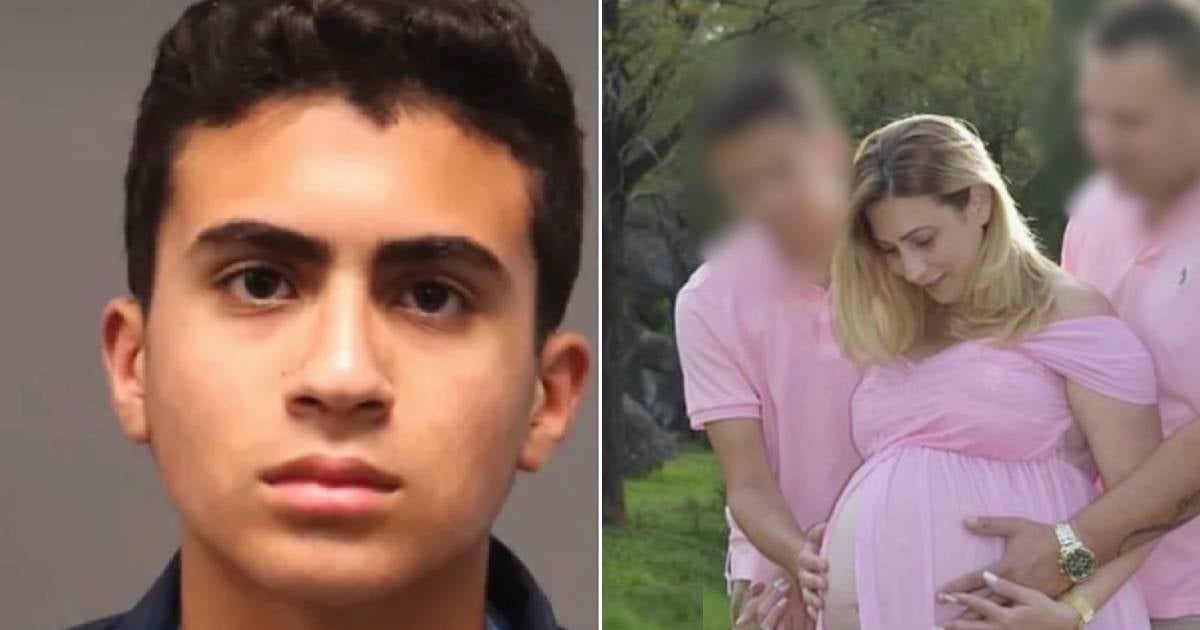
Prosecutors in Florida have requested permission from Judge Richard Hersch to introduce additional evidence in the trial of Derek Rosa, a Cuban teenager accused of murdering his mother in their Hialeah apartment in October 2023.
The motion indicates that moments after the crime, Rosa took photographs of his mother's body, including a selfie with his bloodied hand, and sent them to a friend and a group chat comprising several high school classmates before alerting 911.
The prosecution's document further reveals that two weeks prior to the homicide, Rosa had shown these same students a video depicting a real suicide. He shared the video again on the day of the murder.
When distributing the video in the group chat, he accompanied it with an emoji of a happy face with a gun to its head. Prosecutors argue this demonstrates a "morbid fascination with blood, death, and gore," as well as an intent to shock and disgust his peers.
For the state, these actions shed light on the accused's mental state and his capacity for premeditation on the night he fatally stabbed his mother while she slept.
The prosecution asserts that this pattern of behavior reflects "pride and willingness in his actions," emphasizing that the minor appeared "mocking and playful" both when sharing the suicide video and in messages following the homicide.
Furthermore, they argue that this new evidence will counter potential attempts by the defense to portray the teenager as vulnerable to external coercion or manipulation.
The prosecution's request, submitted to the Eleventh Judicial Circuit Court, seeks to admit what the state describes as "similar facts" under statute F.S. 90.404(2)(a), as well as elements considered "inextricably intertwined" with the crime.
During Wednesday's hearing, it was also confirmed that the trial schedule will remain unchanged.
Judge Hersch reiterated that the trial is set for January and instructed the parties to confirm the availability of defense attorneys for a motion hearing by Friday. If no response is received, the session will be scheduled for November 26 at 10:00 am.
In July, the court approved a defense request to postpone the trial until January 26, 2026, due to the case's complexity, which requires additional time to analyze evidence, prepare legal strategies, and file new motions.
Jury selection is slated for January 20 of the same year, and the judge authorized that neither party could review additional evidence until this November, the deadline for presenting final proofs.
Prosecutors have reiterated their readiness to proceed to trial at any time, asserting that the delay does not weaken their first-degree murder charge.
Rosa was arrested after calling 911 shortly after the crime, at the age of 13. Due to his age, he cannot face the death penalty, but he could be sentenced to life imprisonment or a minimum of 40 years.
The defense has focused part of their strategy on the teen's mental health.
Rosa has been diagnosed with autism and attention deficit disorder, and his attorneys have requested to keep medical records private until the trial. However, Judge Hersch has insisted that the prosecution must have access to this information to ensure a fair trial.
Another active legal front involves the defense's motion to exclude the minor's confession to the police.
According to court documents, the defense argues that the minor was read an incorrect warning regarding his rights, prompting a formal hearing to discuss the legality of the interrogation.
The judge will decide whether the confession, one of the case's most compelling pieces of evidence, will be excluded from the trial or admitted.
This dispute adds to a voluminous case file that includes expert reports, digital records, messages, forensic analyses, and now, the prosecution's new motion to introduce evidence of prior behavior.
The Derek Rosa case, marked by its legal and emotional complexity, is moving towards a trial that could become one of the most closely watched in Miami-Dade County in recent years.
Key Questions Regarding Derek Rosa’s Case
What evidence does the prosecution want to introduce in Derek Rosa's trial?
The prosecution seeks to introduce evidence of Derek Rosa's prior behavior, including sharing photos of his mother's body and a video of a real suicide before the murder, to demonstrate a pattern of fascination with death and gore.
Why is Derek Rosa's confession in question for the trial?
The defense argues that Derek Rosa was given an incorrect warning of his rights during his confession to the police, leading to a formal hearing to determine its legality and whether it should be admitted as evidence in the trial.
What is the defense's strategy in Derek Rosa's case?
The defense is focusing on Derek Rosa's mental health, noting his diagnoses of autism and attention deficit disorder, and has requested that his medical records remain confidential until the trial.
When is Derek Rosa’s trial scheduled to take place?
Derek Rosa's trial is scheduled to begin on January 26, 2026, with jury selection set for January 20 of the same year.