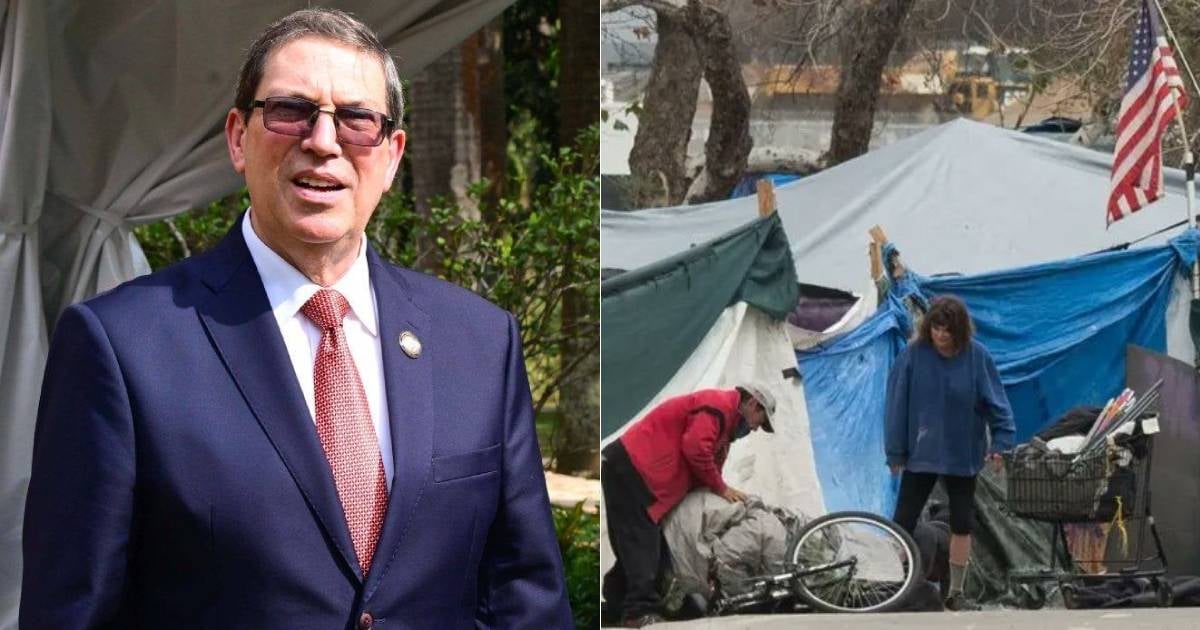
Cuban Foreign Minister Bruno Rodríguez Parrilla took aim at the United States over economic inequality this Thursday. However, the response on social media was a stark reminder of the Cuban government's disconnect from the everyday struggles faced by its own citizens.
On the social platform X, Rodríguez declared that "the U.S. is one of the most unequal countries on the planet," referencing Oxfam statistics concerning American billionaires and the percentage of low-income individuals. His post included an image depicting a homeless encampment in the U.S.
This criticism from the Cuban minister triggered a wave of responses that starkly contrasted the situation in the U.S. with the severe crisis engulfing Cuba.
Many Cubans challenged the regime's "double standards," pointing out that despite issues in the U.S., millions of Cubans rely on that nation for survival. A user highlighted this by saying, “I am poor in the United States and have to support two elderly relatives in Cuba because they can't live on their pensions there,” underscoring the uncomfortable truth that without remittances from these "poor Americans," thousands of elderly in Cuba would go hungry.
Contrasting Realities
Other Cubans noted the irony when Rodríguez speaks of "policies that concentrate power and wealth," as it’s hard to tell if he’s referring to Washington or Havana, where political elites enjoy privileges while most face blackouts, inflation, scarcity, and unlivable wages.
The most frequent rebuttal centered around a straightforward question: if the United States is as unequal as the Cuban government claims, why are the rafts not heading to Cuba?
“The rafts always go from Havana to Miami, never the other way around,” one user remarked. “No one risks their life to escape capitalism, but they do to flee your model.”
Harsh Realities of Cuban Life
Critiques of official propaganda were also prevalent: “Here in Cuba, you can't even afford to be poor; the poor in the United States at least eat decently,” one commentator stated. Another added sarcastically, “In Cuba, everyone is equal: equally poor.”
Even those acknowledging inequality in the U.S. pointed out that the comparison with Cuba is even more heartbreaking. According to one internet user, “a homeless person in the U.S. lives better than a science doctor in Cuba.”
The phrase that best encapsulated the general sentiment was blunt: “You need to have some nerve to talk about inequality in the U.S. when you ignore what's happening in Cuba.”
While the Cuban Foreign Minister attempts to shift attention to other countries' issues, the national reality is harder to hide, with endless blackouts, insufficient salaries, increasing poverty, massive migration, and a government determined to look outward rather than address internal problems.
Understanding the Social Media Backlash Against Bruno Rodríguez
Why did Bruno Rodríguez's comments receive backlash on social media?
Rodríguez's comments were met with backlash because many people felt his criticism of U.S. inequality was hypocritical given Cuba's own severe economic and social issues.
How did social media users compare the situations in Cuba and the U.S.?
Users contrasted the situations by highlighting that despite U.S. inequality, many Cubans depend on the U.S. for survival. They pointed out that rafts never head from Miami to Havana, emphasizing that people risk their lives to escape Cuba's system, not the U.S.'s.
What is the significance of remittances from the U.S. to Cuba?
Remittances from the U.S. are crucial for many families in Cuba, as they often provide essential support for those who cannot survive on local pensions or wages.