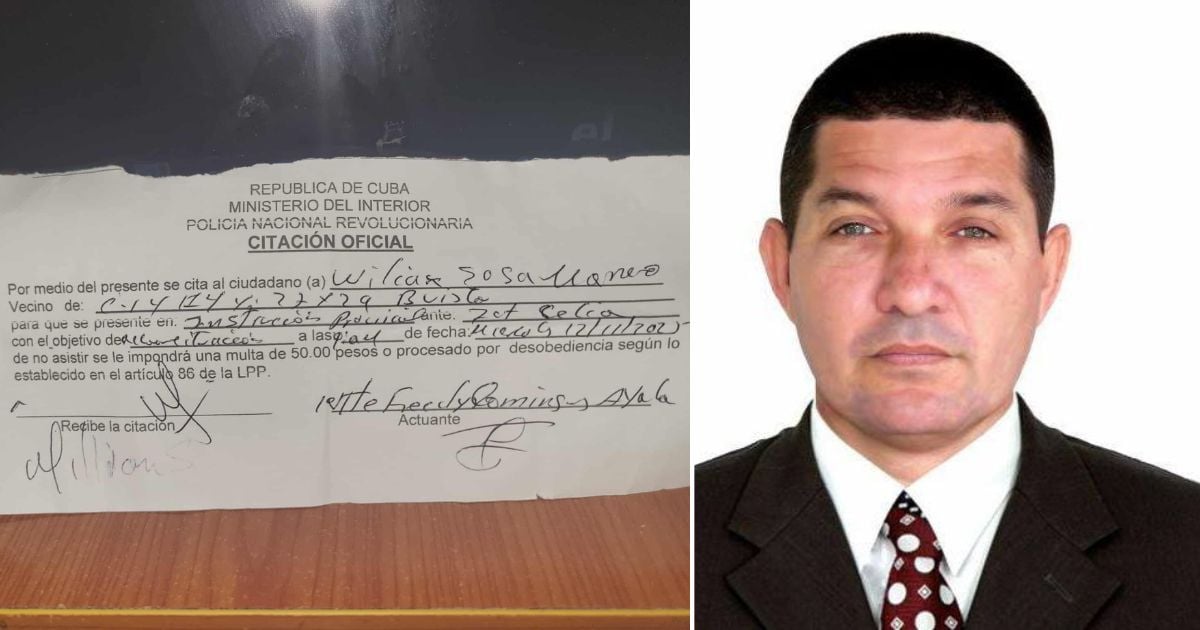
William Sosa, a Cuban resident of Las Tunas, has been summoned by local authorities following his social media activity where he shared posts critiquing national issues, as reported by his son.
Miguel Sosa, using his father's Facebook account, made the incident public on Wednesday. He reported the arrest and sought support to bring visibility to the case.
"His only crime was thinking and writing," the young Sosa stated, describing his father as a respectful man dedicated to analyzing the country's problems.
Miguel shared that the arrest has deeply distressed the family, calling the situation an injustice.
"There's a family that needs him, awaits him, and now endures terrible anxiety due to this situation," he added.
Comments on the post revealed that William Sosa faces accusations of "disobedience," as per Articles 186 and 189 of the Cuban Penal Code, which carry potential penalties of six months to two years in prison or fines up to five hundred quotas.
The family also provided an official summons as evidence that he was called in by authorities prior to his arrest.
This incident occurs amid a climate of increasing censorship and repression against citizens using social media to express views on Cuba's economic, political, and social conditions, as the regime continues to criminalize free speech through vague legal statutes.
Social media in Cuba has become a precarious platform for those voicing criticisms of the political system or the country's circumstances.
In a related incident, a citizen in Santa Clara was detained after posting against power outages, which authorities interpreted as a threat to the established order.
This highlights yet again the repressive measures employed against peaceful digital expressions.
This policy of control is not an isolated case. The Cuban regime has strengthened its legal framework to target those who use digital spaces for civic expression.
Under new regulations and provisions, the mechanisms for punishing users for their opinions have been expanded, including threats of confiscations or fines.
In this context, so-called "gag laws" have served as a legal tool to criminalize social media posts, even those that simply reflect personal experiences or citizen complaints.
Understanding Cuba's Repression of Free Speech
What led to William Sosa's arrest in Las Tunas?
William Sosa was arrested for sharing posts on social media that were critical of national issues, which authorities deemed as "disobedience" under Cuban law.
What are the potential penalties for disobedience under Cuban law?
The penalties for disobedience, according to the Cuban Penal Code, range from six months to two years of imprisonment or fines up to five hundred quotas.
How does the Cuban regime use legal tools against free speech?
The Cuban government employs vague legal statutes known as "gag laws" to criminalize social media activity, expanding punitive measures such as fines and confiscations against those expressing dissent.