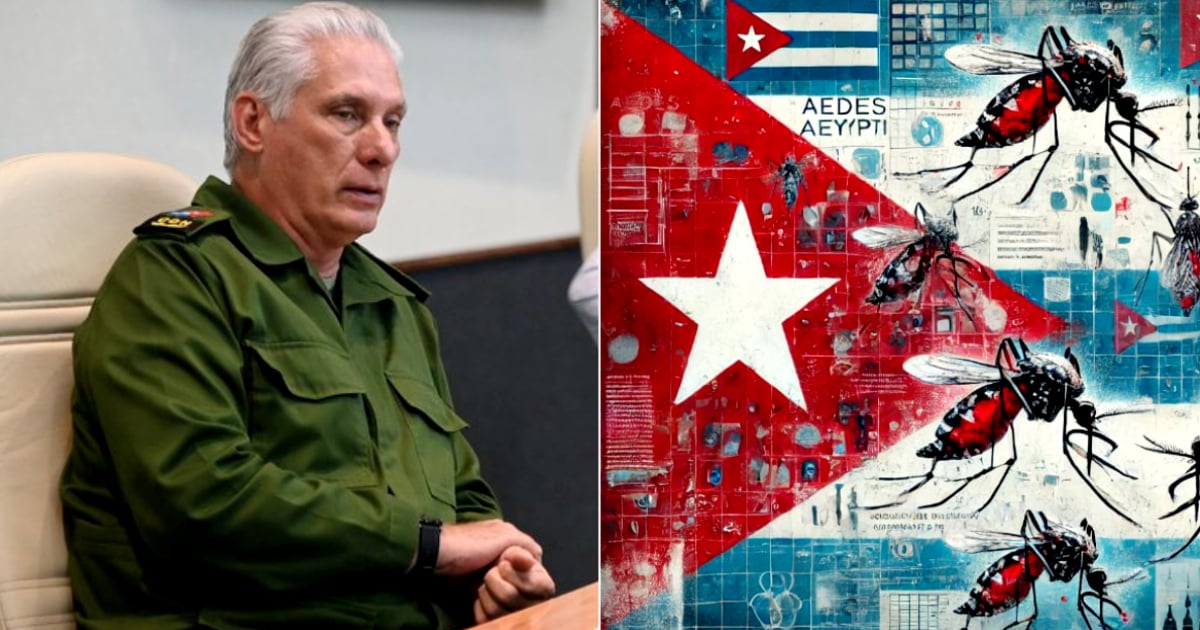
In a surprising turn, the Cuban government has conceded what millions have been asserting for months: the nation is grappling with an uncontrolled epidemic.
Yet, instead of accepting accountability and implementing effective strategies, appointed leader Miguel Díaz-Canel resorts to the regime's usual tactics: televised meetings, overconfident speeches, and empty promises dressed up in scientific jargon.
"We will tackle this epidemic just like we handled COVID-19," Díaz-Canel announced at a meeting on Tuesday in the palace chambers. Rather than instilling confidence, this statement sends shivers through a populace that remembers the chaos, censorship, and secrecy that marked Cuba's pandemic response.
Delayed and Ineffective Admission
The official report finally acknowledges the scale of the crisis: 38 municipalities experiencing active dengue transmission, over 21,000 chikungunya cases, and fever outbreaks in 68 municipalities nationwide. These figures, though likely understated, reveal a widespread national issue.
Despite this, the government claims the situation has "improved" in recent weeks—a narrative disconnected from the reality faced by overwhelmed hospitals, mosquito-infested neighborhoods, and families crafting makeshift treatments without proper medication or medical care.
Rather than addressing the lack of systematic fumigation, scarcity of reagents, and shortage of healthcare personnel—consequences of the mass exodus of doctors and nurses—the regime blames "population indiscipline" and calls for "community participation," a euphemism for shifting its own inefficiencies onto the citizens.
Propaganda Over Practical Management
The report from the Cuban Presidency exemplifies how propaganda replaces public information. Each paragraph echoes slogans of "intersectorality," "discipline," and "revolutionary science," yet fails to provide a single verifiable statistic on mortality, hospitalizations, or supply availability.
While the doctor overseeing vector surveillance admits that "not all locations have been reached" due to equipment, fuel, or personnel shortages, the text hastily praises the "preparation of brigades" and "quality of work," as if rhetoric alone could eradicate mosquitoes or cure the sick.
The insistence on "addressing the epidemic like COVID-19" is nearly ironic: that management resulted in thousands of unacknowledged deaths, collapsed hospitals, oxygen shortages, and repression against doctors and citizens who spoke out. Now, the story repeats with new diseases and the same falsehoods.
Though the official article doesn't explicitly state it, the language—emphasizing "home isolation," "in-home admission," and "patient discipline"—hints that Díaz-Canel's government might be laying the groundwork for partial or selective lockdowns in areas with high infection rates.
Institutional Blindness and Lack of Transparency
Lack of transparency has become an ingrained feature of Cuba's healthcare system. There is no public access to real data on incidence, mortality, or territorial distribution of outbreaks. The Ministry of Public Health's reports have devolved into vague communiqués and broadcasted meetings where officials discuss "accumulated experiences" and "lessons from COVID" while the entire country falls ill.
It's telling that the official text speaks of "identifying the problem when the patient presents with fever," as if the island hasn't been experiencing an explosive rise in febrile syndromes for months. Only now, faced with the impossibility of concealment, does the regime admit the epidemic, wrapping it in their "revolutionary science" narrative to mask the administrative incompetence that has allowed its spread.
An Exhausted System
The healthcare collapse isn't due to chance but results from years of neglect, exporting medical services and professionals, and prioritizing military, propaganda, and tourism infrastructure spending over medical needs.
Hospitals lack beds, laboratories are out of reagents, and pharmacies are empty. Yet, the regime continues funding hotel construction, political campaigns, and ideological affirmation events, while calling on medical students to "reinforce" tasks meant for qualified professionals.
Cuba faces a widespread healthcare crisis without resources or transparency. The regime's response remains unchanged: control the narrative, manipulate data, and blame the people. Meanwhile, arboviral diseases spread, hospitals collapse, and the nation relives the pandemic's nightmare—this time without excuses, vaccines, or hope.
Understanding Cuba's Arbovirus Crisis
What are the main arboviruses affecting Cuba currently?
Cuba is currently battling a severe outbreak of dengue and chikungunya, with both diseases spreading extensively across the country.
How has the Cuban government responded to the arbovirus outbreak?
The government has primarily responded with propaganda and rhetoric, failing to implement effective measures or provide transparency about the situation.
What challenges does Cuba face in managing this health crisis?
Cuba faces significant challenges including a shortage of medical personnel, lack of resources, inadequate fumigation, and poor healthcare infrastructure.
Is there a possibility of lockdowns in Cuba due to the arbovirus outbreak?
There are indications that the government might consider selective or partial lockdowns in areas with high infection rates, though this hasn't been officially confirmed.