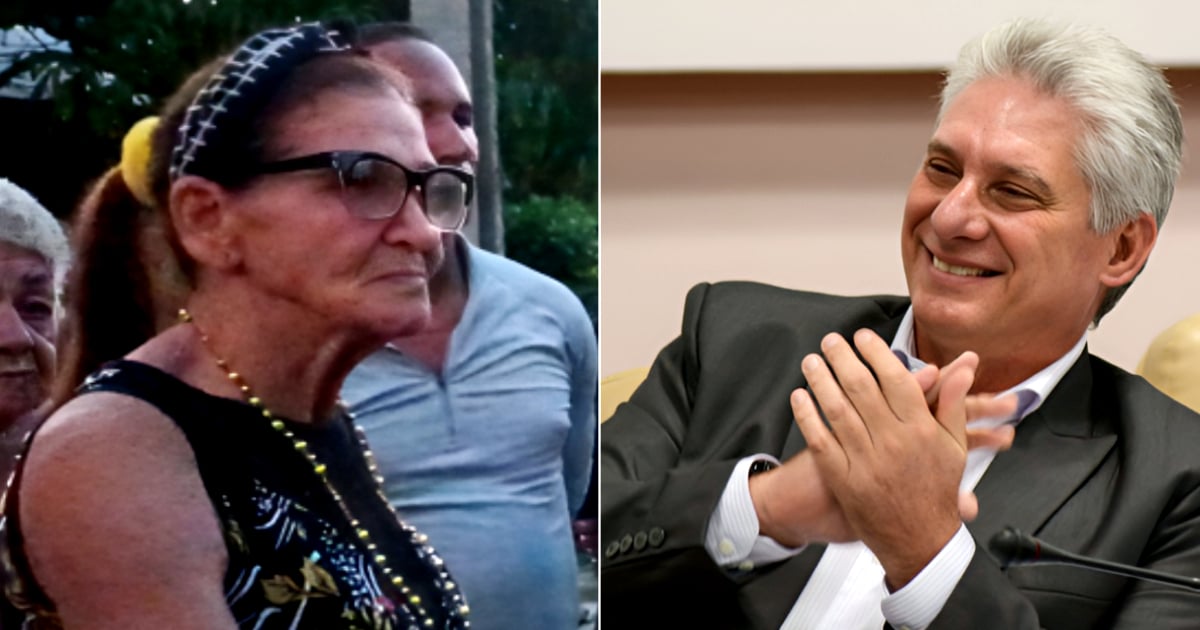
The forced recantation of Francisca, an elderly woman who bravely confronted Miguel Díaz-Canel in El Cobre following the devastation of Hurricane Melissa, has sparked widespread outrage and solidarity. The incident, shared on CiberCuba's Facebook, quickly evolved into a public opinion phenomenon.
Thousands of comments echoed a simple yet powerful sentiment: “What is said, is said. And the whole world witnessed it.”
The Cuban regime's attempt to amend the situation with a video showing the elderly woman appearing “grateful” and praising the so-called "revolution" was seen by many as a coercive maneuver.
“They probably threatened her or told her to say that,” remarked one user. Another summarized the collective feeling with a blunt statement: “Pure theater, she was forced to say the opposite.”
Unyielding Public Outrage
The thread of comments rapidly morphed into a tapestry of emotions: anger, shame, compassion, and helplessness.
“No matter how much they try to fix it, what’s said is said, and the entire world saw it,” one user expressed. “The president is the one who should apologize, not her,” another added.
The consensus was clear: the elderly woman did nothing wrong; it was the regime that lost the moral high ground. “I don’t understand the fuss. She just spoke the truth: she didn’t have a bed. Is that a crime now?” someone questioned.
The indignation was further fueled by the stark contrast between Francisca’s humility—a retired teacher aged 71 who lost everything in the hurricane—and the dismissive attitude of the ruling leader, who retorted, “And I don’t have one to give you right now!”
“A person who has lost everything asks for a bed, and the country’s president responds with arrogance. And she’s the one who should apologize? He should be ashamed,” another reader commented.
The Same Old Script
Numerous comments criticized the repetitive propaganda tactics: using “corrected” videos to gloss over social discontent.
“It’s always the same script,” wrote one user. “First they humiliate, then they pressure, followed by a video to make the public think it was all a misunderstanding.”
The perception of a staged event was overwhelming. “You can tell when the ‘official’ whispers responses to the poor woman,” said another. “The lady doesn’t even know what she’s saying. She’s tired, confused, surrounded by uniforms. It’s pitiful.”
For many, the video served as further proof of the regime's fear: “They try to cover up what everyone saw. But it doesn’t work anymore. No amount of editing can erase the look on that woman’s face when she said she didn’t have a bed.”
Symbol of Courage and Compassion
Amidst the fury, a note of tenderness emerged. Francisca became a symbol of the suffering people who still dare to speak out.
“God willing, nothing happens to her for speaking the truth,” someone wrote. “She spoke for millions who sleep on the floor, without a mattress or hope,” another added.
Religious undertones were recurrent. “The children of God are praying for Cuba,” several messages stated, interpreting the episode as an act of revelation: “God allows these things to show the government’s misery and the people’s nobility.”
The elderly woman, seen in the recantation video thanking the "revolution" and evoking Fidel Castro, was perceived by many as a victim of emotional manipulation. “She’s not sorry, she’s scared. It shows in her eyes, in her voice. They’re dictating what she should say,” a commentator opined.
From Individual Incident to Systemic Rejection
The case quickly surpassed the specific incident, transforming into a collective denunciation against the repressive Cuban model.
“This is the same thing they do with prisoners, doctors, young people: force them to recant. It’s their usual method,” noted a comment that received dozens of reactions.
Others were more direct: “It’s the dictatorship revealing its true face. There’s no respect for the elderly anymore. They intimidate them until they apologize for telling the truth.”
One user summed up the atmosphere of disillusionment: “They try to fix what can’t be fixed. What’s said is said. We all saw it, and it can’t be erased.”
The Power of Social Media and the Failure of Fear
The avalanche of reactions also reveals a deeper truth: the erosion of the totalitarian state’s narrative monopoly.
For decades, the regime could impose its version without resistance. But this time, the official correction faced an empowered public, one that contrasts versions, records, shares, and opines.
“They used to lie with impunity; now they can’t. Social media is the people’s eyes,” an internet user wrote. Others emphasized that, for the first time, “the shame is collective, but the fear is shifting sides.”
“The people no longer remain silent. Not with threats nor cameras. What they did to that elderly woman only shows they fear the truth.”
“He Should Apologize”
The phrase reverberates through dozens of messages: “The one who should apologize is Díaz-Canel.”
This sentiment encapsulates the prevailing sense of inverted justice. “She didn’t offend anyone. She merely expressed her need. He was the rude one,” is repeated over and over.
Others mocked: “And did they give her the bed? Because if that was the point, this whole circus didn’t bring her even a mattress.” One message harshly summarized it: “The president responded with despotism to a woman who lost everything, and now they make her apologize. It’s like a father hitting his child and then forbidding them to cry.”
“No One Believes Them Anymore”
The digital conversation leads to a unanimous conclusion: manipulation has lost its effectiveness.
“No one believes them anymore,” one comment with over a hundred reactions stated. “Each attempt to clean their image only dirties it more.”
And another voice, among hundreds, summed it up with the fatigue of someone who’s seen it all: “This isn’t a communication error. It’s the essence of the system: intimidate, correct, control. But this time, it didn’t work. What’s said is said.”
Frequently Asked Questions about the Cuban Regime's Coercive Tactics
Why was Francisca forced to recant her statement?
Francisca was forced to recant her statement as part of the Cuban regime's attempt to control and manipulate public perception. Her confrontation with Díaz-Canel was seen as a threat to the regime's image.
How did the public react to the recantation video?
The public reacted with outrage and skepticism, interpreting the video as a clear act of coercion. Many expressed solidarity with Francisca and criticized the regime for its oppressive tactics.
What does this incident reveal about the Cuban regime?
This incident highlights the Cuban regime's reliance on intimidation and manipulation to maintain control, as well as the growing power of social media in challenging their narrative.