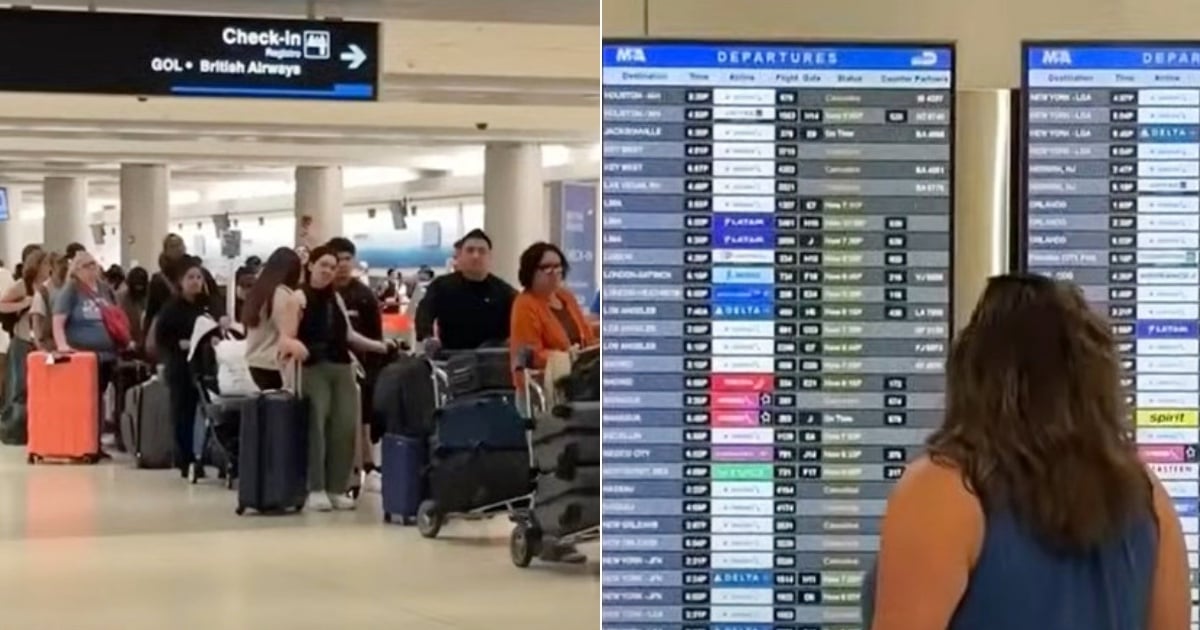
The longest federal government shutdown in U.S. history is beginning to significantly impact air travel across the nation.
Starting this Friday, the Federal Aviation Administration (FAA) will reduce flight capacity by 10% at 40 of the busiest airports. This decision is directly affecting four Florida airports, with Miami International Airport leading the list.
This move is in response to the increasing strain on air traffic controllers, who have been working without pay for several weeks.
The FAA is dealing with an estimated shortage of 2,000 to 3,000 controllers, leading to the decision to limit operations and prevent a more severe crisis in air traffic safety.
“One of our strategies will be a 10% capacity reduction at 40 of our locations. This decision is data-driven, considering which airline operates the most flights and where the system faces the greatest pressure,” explained Secretary of Transportation, Sean Duffy.
Florida's Airports Among the Hardest Hit
Among the affected airports in Florida are Miami, Fort Lauderdale, Orlando, and Tampa, crucial for both tourism and business travel. The reduction in flights is expected to have significant consequences.
Miami International Airport is a key aviation hub in the hemisphere, having set a record in 2024 with 55.9 million passengers, averaging over 150,000 travelers daily.
Meanwhile, Fort Lauderdale–Hollywood Airport handled more than 35.2 million passengers in the same year, marking it as another strategic terminal for South Florida's connectivity.
In response, Miami International Airport released an official statement asserting that operations remained normal as of Thursday, but acknowledged it was too early to fully assess the impact. “At this time, it is too soon to determine any specific impact the FAA’s 10% domestic flight reduction may have on Miami International Airport. We are closely monitoring the situation,” the statement noted, advising travelers to stay in touch with their airlines.
Passengers are urged to check directly with their airlines due to the uncertainty. Cancellations could vary by route, schedule, and airline.
Local Authorities Sound the Alarm
The mayor of Miami-Dade County, Daniella Levine Cava, warned of the potential ripple effects of this measure.
“This decision could have significant repercussions for the economy, connectivity, and workforce of our region,” she stated.
Levine Cava emphasized that Miami International Airport is not just a logistical hub for international travel but a vital economic engine for the entire state: “The Miami International Airport is a major economic driver for our county, the state of Florida, and the region as a whole.”
She also highlighted that the FAA's reduction is another direct result of the ongoing federal shutdown.
“The FAA’s decision is the latest consequence of the longest federal government shutdown in history, and the prolonged disruption of air services will result in even deeper impacts,” she added.
Her administration is working with airport personnel to develop contingency plans and push for a swift resolution.
Details of the Reduction
According to the emergency order issued by the FAA, the capacity reduction will begin gradually at 6:00 a.m. local time on Friday at each terminal, with the 10% reduction expected to be completed by the next week.
This plan affects not only airports with high passenger volumes but also key terminals for cargo transport and private aviation, such as Teterboro in New Jersey.
Also impacted are JFK, LaGuardia, and Newark in New York, LAX in Los Angeles, ORD in Chicago, ATL in Atlanta, and DCA in Washington D.C.
Air Traffic Controllers Under Pressure
The crisis stems from air traffic controllers, deemed essential workers, continuing to work without pay.
Some controllers have already sought second jobs to meet their basic needs, according to Duffy.
“What we’re witnessing is our air traffic controllers, due to financial pressures at home, are looking for additional jobs,” said the Secretary of Transportation.
“I certainly don’t want them to seek other employment. I want them to show up for work. But I understand they are trying to find ways to meet their daily obligations,” he added.
This episode highlights the vulnerability of the U.S. air system amid political tensions in Washington. The lack of budget agreements not only leaves thousands of public employees unpaid but also disrupts critical services for the economy and mobility of the country.
Florida, as a prime tourist and logistical state, finds itself at the center of a storm with consequences yet to be fully realized.
It is already clear that flights in Miami and Fort Lauderdale will become less frequent, at least while the government shutdown continues. This is alarming for a region heavily dependent on air traffic.
Full List of 40 Airports Affected by the FAA Cuts
ANC – Anchorage International Airport (Alaska)
ATL – Hartsfield–Jackson Atlanta International (Georgia)
BOS – Boston Logan International (Massachusetts)
BWI – Baltimore/Washington International (Maryland)
CLT – Charlotte Douglas International (North Carolina)
CVG – Cincinnati/Northern Kentucky International (Ohio)
DAL – Dallas Love Field (Texas)
DCA – Ronald Reagan Washington National (Virginia)
DEN – Denver International (Colorado)
DFW – Dallas/Fort Worth International (Texas)
DTW – Detroit Metropolitan Wayne County (Michigan)
EWR – Newark Liberty International (New Jersey)
FLL – Fort Lauderdale–Hollywood International (Florida)
HNL – Honolulu International (Hawaii)
HOU – William P. Hobby (Houston, Texas)
IAD – Washington Dulles International (Virginia)
IAH – George Bush Intercontinental (Houston, Texas)
IND – Indianapolis International (Indiana)
JFK – John F. Kennedy International (New York)
LAS – Harry Reid International (Las Vegas, Nevada)
LAX – Los Angeles International (California)
LGA – LaGuardia (New York)
MCO – Orlando International (Florida)
MDW – Chicago Midway International (Illinois)
MEM – Memphis International (Tennessee)
MIA – Miami International (Florida)
MSP – Minneapolis–St. Paul International (Minnesota)
OAK – Oakland International (California)
ONT – Ontario International (California)
ORD – Chicago O’Hare International (Illinois)
PDX – Portland International (Oregon)
PHL – Philadelphia International (Pennsylvania)
PHX – Phoenix Sky Harbor International (Arizona)
SAN – San Diego International (California)
SDF – Louisville International (Kentucky)
SEA – Seattle–Tacoma International (Washington)
SFO – San Francisco International (California)
SLC – Salt Lake City International (Utah)
TEB – Teterboro (New Jersey)
TPA – Tampa International (Florida)
FAQs on FAA Flight Reductions and Impact
Why is the FAA reducing flight capacity?
The FAA is reducing flight capacity due to the strain on air traffic controllers who are working without pay during the federal government shutdown, which has led to a shortage of personnel.
How will this affect travel in Florida?
The reduction in flights will particularly impact Florida's major airports, including Miami, Fort Lauderdale, Orlando, and Tampa, potentially affecting both tourism and business travel.
What should passengers do in response to these changes?
Passengers are advised to check directly with their airlines regarding cancellations or schedule changes, as these may vary based on routes, timing, and different airlines.
What are the broader implications of these flight reductions?
The flight reductions highlight vulnerabilities in the U.S. air system during political tensions, potentially disrupting services critical to the economy and mobility of the country.