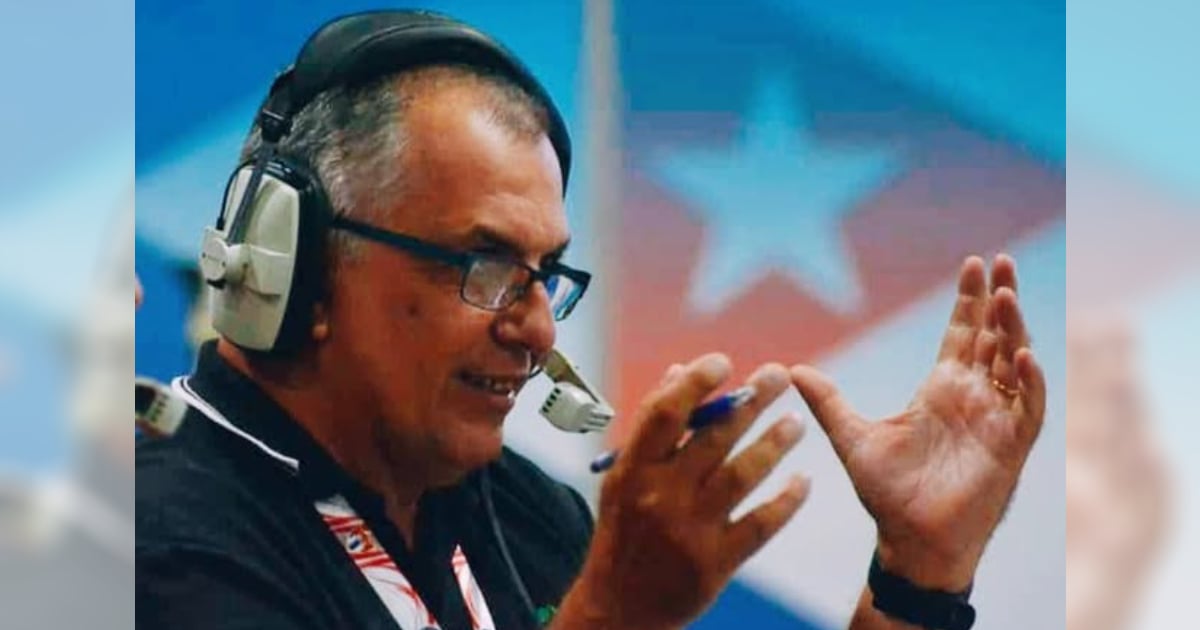
Our guest today is an affable, considerate, and highly professional individual. Manuel Alejandro Pérez Capote, a renowned Cuban sports commentator and broadcaster with over three decades of experience in Cuban radio and television, is well-known for covering significant national and international events.
With a robust academic and teaching background, Pérez Capote has participated in four Olympic Games (Athens 2004, London 2012, Rio 2016, Tokyo 2020); eight Pan American Games, from Havana 1991 to Lima 2019 (excluding Rio 2007), and seven World Cup qualifiers, among other major events.
From Cuba to the Canary Islands: A New Chapter
"Manolito, you've vanished from Cuban screens and radio waves. Where are you now, and what are you up to?"
"First, greetings to you and CiberCuba readers. Thank you for reaching out and not forgetting me. I'm currently in Fuerteventura, Canary Islands, Spain. I arrived here as a Spanish citizen through my great-grandfather and the Democratic Memory Law. I've been here for eight months, and I recently started working at 'Sabor a España,' the only real opportunity that came my way. It's a store selling dry-roasted nuts, and I'm assisting as a sales clerk."
Life as an immigrant isn't easy. It's the reverse journey our ancestors made; they left with dreams seeking a future, while we, at this age, are compelled to find a present... nothing more!
I've sent resumes and applied personally to various jobs, including almost all the radio stations on this island, but nothing has come through yet. Thanks to Tenerife broadcaster Marcelino Hernández, a family friend, I've been able to collaborate on a sports segment first with Radio Tiempo Tenerife and now with Radio Juventud de Canarias.
Hopeful for Opportunities in Sports Broadcasting
"Do you see any chances for narration work?"
"Hope is never lost. I'm determined to pursue my profession, although it seems challenging in the Canary Islands. Nevertheless, I'm not stopping, and there are projects in the works!"
Leaving Cuba: Motivation and Reflections
"You're no longer young, so what motivated you to leave Cuba at this stage?"
"The reason is clear. You only live once, and there's no room for romanticism. Sadly, I lost my mother in November 2024, which was my main tie, aside from my children, who also have their paths set. Moreover, as everyone knows, the country is going through a crisis in every sense. If you have the chance to seek a better future, you should take it."
"I believe any Cuban with the slightest opportunity to emigrate will take it. Just look at the emigration statistics from the past year, or the past two years, and you'll see."
Manuel Alejandro's Journey: From Cycling to Broadcasting
"Where are you from, and why did you choose broadcasting? Did you participate in any sports?"
"I'm proudly from Guanabacoa, the Villa of Pepe Antonio, home to cultural icons like Bola de Nieve and Rita Montaner. I grew up in San Miguel del Padrón, quite a mix! It was there, in 1988, at the Bobby Salamanca Journalism School, where I embarked on this journey."
"I practiced several sports, but the one where I achieved a certain level was cycling; I spent two years at the Manuel Permuy ESPA in Havana. However, my future wasn't in cycling. In 1989, I began collaborating with COCO, the capital's radio station. I consider my career starting in 1991 when I participated as a sports narrator-commentator in the Pan American Games in Havana, part of COCO's coverage team."
"That experience was invaluable, forming a solid foundation for my professional life and confirming my passion for this field. I stayed with them until 1996 before moving to Radio Rebelde, where I remained until 2023."
Radio vs. Television: A Broadcaster's Dilemma
"Do you prefer radio or television?"
"I enjoy both. I don't have a preference, as each has its own style and way of communicating."
"What unforgettable moments do you have from your radio days?"
"We all have moments we cherish or wish to forget. In 2007 and 2008 at Rebelde, despite my hard work, I earned the right to attend the Pan American Games in Rio and the Beijing Olympics, yet I wasn't part of the narrators' team. No one ever told me why... these things happen, as you know!"
"In Tele Rebelde, the 'bad' moment was missing the Paris 2024 Olympics. Ángel Luis was no longer there, and I could have gone, but they preferred to send a cameraman. It's one of those mysteries you'll never understand, nor will I... hahaha."
"I have nothing against cameramen. Without them, journalists' work wouldn't exist, and they're as crucial as narration. But one profession shouldn't invalidate another, especially since there was already a cameraman in the delegation."
Memories and Mentors in Cuban Broadcasting
"Reflecting on your career, who are the colleagues you fondly remember?"
"Piti Rivera, a friend and one of the best narrators in Cuba, without question! We covered about ten cycling tours of Cuba and various baseball playoffs together."
"Then there's Eddy Martin, a gentleman of Cuban narration, a decent person, and an excellent professional with vast culture who always lent a hand. Not to forget the stellar narrators René Navarro, Héctor Rodríguez, and Diego Méndez, my instructors in the Narration course and later colleagues. I must mention Modesto Agüero, highly versatile, capable in any sport with knowledge and skill."
"As for those less pleasant, it's better not to mention them, though I never had issues with anyone. Ah! I can't forget the best of these times, Renier González, and not just because he's my son-in-law, okay? Hahaha..."
"In the elite, I place two: the brilliant Bobby Salamanca, who left us too soon, and Felo Ramírez, who didn't get to showcase his talents in Cuba but elevated our profession in the world's top baseball, earning a place in the Baseball Hall of Fame in Cooperstown. I was honored to meet him in Miami and chat for nearly an hour."
Sports Narration and the Social Climate
"Which sports did you narrate most often, and which did you wish to cover more?"
"I frequently narrated soccer, cycling, baseball, volleyball, and basketball, as well as rowing, kayaking, and canoeing. I would've loved to cover more combat sports, although I did taekwondo and judo, but never got to do boxing and wrestling, which I would have enjoyed."
"What can you say about violence in Cuban stadiums? Is it a reflection of the society?"
"I'm aware of the events, the violence in Sancti Spíritus, Santiago... in many beloved places with fond memories, which should be peaceful sports venues."
"That hostile atmosphere on fields and stands mirrors the societal reality, and serious measures are needed to prevent escalation, although there have been significant incidents already."
Family and Favorite Teams
"Tell us about your family."
"I have two children, Alejandro and Massiel, still in Cuba but full of dreams and ambitions. I'm married to Itahimy, and together with her daughter Patricia, we form a family here on this side of the 'pond.'
"Even though journalists and narrators shouldn't have favorite teams, you know it's a myth. Who are your favorites in soccer and baseball?"
"Ah, Julita, you're right! Here it goes: in MLB, my teams are the Astros and Dodgers; in soccer, it's Barcelona. In Cuba, for the National Series, it's Industriales, and in the NBA, Lakers and Warriors."
Reflecting on Cuba and New Beginnings
"Living in the Canary Islands and building a new life close to what could have been your retirement, what are your thoughts on current Cuba, and the many stars and professionals who were let down?"
"Though I no longer reside on the island and hold a different nationality, it pains me to see our homeland in such a state. It's a country full of good people eager to make a difference. I highly respect those who boldly voice criticism, defending a fading nation."
"For instance, I admire actor Luis Alberto García for his courage, intelligence, and the straightforwardness of his messages, which highlight the harsh reality of neglected figures (not just in sports) and emblematic places."
"The situations of volleyball player Abel Sarmientos, basketball coach and player Miguelito Calderón, and 'El Meteoro de La Maya,' Braudilio Vinent, are just some tangible examples of the harsh reality."
"Oh, by the way, I've seen you on your YouTube channel 'Narrating Life'..."
"Yes, indeed. You can join me on that channel to share great experiences and truths about current Cuban sports; it's another way to start anew... That's where we are!"
Frequently Asked Questions about Manuel Alejandro Pérez Capote
What events has Manuel Alejandro Pérez Capote covered as a sports commentator?
Manuel Alejandro Pérez Capote has covered four Olympic Games, eight Pan American Games, and seven World Cup qualifiers, among other significant sports events.
Why did Manuel Alejandro Pérez Capote leave Cuba?
He left Cuba seeking better opportunities and a future, influenced by the country's ongoing crisis and personal reasons, such as the loss of his mother.
What sports did Manuel Alejandro Pérez Capote narrate most frequently?
He frequently narrated soccer, cycling, baseball, volleyball, basketball, rowing, kayaking, and canoeing.
How has Pérez Capote adapted to life in the Canary Islands?
Pérez Capote has been adjusting to life in the Canary Islands by working in a store, collaborating on sports segments, and planning future projects despite challenges in finding work in his field.