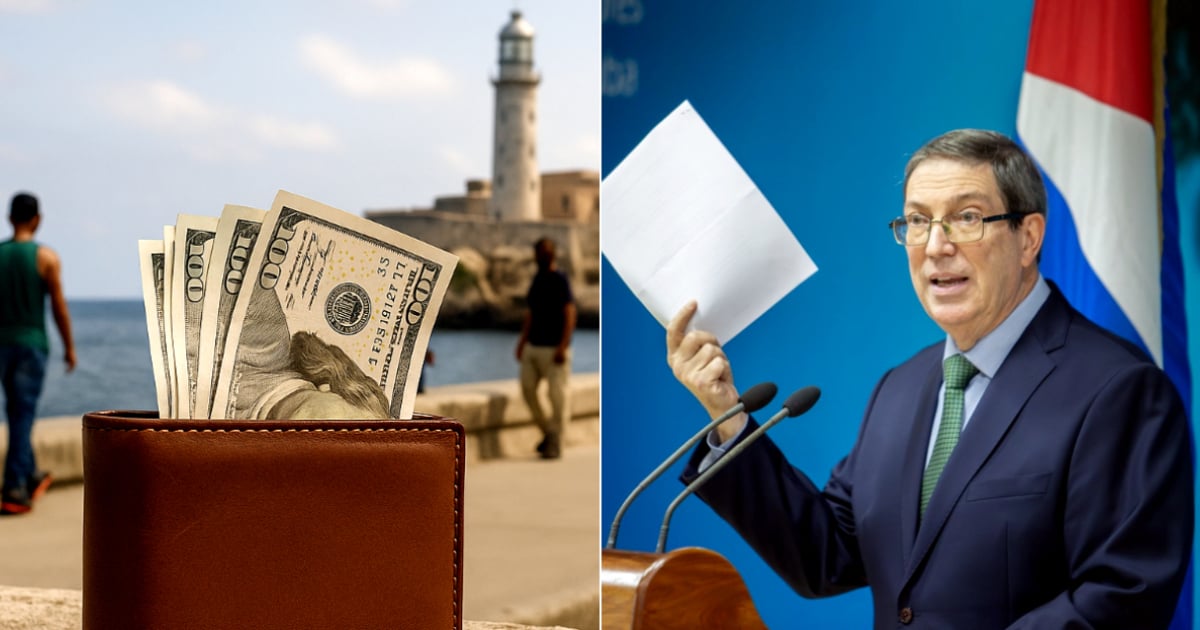
On Monday, Cuban economist Pedro Monreal took a stand against the remarks made by Foreign Minister Bruno Rodríguez Parrilla, who had recently accused the United States government of orchestrating a comprehensive destabilization operation aimed at manipulating the exchange rate of the Cuban peso in the informal market.
Through a series of posts on social media platform X, Monreal refuted the foreign minister's allegations, asserting that the depreciation of the peso and the existence of the informal currency market are not the result of foreign plots but rather the direct outcome of the regime's own failed economic "reordering."
"Someone should inform the MINREX that the peso's devaluation in the informal market, and the market itself, mainly reflect the failure of the reordering design. Murillo can certainly enlighten them by repeating what he said in October 2021," Monreal posted, referencing Marino Murillo Jorge, the architect of the so-called 'Task Reordering.'
The Structural Failures of Economic 'Reordering'
The "reordering" was unveiled by the Cuban government at the beginning of 2021 as a comprehensive reform to unify currencies, eliminate subsidies, raise wages, and strengthen the national currency.
However, in practice, it led to a spiral of inflation, loss of purchasing power, and rapid devaluation of the peso, forcing both the public and the private sector to rely on the dollar, euro, or MLC (Freely Convertible Currency).
According to Monreal, the presence and growing influence of the informal market are not anomalies caused by external forces but a direct consequence of the lack of trust in the Cuban peso and failed monetary policies. Simply put, the issue originates in Havana, not Washington.
Hotel Investments Lacking Foreign Capital
In another tweet, Monreal challenged another implicit claim in the foreign minister's speech regarding foreign investors' involvement in the hotel sector.
"The MINREX should also be informed that hotels were not built with foreign investment. Marrero could explain his 2018 statement that 'the bulk is executed with limited resources of our own.' There has been no official declaration contradicting this," Monreal emphasized.
The economist referred to comments by then-Tourism Minister Manuel Marrero Cruz, who admitted that most hotel investments in Cuba are funded by state resources, not foreign capital.
Monreal included an official excerpt from Cuba's tourism development plan in his tweet image, which acknowledged that "the bulk is executed with limited resources of our own, but foreign investment is also prioritized."
This statement, found in official press reports, confirms that the hotel expansion—including five-star hotels in Havana and Varadero—has been sustained by internal resources amid a context of crisis and widespread scarcity.
Strategic Errors in Energy Investment
In a third message, Monreal expanded his critique by highlighting another blind spot in the government's narrative: the lack of investment in electrical energy.
"MINREX should also be informed that the lack of investment in thermoelectric plants was not due to a lack of appeal for potential foreign investors, but rather a political decision not to invest in new thermoelectric plants (Fidel Castro, December 21, 2005)," he recalled.
With this, the economist pointed out a long-standing political decision that has left the country with an outdated electrical system dependent on emergency repairs, which is a primary cause of the power outages affecting the entire island.
Discrepancy Between Official Narrative and Economic Reality
Monreal's statements stand in stark contrast to Rodríguez Parrilla's rhetoric, which attributes inflation, the peso's devaluation, and the chaos of the informal market to an "economic war" waged by Washington.
For Monreal, that explanation overlooks the real causes: the flawed design of the Cuban economic model, state inefficiency, and political decisions that have prioritized hotels over thermoelectric plants, propaganda over production, and control over economic freedom.
The exchange between the two highlights the widening gap between official discourse and the technical assessment of Cuban economists. While the regime continues to blame the embargo and "speculative manipulation," voices like Monreal's point out that the root of the crisis lies within Cuba itself.
Instead of making accusations and conspiracy-laden speeches, the Cuban government should focus on establishing a realistic exchange rate and an effective monetary policy. Without proper control or productive backing, the peso doesn't need external enemies; it collapses on its own.
Understanding Cuba's Economic Challenges
What is Pedro Monreal's stance on the informal market in Cuba?
Pedro Monreal argues that the informal market and the devaluation of the Cuban peso are the results of internal economic mismanagement rather than foreign interference.
How does the Cuban government view the economic situation?
The Cuban government attributes the economic difficulties to a "comprehensive destabilization operation" by the United States, rather than internal policy failures.
What does Monreal say about hotel investments in Cuba?
Monreal highlights that most hotel investments are funded by state resources, not foreign capital, contradicting claims of significant foreign investment.
Why is Cuba's electrical system facing issues?
Cuba's electrical system suffers due to a political decision against investing in new thermoelectric plants, leading to an outdated system reliant on emergency repairs.