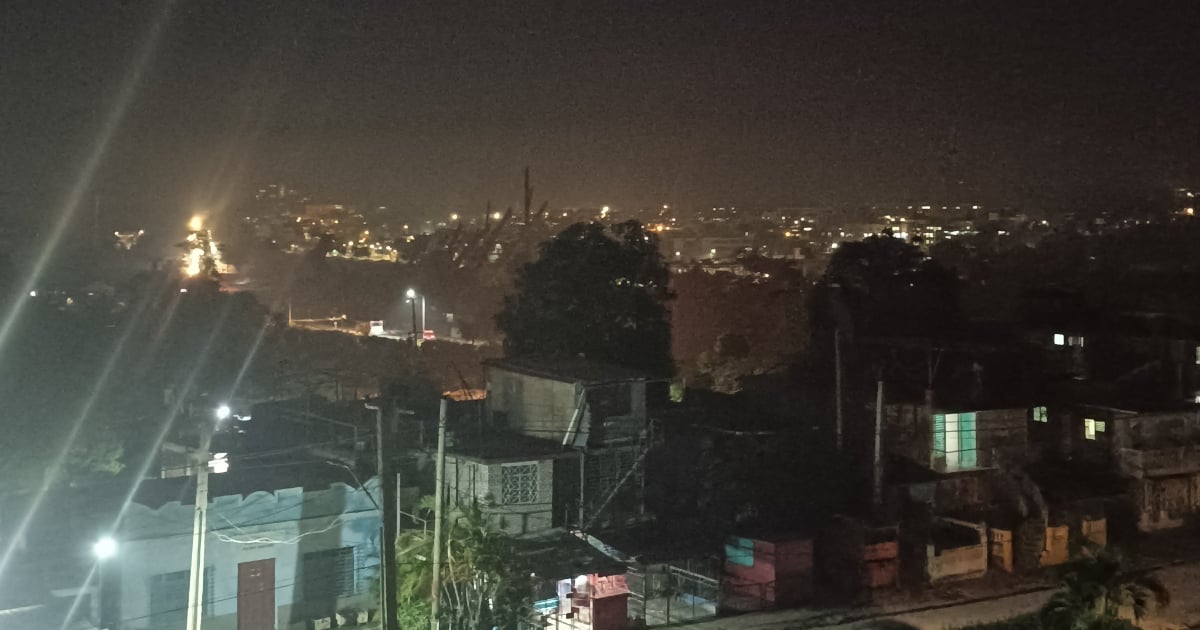
Journalist Lázaro Manuel Alonso announced on Facebook, "Light is beginning to return to the city of Santiago de Cuba," along with nighttime images showing illuminated areas. This update came after the province in eastern Cuba endured over a week without power.
The post sparked a significant response on social media. Independent reporter Yosmany Mayeta Labrada shared Alonso's post, commenting, "These agents of Cuban propaganda claim light is returning to Santiago. How many residents actually have electricity right now?"
In the comments, dozens of people reported that most of the city remains in darkness. Some suggested the photos were "archived" or "taken before Hurricane Melissa," while others noted that "only a main road and some prioritized areas, like circuits 2 and 7, have electricity."
Many echoed sentiments of neglect: "Nothing at Abel Santamaría," "Nine days without power in Versalles," "Santiago remains dark, not even the light at the end of the tunnel is visible," and "This is a graveyard of living men." A small number of users mentioned partial power restoration in certain areas.
Recently, the Santiago de Cuba Electric Company stated that "four circuits have service on a sectionalized basis (part of the circuit, not the entire circuit): 7, 10, 17, and 18," and work was underway on fourteen more. The company also shared images of brigades from Cienfuegos assisting recovery efforts in circuits 17 and 18, near the University of Oriente and Puerto de Boniato.
Prior to Hurricane Melissa, the Union Eléctrica (UNE) had announced the preventive shutdown of the Antonio Maceo (Renté), Felton, and Moa Central Fuel power plants, leaving the eastern region without electricity generation. At that time, the company acknowledged severe structural damage to transmission lines and warned that restoration could take at least 15 days, contingent on technical and fuel resources.
The lack of electricity has also impacted other essential services. On Monday, ETECSA reported that only 3% of telecommunications in Santiago de Cuba had been restored due to fallen fiber optic cables, poles, and communication towers, leaving the province nearly isolated.
In neighborhoods like Altamira, residents have reported being "without food, water, or power" and that "no one has come to collect trash or ask questions," according to accounts shared by Yosmany Mayeta Labrada, who showed images of debris-filled streets and families cooking with firewood due to the lack of basic resources. These reports from the neighborhood highlight the dire conditions faced by hundreds of families after Hurricane Melissa.
While authorities report on repair efforts and interprovincial support brigades, citizen reports indicate that vast areas of Santiago de Cuba remain without power, amid blackouts, isolation, and severe shortages.
Understanding the Blackout Situation in Santiago de Cuba
What caused the blackout in Santiago de Cuba?
The blackout was primarily due to the preventive shutdown of key power plants before Hurricane Melissa, compounded by severe structural damage to transmission lines.
How has the power outage affected basic services?
The power outage has severely impacted other services, including telecommunications, with only a small percentage restored due to damaged infrastructure.
What areas in Santiago de Cuba have electricity restored?
Some prioritized areas, such as circuits 2 and 7, have electricity, but much of the city remains without power.