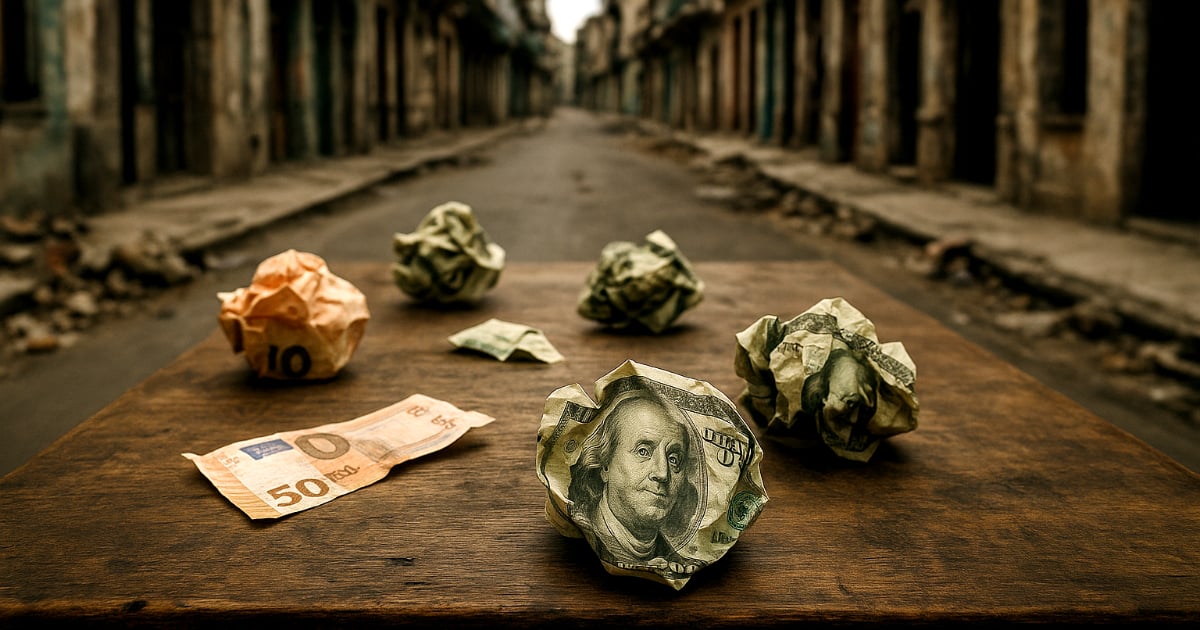
In recent days, Cuba's informal currency market has taken a sharp and puzzling turn.
After months of relentless increases, both the dollar and the euro have dropped by over 10% in just a week, breaking what seemed like an unstoppable trend.
However, while the currencies appear to decline on paper, the cost of essential goods and food continues to rise in both agro-markets and the black market.
This contradiction has sparked a mix of surprise, disbelief, and suspicion among Cubans. Many on social media recall a saying that emerged during the 1990s Special Period: "The dollar doesn't drop, it just crouches to gather momentum."
Perplexing Decline without Economic Justification
The dollar had soared past 490 Cuban pesos, while the euro held steady for nearly a week at 540 pesos, before both currencies experienced a dramatic drop without any accompanying economic announcements.
No increase in currency supply, no market stabilization by the government, and certainly no decrease in the cost of basic goods have occurred. Quite the opposite: inflation remains high, and the purchasing power of the Cuban peso continues to erode.
Economist Pedro Monreal theorized that this decline might be influenced by expectations of increased remittances following recent natural disasters in the Caribbean, though he clarified it's more of a psychological effect rather than an immediate impact.
Other economists and market observers argue that the informal market is driven by speculative factors, inherent volatility, and potential data collection distortions due to regional disconnections and lack of transparency.
Theories and Speculation Abound
Amidst the confusion, various theories are emerging. Some suggest that there may be indirect intervention or manipulation to create an artificial sense of peso stabilization and discredit El Toque, the outlet that publishes the Informal Market Representative Rate (TRMI).
Others point to a natural "technical correction" after months of increases, while independent economists argue that the phenomenon reveals distorted expectations and the influence of political or media campaigns on a market that, by definition, lacks regulation and transparency.
Inflation Persists Despite Currency Trends
Beyond the currency charts, everyday life in Cuba contradicts any signs of economic recovery.
Prices for food items like rice, oil, pork, produce, and eggs continue to skyrocket. The same is true for hygiene products, medications, and services.
Under normal circumstances, an appreciation of the peso against the dollar would lead to lower prices, but in Cuba, the opposite happens. The exchange rate reflects not the real economy, but rather perceptions, rumors, and the restrictions of an opaque informal market.
The exchange rate seems to move in a dimension detached from reality. In people's wallets, the peso isn't worth more; it's just that the dollar appears less valuable on paper.
Is it Manipulation or Misrepresentation?
The most widespread theories among the populace extend beyond economics.
Many Cubans suspect there's a visible hand behind the informal market capable of influencing exchange rates to create an illusion of stability or discredit independent actors.
In this context, recent accusations by the regime and spokespersons like Sandro Castro against El Toque have fueled perceptions of a political or media operation aimed at undermining the credibility of alternative indicators.
Others point to technical issues, such as geographic bias in data collection due to internet outages and disconnected provinces. If the sample is concentrated in Havana or areas with more connectivity, rates might only reflect part of the market.
Private Enterprises Under Scrutiny
Amidst this uncertainty, criticism is also mounting against the behavior of some private small and medium-sized enterprises (SMEs), accused of capitalizing on market volatility.
User Manuel Viera shared a viral account of attempting to exchange a $10 bill for food, only to find no one willing to accept it.
In his complaint, he noted that several private businesses refuse to sell for physical dollars, even though their prices are calculated in that currency.
“If a 10-pound chicken package costs $10, why can’t I pay with $10?” he questions. “They’re not losing; they just want to gain a few more pesos on the exchange tomorrow. Sometimes they seem more like bankers than merchants.”
Viera’s reflection highlights a deeper issue: some entrepreneurs are acting as financial speculators, setting prices based on the next day’s expected exchange rate and refusing to accept the currency underlying their operations.
This behavior, which Viera describes as “abuse and usury,” reinforces the perception that the market is driven by speculative and opportunistic logic rather than productive one.
Between Perception and Reality
The end result is an economy where the dollar falls, but nothing else does. The average citizen sees prices continue to rise while currencies "drop," perceiving a manipulation that remains unexplained.
Analysts agree: Cuba’s informal market doesn’t behave like a free market but rather as a space influenced by rumors, expectations, and political pressures. The current downward trend seems more like a temporary respite than a sign of the Cuban peso’s recovery.
On the streets, few believe it. Amid skepticism and irony, a phrase that has become part of the crisis lexicon echoes: “The dollar doesn’t drop, it just crouches to gather momentum.”
Understanding Cuba's Currency Market
Why did the dollar and euro suddenly decrease in value in Cuba's informal market?
The abrupt decrease in the dollar and euro's value is not attributed to any official economic policy changes. Speculative factors, psychological impacts from expected remittances, and potential data collection distortions are believed to influence this trend.
How does the informal currency market in Cuba impact everyday life?
The informal market’s fluctuations directly affect the cost of living, as essential goods and services do not mirror the currency's apparent value on paper. This disconnection contributes to the ongoing inflation and economic hardship experienced by Cubans.
What are the main criticisms of private enterprises in Cuba's current economic climate?
Private enterprises, especially SMEs, are criticized for exploiting market volatility by setting prices based on speculative exchange rates and refusing to accept physical dollars, prioritizing profit over fair trade practices.