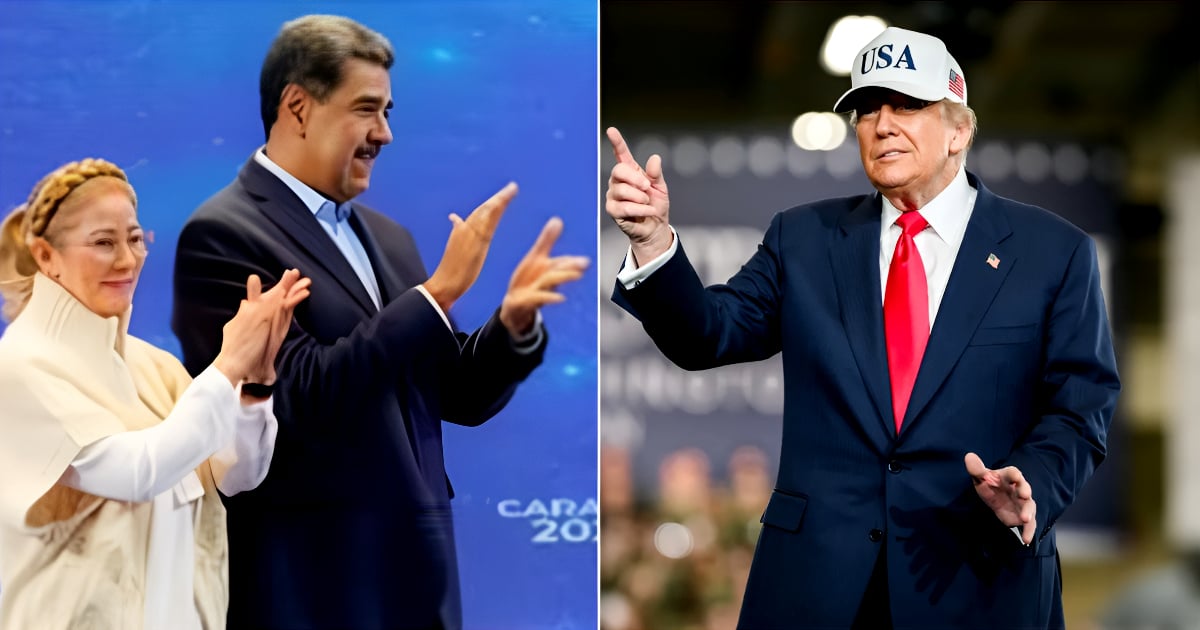
President Donald Trump of the United States has declared that Venezuelan dictator Nicolás Maduro's hold on power is waning, although he stopped short of affirming whether Washington is planning a direct military intervention in the South American nation.
When asked by '60 Minutes' (CBS News) journalist Norah O'Donnell if Maduro's time as president was limited, Trump responded, "I would say yes. I think so." However, he refrained from detailing what actions might be taken concerning Venezuela, leaving the door open for potential developments.
Following the deployment of over 10,000 personnel, F-35 fighter jets, and several warships — including the aircraft carrier USS Gerald Ford — in the Caribbean Sea, just miles away from Venezuela's coast, Trump reiterated his administration's hardline stance against leftist regimes allied with Cuba.
When questioned about the possibility of war with Venezuela, Trump expressed doubt, stating, "I doubt it. I don't think so." Yet, he justified the military presence by criticizing Maduro's regime for mistreating the U.S. and accused the Venezuelan government of releasing criminals and psychiatric patients to the U.S. during Joe Biden's administration.
Intelligence sources cited by CNN indicated that the Pentagon has contemplated "surgical strikes" on cocaine laboratories and trafficking routes within Venezuela, with logistical support from bases in Puerto Rico and Curaçao.
Prior reports suggested that U.S. forces have destroyed at least nine vessels and caused numerous casualties in the Caribbean as part of an operation to curb drug trafficking.
Trump neither confirmed nor denied these actions but emphasized that "Venezuela is a country that has allowed its prisons to be emptied into the United States," labeling this a "national security priority."
Rising tensions have sparked concern across Latin America, where several governments have urged against military escalation. Nevertheless, in Washington, the consensus is growing that the collapse of the Chavista regime is merely a matter of time.
"Maduro's days are numbered," Trump reiterated, marking a significant shift in the already strained Caracas-Washington relations.
U.S. Officials Echoing Trump's Stand
The refrain that "Maduro's days are numbered" has become a common theme among key U.S. officials and influential figures in recent weeks, signaling a hardening stance towards the Chavista regime and a readiness for potential political change in Venezuela.
Since early October, members of Trump's administration, alongside Republican lawmakers and former intelligence and diplomatic leaders, have consistently warned that the Venezuelan dictator's grip on power is nearing its end.
On October 5, former National Security Advisor General Michael Flynn stated, "Maduro is cornered, and his fall is a matter of time," emphasizing Washington's unwillingness to allow Venezuela to remain a narcotrafficking sanctuary and an ally of Havana and Tehran.
Ten days later, on October 15, international media reported that the U.S. had tightened the military noose around Venezuela, conducting joint exercises in the Caribbean and Pacific, along with an "unprecedented" naval mobilization since 2020.
Pentagon sources at the time cited the "need to ensure hemispheric security" due to alleged Chavista collaboration with criminal networks and armed groups.
On October 27, Republican Senator Rick Scott reiterated the message: "Maduro knows his end is near. The U.S. and our allies will not rest until Venezuela is free from his dictatorship," he proclaimed in Washington.
The following day, the former U.S. Ambassador to the OAS suggested that "the next 30 days could be decisive" for Maduro's future, referencing U.S. military maneuvers in the Caribbean and the regime's internal deterioration.
Congresswoman María Elvira Salazar, in statements recorded on October 11, claimed that "Maduro is terrified" and that his inner circle is "seeking a negotiated exit in light of the international siege."
These statements, circulated by various media outlets, reinforce the perception that the Trump administration and the U.S. Congress are working in tandem to pressure the collapse of the Chavista regime.
Overall, Washington's narrative points in a single direction: Maduro finds himself in his politically weakest moment, isolated internationally, facing increasing economic sanctions and a military encirclement that leaves his regime with few survival options.
The phrase "Maduro's days are numbered" has evolved from a diplomatic assertion to a strategic slogan, setting the political and communicational stage for a potential outcome in Venezuela.
Russia's Involvement in the Caribbean Crisis
This Sunday, Moscow confirmed that it has increased its presence and support for the Chavista regime in Venezuela, altering the geopolitical landscape in the Caribbean. International reports suggest that Maduro's government has formally requested Russian backing as Washington deploys naval and air forces in the area.
According to reports, Caracas recently signed a strategic partnership treaty with Russia that includes economic cooperation, military exchange, technology supply, and energy collaboration.
Moscow has provided diplomatic backing to Maduro in the face of pressure from Donald Trump and his administration, condemning what it calls U.S. "interference attempts" in the region.
The strengthening of ties between Venezuela and Russia occurs at a crucial juncture. In this context, the Moscow-Caracas partnership appears as a direct response to what the regime describes as a U.S. "threat" to its sovereignty.
For the Cuban regime and its Latin American allies, this Russian support is seen as a critical lifeline. It not only bolsters Maduro's political survival against international sanctions and isolation campaigns but also serves as a platform to project regional power and counter U.S. dominance.
Moreover, Moscow gains a strategic ally in the hemisphere, access to energy resources, and a broader geopolitical position encompassing the Caribbean.
The Maduro regime's request to Russia and the Kremlin's involvement in the Caribbean crisis are not mere statements but a strategic shift that also implicates the Cuban regime, further complicating Venezuela's situation and heightening tensions between major powers as Caracas clings to external support for its survival.
Key Questions about U.S. and Venezuela Relations
Why is the United States increasing military presence near Venezuela?
The U.S. has deployed military forces to the Caribbean near Venezuela as part of a strategy to pressure the Maduro regime and curb drug trafficking activities linked to the region.
What role is Russia playing in Venezuela's current crisis?
Russia has increased its support for the Maduro regime, signing strategic partnership agreements that include military and economic collaboration, thus complicating the geopolitical dynamics in the Caribbean.
How has Trump's administration addressed the situation in Venezuela?
The Trump administration has adopted a maximum pressure policy, involving economic sanctions and military readiness, to catalyze political change in Venezuela and end Maduro's regime.