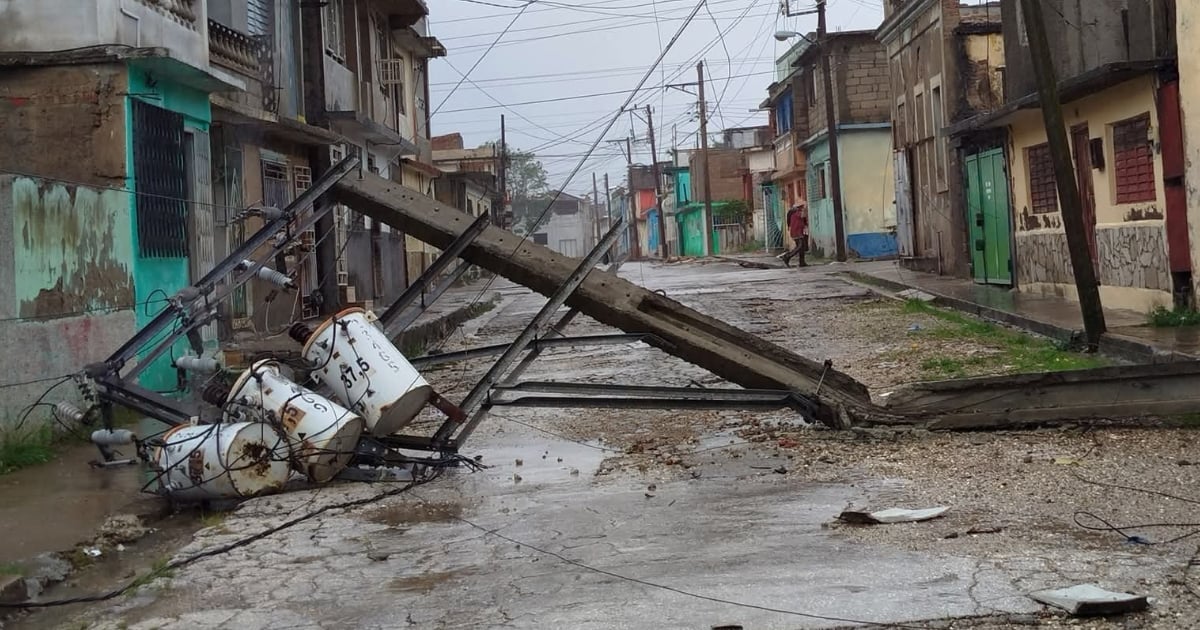
The Cuban government has acknowledged significant difficulties in restoring electricity in the eastern part of the country following the extensive damage caused by Hurricane Melissa. The storm severely impacted both power distribution networks and high-voltage transmission lines.
According to a report on the Presidency of Cuba's website, the Minister of Energy and Mines, Vicente de la O Levy, conceded that recovery efforts are progressing slowly due to the extensive destruction of electrical systems across various provinces.
During a briefing to the National Defense Council, De la O Levy detailed that in Las Tunas, over 48,000 customers have had their power restored. In contrast, only 34% of the population in Guantánamo and a mere 17% in Granma have electricity, relying on temporary isolated micro-systems.
The minister elaborated that the power supply from the National Electric System (SEN) to Granma remains disrupted after the collapse of six high-voltage towers between Cueto and Bayamo. Efforts are underway to repair these structures, prioritizing the allocation of fuel for emergency generators and essential centers.
The situation in Santiago de Cuba is described as more severe, with De la O Levy admitting that the restoration is "complex" due to the extensive damage to distribution networks. This damage prevents the establishment of electrical circuits or "islands" to partially restore service.
De la O Levy also reported that numerous mini and micro hydropower plants are flooded, hampering their operation. Currently, 98 transformers are damaged, and many poles are down or leaning, although most are not broken.
Despite these challenges, the minister claimed that "all thermoelectric units from Camagüey to Artemisa are operational," although residents continue to experience prolonged blackouts. The national power supply remains stable thanks to plants unaffected by the hurricane.
The official report emphasized that fuel supplies are being secured to keep backup generators operational at hospitals, water facilities, and evacuation centers. However, the Presidency’s information confirms that much of eastern Cuba still lacks electricity, with restricted access to the most flood- and landslide-affected areas.
During the National Defense Council meeting, led by Miguel Díaz-Canel, the Cuban leader urged "intensive work" on basic service restoration, debris cleanup, and victim assistance, though his statements seem more propagandistic than reflective of the dire reality faced by millions in the east.
Díaz-Canel also stressed the importance of "prioritizing the distribution of donations" to the provinces hardest hit by the hurricane, including Santiago de Cuba, Granma, Holguín, and Las Tunas.
FAQs on Cuba's Power Restoration Efforts Post-Hurricane Melissa
What is the current state of power restoration in eastern Cuba?
The power restoration process in eastern Cuba is complex, with significant portions of the population still without electricity. Recovery is slow due to extensive damage caused by Hurricane Melissa.
Which areas are most affected by the power outages?
The most affected areas include Santiago de Cuba, Granma, Guantánamo, and Las Tunas, with varying degrees of power restoration.
How is the government addressing the ongoing power crisis?
The government is prioritizing the repair of damaged infrastructure and the distribution of fuel for emergency generators, although progress remains slow.