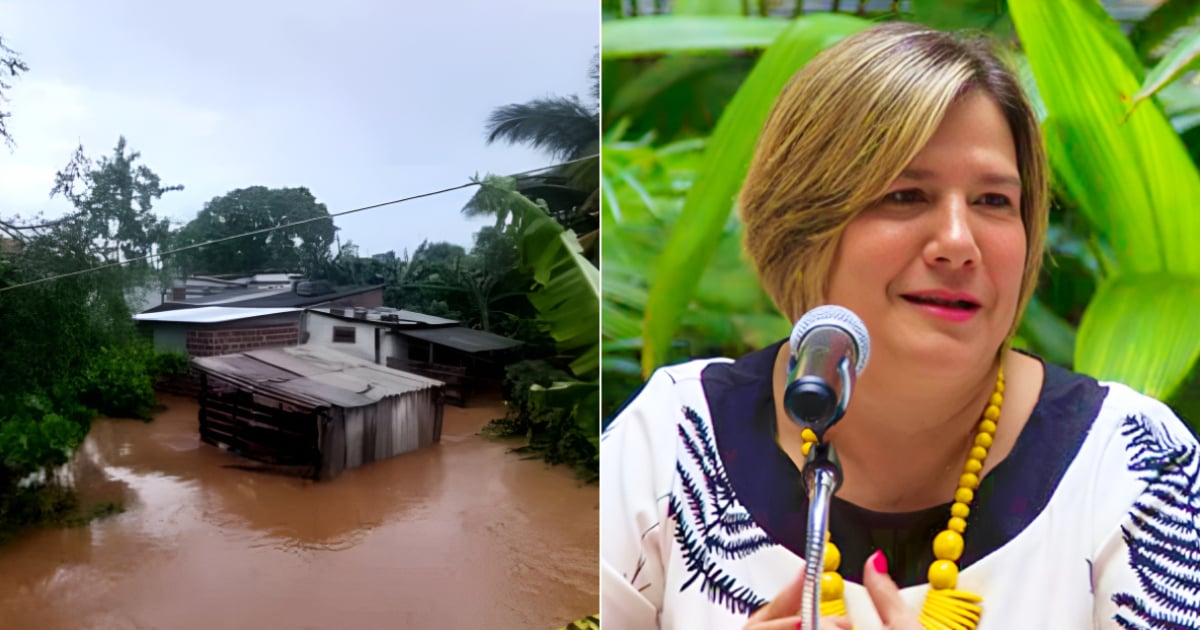
As eastern Cuba struggles to recover from the destruction left by Hurricane Melissa, which has left countless families homeless, hungry, and neglected, Lis Cuesta Peraza, the wife of Cuban leader Miguel Díaz-Canel, remains noticeably silent.
Dubbed the "non-first lady" of the Cuban regime, Cuesta Peraza has shown little empathy for the hurricane victims, opting instead to share political propaganda about the U.S. embargo.
In her recent posts on the social media platform X (formerly Twitter), Cuesta Peraza has merely reposted Díaz-Canel's comments about the alleged "defeat of the genocidal blockade" and the "dignity of the Cuban people in the face of the Yankee empire."
The only indirect reference to the hurricane came on October 28, where she blamed the "criminal U.S. blockade" for the island's lack of resources, asserting that "the State marshals all resources for the East."
Criticism and Public Outcry
This disconnect between her rhetoric and the harsh reality faced by hurricane victims has sparked criticism both within and outside of Cuba. Social media users question "where is Lis Cuesta from Holguín?", recalling that despite being from this province, she has not made any public appearances nor shown tangible solidarity with her people.
An alternative media outlet, 'La Tijera', highlighted a common sentiment: "She only appears for international events, luxury hotels, or cultural missions; when the people suffer, she vanishes."
Cuesta Peraza is no stranger to public outrage due to her apparent disconnection from citizen suffering. In 2022, amidst prolonged blackouts, she famously wrote that her heart was "in mop mode," a statement that became a target for ridicule and memes for its lack of empathy. Since then, she has been associated with the frivolity of power, contrasting sharply with the country's widespread poverty.
The Reality in Holguín
In Holguín, the devastation is stark: homes are destroyed, crops obliterated, and entire communities cut off. Meanwhile, the "title-less first lady" continues to echo regime slogans about the embargo, rather than confronting the disaster affecting her own birthplace.
The Role of Privilege and Silence
For years, Cuesta Peraza has played the role of the "woman of power" in a dictatorship that doesn't even officially acknowledge a first lady. She dismisses the title as "bourgeois and patriarchal," yet behaves as such while accompanying her husband to red carpet events, international banquets, or Communist Party gatherings, complete with security, designer outfits, jewelry, and luxury accessories.
When tragedy strikes the populace, Cuesta Peraza is nowhere to be found. There are no tears, no solace, no human gesture. Her social media activism is confined to applauding slogans about the "genocidal blockade," ignoring blackouts, collapses, and children lacking medicine. Instead of empathy, she offers hollow rhetoric of "resistance" and statements bordering on the absurd, such as her 2022 claim of having "the heart in mop mode" while millions of Cubans cooked with wood and endured sweltering heat due to power outages.
Public Image and Criticism
This incident set the tone for her relationship with public opinion: a woman who plays the victim amid criticism, claims feminism within a patriarchal system, and justifies herself as a "professor and cultural worker," though her true role is that of a regime propagandist.
From her position as Director of Events at the Ministry of Culture, she has focused on promoting failed festivals like the 'San Remo Music Awards', organizing banquets, and maintaining the cultural facade of a state that censors artists, imprisons dissidents, and starves its people.
Her empathy is mere performance. She speaks of "female resistance" from an air-conditioned office, while ordinary Cuban women carry buckets of water, stand in endless lines, and survive on salaries that can’t even afford a liter of oil.
She calls herself a "feminist," yet has never spoken on behalf of political prisoners, the mothers of 11J protesters, or the women fleeing in rafts from the misery perpetuated by her government.
In a March interview on state television, Cuesta claimed that "even from the enemy one learns," referring to her critics. But her idea of "learning" is that of power that never listens: a monologue cloaked in moral superiority. It's the pedagogy of cynicism. She speaks of "forgiveness and harmony" in a country where political police hound those with different thoughts.
Lis Cuesta Peraza, the woman who once referred to her husband as the "dictator of my heart," epitomizes the vast disconnect between the elite and the reality of the nation. While Holguín drowns in mud and neglect, she remains on her pedestal, blaming the embargo while ignoring the suffering of her own people.
She is not a first lady, nor does she need to be. She is the perfect representation of Cuban power: deaf to suffering, blind to poverty, and silent in the face of tragedy.
Insights on Lis Cuesta's Role and Public Perception
What has been Lis Cuesta's response to the hurricane devastation in eastern Cuba?
Lis Cuesta has remained silent on the hurricane's impact, focusing instead on sharing political messages about the U.S. embargo.
How do Cubans view Lis Cuesta's silence and political stance?
Many Cubans criticize her for being disconnected from the people's suffering, questioning her absence and lack of empathy during crises.
Why is Lis Cuesta referred to as the "non-first lady"?
The term reflects her role in a regime that doesn't officially acknowledge a first lady, highlighting her influence and presence alongside the leader.