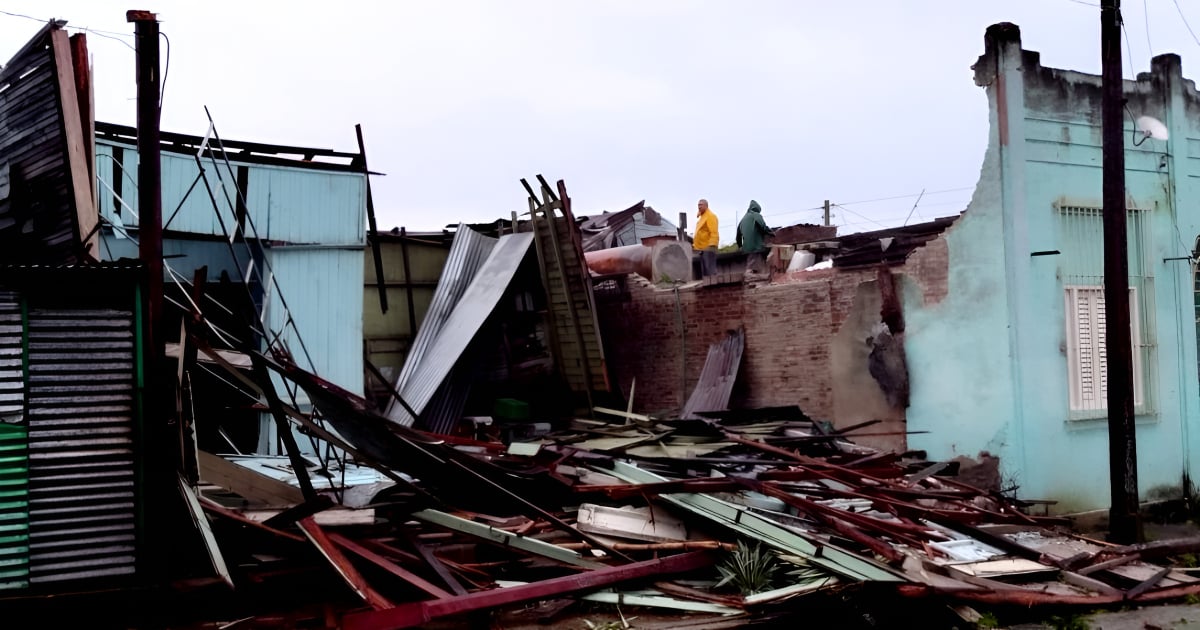
The eastern region of Cuba is grappling with widespread devastation in the wake of Hurricane Melissa, which resulted in a staggering 1,318 homes being completely destroyed, according to an early report released by the Ministry of Construction (MICONS).
Hurricane Melissa, striking with a Category 3 force on the Saffir-Simpson scale, unleashed its fury during the early hours of Wednesday with winds reaching up to 124 miles per hour, accompanied by torrential rains and storm surges that wreaked havoc on entire communities.
Ricardo Guardia, head of Project Management at MICONS, detailed on state television that alongside the total collapses, 16,464 homes were impacted, with 1,142 sustaining partial damages. Roofs were particularly hard-hit, with 5,279 completely demolished and another 8,666 partially damaged.
As reported by EFE, Guardia guaranteed that "all affected cases will be addressed," announcing the sale of construction materials to victims, the ramp-up of tile production, and the dispatch of 1,000 tons of cement earmarked for reconstruction efforts.
Nevertheless, the government has yet to provide an official assessment of the damages or clarify the actual resources available to tackle the emergency, amid an ongoing economic crisis that has left the country ill-equipped to respond effectively to natural disasters.
Hurricane Melissa's path of destruction heavily impacted the provinces of Santiago de Cuba, Granma, Holguín, Las Tunas, and Guantánamo, leaving behind power outages, disrupted telecommunications, damaged roads and bridges, and communities isolated by river floods.
Despite the extensive damage, state media has shied away from delivering a transparent account of the humanitarian situation in the hardest-hit areas, opting instead for general reports on rescue operations and cleanup efforts.
In the meantime, hundreds of families find themselves with nothing left, uncertain of when they might be able to rebuild their homes or receive effective assistance.
Regarded as one of the most destructive hurricanes to hit Cuba in the last decade, Hurricane Melissa has highlighted the structural vulnerability of Cuban housing and the country's lack of preparedness for severe meteorological events.
Official Figures Questioned Amid Human Tragedy
Although MICONS provided an initial damage assessment, skepticism abounds among those affected, who claim the number of collapses might be far greater than what the government acknowledges.
On social media, residents of Santiago de Cuba, Guantánamo, and Holguín have reported entire neighborhoods reduced to rubble, while state media continues to portray an image of control and "guaranteed attention" that starkly contrasts with the reality on the ground.
The hurricane has once again exposed the frailty of Cuba's aging housing stock, with many homes built decades ago lacking maintenance and proper materials. For numerous families, the collapse of their home was not a shock but an inevitable result of years of official neglect and unfulfilled promises.
Despite reassuring speeches, state aid is progressing slowly. Victims face shortages of cement, roofing, and wood, compounded by bureaucracy that delays any reconstruction. In several municipalities, people are sleeping outdoors or creating makeshift shelters with plastic sheeting, lacking water and electricity.
The government, meanwhile, refrains from providing data on casualties, displaced persons, or agricultural damage, offering only partial figures intended to project efficiency, as the eastern part of the country struggles to rise from the mud and despair.
Understanding the Impact of Hurricane Melissa in Cuba
What were the main areas affected by Hurricane Melissa in Cuba?
The main areas affected by Hurricane Melissa were the provinces of Santiago de Cuba, Granma, Holguín, Las Tunas, and Guantánamo.
How many homes were completely destroyed by Hurricane Melissa?
A total of 1,318 homes were reported as completely destroyed by Hurricane Melissa.
What challenges are victims facing in the aftermath of the hurricane?
Victims are facing shortages of essential construction materials, bureaucratic delays, and a lack of basic services such as water and electricity.