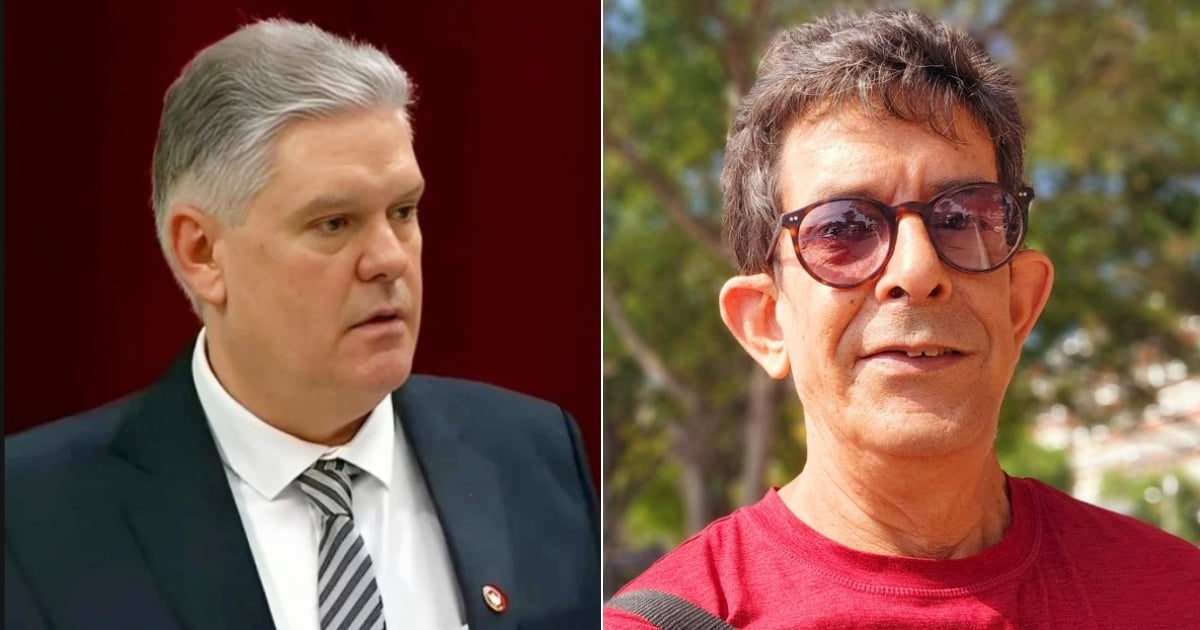
Comedian Ulises Toirac has described the situation involving former Cuban Economy Minister Alejandro Gil Fernández as "a puzzle missing pieces."
Sharing his thoughts on social media, Toirac didn't just focus on the legal proceedings, but also emphasized the political environment and how information is controlled by the authorities.
Amid the media and political upheaval triggered by Gil's arrest and prosecution, Toirac admitted he'd previously avoided delving deeply into the issue. However, he now offers a clear warning: the case appears incomplete, shrouded in silence, and marked by calculated timing.
His analysis points to a lack of transparency and highlights how the authorities manipulate the timing of information, deciding strategically what to reveal and what to conceal.
This commentary serves as a broader critique of the power structures in Cuba and the regime’s systemic control mechanisms.
Systemic Immunity and Accountability Gaps
Toirac's observations extend beyond Gil, targeting a fundamental issue within the Cuban system: the lack of genuine accountability mechanisms.
According to him, the removal of officials in Cuba only occurs when an issue becomes too visible to hide, often when it leaks beyond national borders.
He argues that justice is selectively and reactively applied, not driven by transparent policies or investigative journalism. "Investigative journalism? Not a chance. They just copy down what's dictated," he quips, comparing today's media to medieval scribes.
Public Skepticism and Distrust
Toirac assesses the social impact of Gil's case, concluding that rather than fostering confidence in the judicial system, it has deepened widespread skepticism.
"The Gil case has understandably led people to believe 'they all do the same,'" he notes, criticizing how the official narrative fails to differentiate between isolated corruption and systemic impunity.
He suggests that the trial doesn't clear doubts but rather confirms suspicions that corruption is the standard, not an exception.
The Political Timing: Why Now?
One of Toirac's more revealing insights concerns the timing of the prosecutor’s conclusions about Gil.
He questions why this announcement, alongside new economic measures and post-hurricane issues in the East, was made public amidst the crisis following Hurricane Melissa.
"Just days ago, I talked about political timing... This document came out two or three days before Melissa... The Gil case two or three days after... Either the timing is a mess, or something's up with Melissa," he suggests, implying the government might be using the Gil scandal as a distraction from their inadequate response to the disaster.
Toirac argues the focus should be on the hurricane victims, prevention measures, and the structural deficiencies in Eastern Cuba. "THE WHOLE COUNTRY SHOULD BE FOCUSED ON MELISSA AND THE EAST," he emphasizes.
Justice or Political Theater?
The comedian closes with a harsh critique of the manipulation of political timing and public perception.
He points out the nearly two-year delay between Gil's arrest and the official case announcement, linking it to the regime's ability to control social memory: "If people forgot about Saratoga and the rate hikes... Gil? He could've waited two more months unnoticed."
"A couple more months wouldn't have mattered. Given the long sentence he's likely facing... I don't know. Just my thoughts," he concludes.
Toirac's statement not only underscores his sharp political and social insight but also his commitment to critique that extends beyond mere sarcasm.
His analysis of Alejandro Gil's case is a clear, albeit veiled, indictment of a system where secrecy, impunity, and discourse manipulation uphold the status quo.
Through his direct, irreverent, and profoundly human style, Toirac articulates thoughts many have but few dare to express: the issue isn't a bad apple, but the whole tree.
Other Critical Voices: Luis Alberto García
Ulises Toirac's statement wasn't isolated. Actor Luis Alberto García also responded with sharp irony to the list of charges against Gil Fernández, reminding that the former minister was one of the regime's most prominent economic figures for years.
His viral post deconstructed the official narrative, which attempts to frame the case as an individual deviation rather than a structural power failure.
"He would have to be quite naïve to think he was the only rotten potato in that bag," García quipped, pointing to the chain of political responsibilities that allowed Gil's rise and tenure.
In his harshest critique, García cited Hamlet: "Something is rotten in the state of Denmark," highlighting that the problem isn't just a corrupt official, but a system decaying from within.
Charges Against Alejandro Gil
The Attorney General's Office reported on Friday that public prosecution actions were initiated against Alejandro Miguel Gil Fernández — former Vice Prime Minister and Minister of Economy and Planning — and other defendants, after concluding the criminal investigation conducted by the Ministry of the Interior (MININT).
Charges against the former Vice Prime Minister and Minister of Economy and Planning have been presented to the appropriate court, seeking prison sentences in accordance with the committed offenses.
The prosecution's request for penal responsibility includes a wide range of charges: espionage; acts detrimental to economic activity or contracts; embezzlement; bribery; forgery of public documents; tax evasion; influence peddling; money laundering; violation of classified document protection norms; and theft or damage to documents or other objects under official custody.
Understanding the Case of Alejandro Gil
What are the main allegations against Alejandro Gil?
Alejandro Gil faces a wide array of charges, including espionage, embezzlement, bribery, and money laundering, among others, following a criminal investigation by the Ministry of the Interior.
How has Ulises Toirac criticized the handling of Gil's case?
Ulises Toirac has criticized the case for its lack of transparency and the calculated timing of information release, suggesting it serves as a distraction from larger systemic issues.
What does the case of Alejandro Gil reveal about the Cuban judicial system?
The case highlights issues of systemic impunity and selective justice within the Cuban judicial system, according to critics like Ulises Toirac and Luis Alberto García.