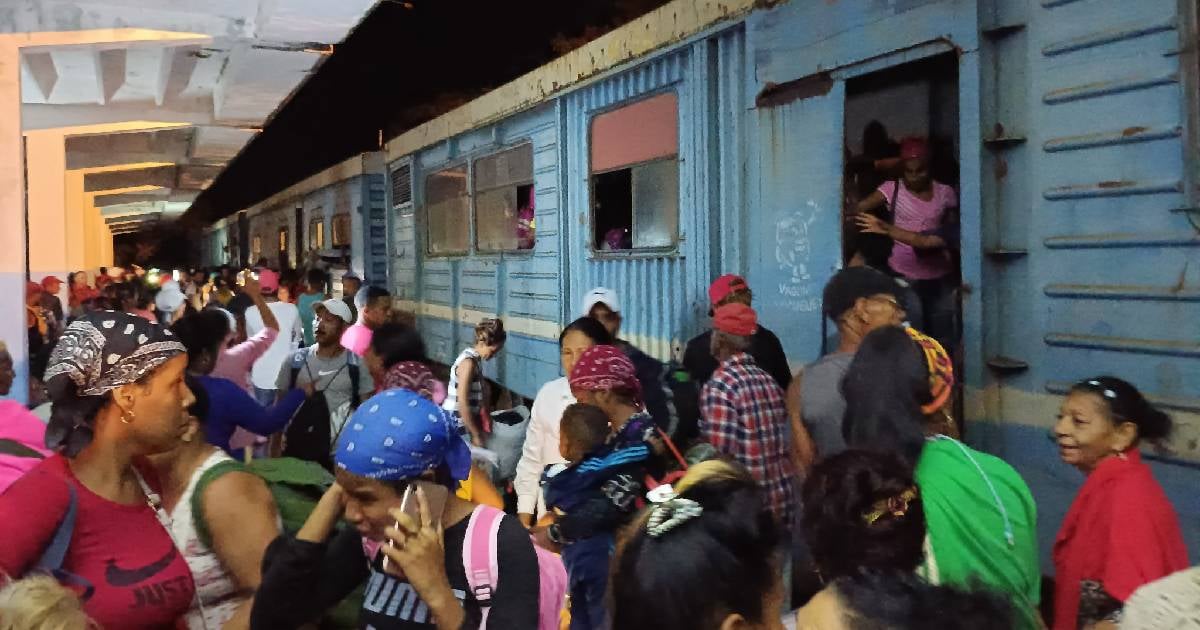
A tense scenario unfolded when a train transporting hundreds of evacuees due to the severe flooding in Río Cauto, Granma province, encountered a technical issue, heightening the anxiety of the Cuban rescue operation.
The Cuban Railways Union (UFC) reported that locomotive 52554, comprising thirteen cars and over 2,600 passengers, arrived in Guamo on Friday to transport residents anxiously awaiting relocation to safer areas. However, during its return trip to Jobabo in Las Tunas province, the train encountered a flooded section of the track, resulting in a technical complication.
According to an official statement shared on Facebook by Transportation Minister Eduardo Rodríguez Dávila, erosion caused by the river's overflow led to the detachment of the fourth and fifth cars, splitting the train into two sections. The segment led by the locomotive and four cars continued, while the remaining nine cars, with dozens of passengers, were left behind.
The UFC clarified that there was no derailment or injuries, though they described the situation as "extremely complex" due to the water level and the distance separating the two sections. "It was not a railway accident, but a challenging situation managed collectively," stated the state entity.
Some passengers in the rear cars returned to the Guamo station, while others remained in the cars under critical conditions, with water reaching the rail level. Local authorities organized a rescue operation to access that part of the train and evacuate the remaining travelers.
By early Saturday, motorized cars dispatched from Jobabo returned to Guamo to retrieve passengers stranded in the flooded area, where water levels continue to rise.
Osbel Lorenzo Rodríguez, the President of the Provincial Defense Council of Las Tunas, confirmed that the train would continue its trips "as many times as necessary" to ensure all residents were evacuated.
Reinaldo Reyes, the Transportation Delegate in Las Tunas, announced that buses were arranged in Jobabo to transport evacuees to the municipality of Colombia, where they received medical care, food, and temporary shelter.
The Ministry of Transportation had announced on Friday that a special train operation departed from Camagüey, equipped with additional motor cars and crews, to evacuate isolated communities in Río Cauto, one of the areas hardest hit by the river's flooding.
On social media, families and residents described the ordeal as "a nightmare," pleading for information about relatives still in Guamo. The distress became widespread as Cubans urged for a quicker evacuation of families trapped by rising waters.
Although authorities claim there were no casualties, the incident highlights the fragility of Cuba's railway system amid extreme weather conditions.
Recent rains linked to Hurricane Melissa have submerged extensive areas of Granma, damaging homes, severing roads, and displacing thousands of people.
The Ministry of Transportation and the Cuban Railways Union stated that rescue operations and repair efforts for the damaged track are ongoing, supported by the Armed Forces and technical brigades.
Key Questions About the Train Incident in Cuba
What caused the train to split into two sections?
Erosion from the overflowing river led to the detachment of the fourth and fifth cars, dividing the train into two parts.
Were there any injuries reported in the incident?
No injuries were reported, although the situation was described as extremely complex.
How are evacuees being assisted after the incident?
Evacuees are being transported to the municipality of Colombia, where they receive medical care, food, and temporary shelter.
What are the authorities doing to address the flooding in Granma?
The authorities, along with the Armed Forces, are conducting rescue operations and repairing damaged tracks to mitigate the flood impact.