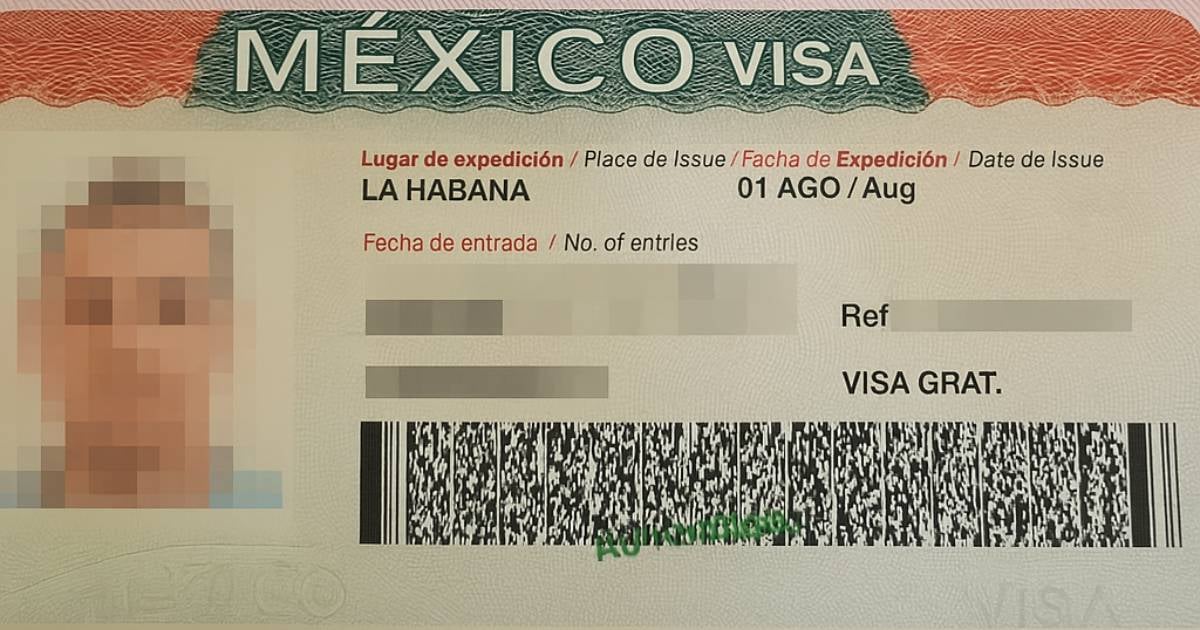
Mexico has increasingly become a popular stopover for Cubans seeking to escape the ongoing crisis on the island. Amid an unabated exodus, the administrations of Andrés Manuel López Obrador (2018-2024) and Claudia Sheinbaum, known as the Fourth Transformation (4T) and allies of the regime led by Miguel Díaz-Canel, have significantly increased the number of visas issued to Cuban citizens, as reported by El Sol de México.
According to official data from the Mexican Ministry of Foreign Affairs cited by the newspaper, during López Obrador's tenure, a whopping 244,896 visas were granted to Cubans, more than double the 122,000 issued under Enrique Peña Nieto's administration (2012-2018). Claudia Sheinbaum's government has already issued over 43,000 visas.
Complex Realities Behind Visa Statistics
However, these figures mask a more nuanced reality. A portion of the Cuban influx to Mexico is facilitated through state agreements that have brought over 3,600 Cuban doctors, as well as sports, academic, and scientific delegations to the country.
In such cases, travelers carrying official passports need no visa for stays under 90 days. Yet, when agreements involve extended stays or paid work, specific immigration documents are processed.
This indicates that the overall number of visas granted does not necessarily equate to a proportional increase in Cuban migrants arriving independently. Instead, it also signifies the expansion of a political and institutional cooperation network between the two governments.
Diplomatic and Economic Cooperation
The alliance between Havana and the 4T has extended beyond lucrative medical contracts to include petroleum shipments, educational collaboration, and consistent diplomatic support against the U.S. embargo.
Eduardo Bueno, an analyst cited by El Sol de México, notes that this closeness has fostered a perception that "Mexico is more open and less restrictive with Cubans," which, in turn, fuels migration expectations.
Balancing Restrictions and Opportunities
Alongside the rise in visas, Mexico has enforced stricter measures to manage migration flows. As of October 22, 2023, the Mexican government mandates that airport transit travelers present a "visitor visa without permission for remunerative activities," even if merely passing through.
The Consulate of Mexico in Havana stated that this rule applies to all foreigners requiring a visa to enter the country, except for permanent residents of nations like the United States, Canada, or the Schengen Area.
Simultaneously, by 2024, Mexico had issued nearly 50,000 humanitarian visas to Cubans since 2022, as per the Ministry of the Interior. These permits allow recipients to work and stay for a year in Mexico, serving as a temporary solution for those unable to return to the island.
Of the over 65,000 Cuban migrants detained in Mexico between 2022 and 2023, only around 6,000 were returned to Cuba, while the majority received "exit orders" or humanitarian permits to continue their journey northward. Adding to this scenario are the migration restrictions imposed by the current administration of Donald Trump in the United States.
Rising Asylum Applications and Border Crossings
Data from the Mexican Commission for Refugee Assistance (Comar) shows that asylum applications from Cubans surged by 115% between 2021 and 2024, climbing from 8,248 to 17,487 requests. Concurrently, irregular crossings at the southern border increased by 52%. Many Cubans arrive weary, undocumented, but hopeful of continuing their journey north.
"Mexico has become a sort of interim relief," Bueno remarks. "For thousands of Cubans, it represents the chance to work or wait with dignity as they seek a definitive escape from the crisis that drove them away."
In the streets of Tapachula, Cancun, or Mexico City, Cuban accents are now part of the landscape. Some open small food businesses or barbershops; others make a living by selling products at traffic lights or awaiting a response to their asylum applications. They all share the same starting point: an island that pushed them to seek a future elsewhere.
Key Questions About Cuban Migration to Mexico
What is the Fourth Transformation (4T) in Mexico?
The Fourth Transformation (4T) refers to a political movement led by Mexican President Andrés Manuel López Obrador, aimed at transforming the country's economic and political landscape through progressive reforms.
How have Mexico's visa policies impacted Cuban migration?
Mexico's visa policies, which include issuing humanitarian visas and enforcing stricter immigration controls, have facilitated increased Cuban migration while also controlling and managing the flow of migrants.
What are humanitarian visas in Mexico?
Humanitarian visas in Mexico allow foreigners, including Cubans, to stay and work in the country for up to a year. They offer temporary refuge for those unable to return to their home countries.
Why do many Cubans choose Mexico as a transit country?
Cubans often choose Mexico as a transit country due to its geographical proximity to the United States, the potential for work opportunities, and the perception of a more lenient immigration policy compared to other countries.