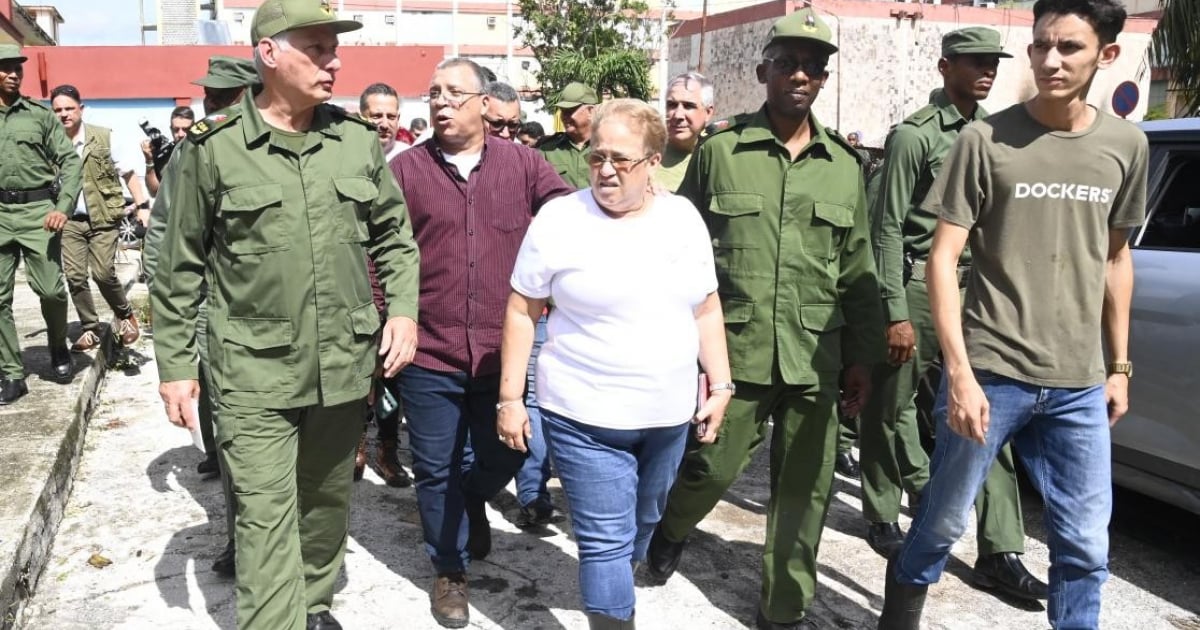
On Thursday, Cuban leader Miguel Díaz-Canel visited the Vladimir Ilich Lenin Provincial Hospital in Holguín, a key medical institution in eastern Cuba, which recently suffered severe damage from Hurricane Melissa.
The Cuban Presidency announced on their X account that Díaz-Canel, alongside local officials, toured the facility.
Despite the flooding and issues with the power generator, the official message claimed that "the hospital maintains its vitality, as do other health facilities in Holguín."
After the visit, Díaz-Canel expressed a "positive impression" of the efforts in the province, sending greetings from Raúl Castro, who he said is "fully informed of the entire situation."
Discrepancy Between Official Statements and Hospital Reality
The optimistic narrative sharply contrasts with earlier broadcasts on Cuban television and social media posts, which showed flooded wards, waterlogged corridors, fallen trees, and medical equipment covered with makeshift tarps for protection against the water.
An official reporter admitted the conditions were "extremely challenging," as medical staff and workers struggled to remove the accumulated water.
Local reports indicated that the hospital lost part of its operational capacity due to the failure of the emergency electrical system.
"There's no power, no water, and the generators are barely holding up. We're doing what we can," a healthcare worker anonymously shared on social media.
Widespread Impact of Hurricane Melissa in Holguín
Holguín was one of the provinces hardest hit by Melissa, whose torrential rains caused rivers to overflow, urban drainage systems to collapse, and entire communities to become isolated.
While Díaz-Canel speaks of "immediate recovery" and "vitality," the hospital reality tells a different story: buildings have gone years without maintenance, roofs leak, medicines are scarce, surgical supplies are minimal, and the staff is exhausted.
Another Hospital Suffers in Santiago de Cuba
Over a hundred kilometers southeast, the Dr. Juan Bruno Zayas Alfonso General Hospital in Santiago de Cuba also faced severe structural damage following the hurricane.
Photos shared by the hospital on Facebook depicted a scene of detached roofs, shattered windows, waterlogged hallways, debris, and fallen trees within the hospital premises.
"Melissa, like a harbinger from the underworld, has wreaked havoc on our hospital," acknowledged the hospital's management, closing their statement with the usual tone of "unity and victory" despite the devastation.
Just days before the hurricane's impact, the Ministry of Public Health had assured that hospitals in the region were prepared to face the storm, with reviewed generators and guaranteed supplies.
The reality contradicted that assurance: years of neglect and shortages left hospitals as fragile structures, unable to withstand a severe weather event.
A Health System on the Brink
Melissa's passage not only caused physical damage but also exposed the collapse of a healthcare system that the regime continues to tout as a model of humanity and efficiency.
Even before the hurricane, complaints about infectious outbreaks, lack of hygiene, essential drug shortages, and power outages disrupting surgeries were widespread.
Today, Cuban hospitals survive with the same precariousness as the rest of the country: without resources, without maintenance, and without official solutions beyond triumphalist rhetoric.
While Díaz-Canel tours flooded halls claiming "vitality is maintained," the population faces the crisis with resignation and without real assistance, trapped in a crumbling system that long ago ceased to provide even the basics: health and dignity.
Key Questions About Cuba's Healthcare Challenges
What impact did Hurricane Melissa have on Cuban hospitals?
Hurricane Melissa severely damaged hospitals in eastern Cuba, causing flooding, power outages, and structural damage, which highlighted the system's vulnerability.
How do official statements about Cuban hospitals compare to reality?
Officials claim hospitals maintain vitality, but images and reports show significant damage, resource shortages, and operational challenges, revealing a stark contrast.
What challenges do Cuban hospitals face beyond natural disasters?
Cuban hospitals contend with chronic issues such as infectious outbreaks, inadequate hygiene, drug shortages, and frequent power outages affecting operations.
Why is the Cuban healthcare system struggling?
Years of neglect, lack of resources, and insufficient maintenance have left the Cuban healthcare system fragile and unable to cope with crises effectively.