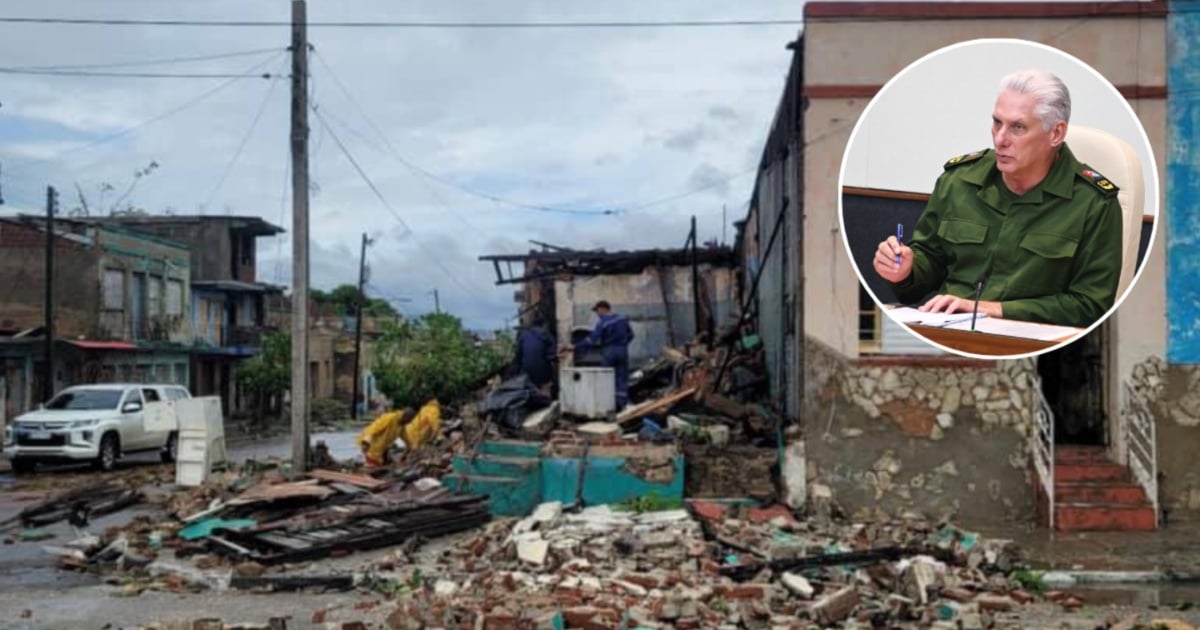
The Cuban leader, Miguel Díaz-Canel, faced a wave of backlash following his statements that "control over the situation is maintained" and that "measures have been effective" in response to Hurricane Melissa. His remarks, shared on his official social media account, sparked widespread criticism.
Many users questioned the reality of this so-called "control" and highlighted unaddressed emergency situations, such as urgent rescue requests during the early hours in El Cobre and makeshift evacuations to caves.
Díaz-Canel claimed to have been in communication "throughout the night" with leaders in the eastern part of the country, asserting that preparations were made "for the worst-case scenario" and that the response plan was effective.
However, comments on his profile pointed out shortcomings in assistance and raised doubts about the management, while others demanded transparency regarding donations. Criticism also focused on the contrast between empty hotels and families sent to natural shelters.
Among those who challenged Díaz-Canel was activist Amelia Calzadilla, accusing him of "declaring victory" without verifying the condition of streets, homes, and properties in the eastern region. She urged him to ask the people if they genuinely felt the measures were effective.
Other remarks, many with harsh language, mocked the supposed aid—"a pound of rice"—and questioned the repeated "measures" that failed to address the urgent needs of those affected.
Community Concerns and Government Response
In the same thread, users reported that entire communities sought refuge in caves due to the fragility of their homes, criticizing the lack of secure housing solutions and questioning the prior preparation emphasized by the leader.
Messages also lamented the lack of popularity metrics or political alternatives, expressing a desire for elections in Cuba.
These reactions highlight the gap between the official narrative and citizen accounts in areas impacted by Melissa. While the government speaks of foresight and control, part of the digital audience insists the response was inadequate and that the on-the-ground reality contradicts the triumphant tone.
Weather Warnings and Predictions
The National Hurricane Center (NHC) reported at 11:00 a.m. on Wednesday that Hurricane Melissa is located off Cuba's eastern coast, now in the southwestern Atlantic, with a central pressure of 974 mb and moving northeast (35°) at 14 mph (22 km/h). It continues to bring heavy rainfall and storm surges to the island.
The NHC maintains extensive warnings: a hurricane warning for Cuban provinces Granma, Santiago de Cuba, Guantánamo, Holguín, and Las Tunas, as well as for the southeastern and central Bahamas and Bermuda; a tropical storm warning for Haiti, Camagüey, and Turks and Caicos.
In Cuba, hurricane conditions are expected within the warning area—with weakening expected later today—while hurricane conditions are anticipated in the Bahamas and tropical storm conditions in Turks and Caicos.
The threat from rainfall remains severe. Eastern Cuba will continue to experience heavy rain this morning, with totals of 10 to 20 inches and localized maximums up to 25 inches in mountainous areas, capable of causing catastrophic flash floods and numerous landslides; the rainfall regime is expected to ease by the afternoon.
Questions About Hurricane Melissa's Impact and Response
What were the criticisms against Díaz-Canel's response to Hurricane Melissa?
Critics challenged Díaz-Canel's claims of effective control and measures, highlighting unaddressed emergencies and inadequate assistance. They also questioned the transparency regarding donations and the contrast between empty hotels and natural refuges for families.
What impact did Hurricane Melissa have on Cuba?
Hurricane Melissa caused heavy rain, storm surges, and prompted emergency responses in Cuba, affecting eastern provinces and causing communities to seek shelter in caves due to fragile housing.
How did the public react to the government's handling of the hurricane?
The public expressed skepticism and frustration over the government's handling of the hurricane, with calls for more transparency, accountability, and effective measures to support affected communities.